[00:00:01] Speaker A: He was born on a Saturday in 73 he loves punk rock music fighting the 13 jabbing the dazzle Jazz rock Now on the beat guitar with the short wind radio back his motherfucking envy Scrolling look at motherfucker, cuz here he comes Andy Scrolling wearing his or his.
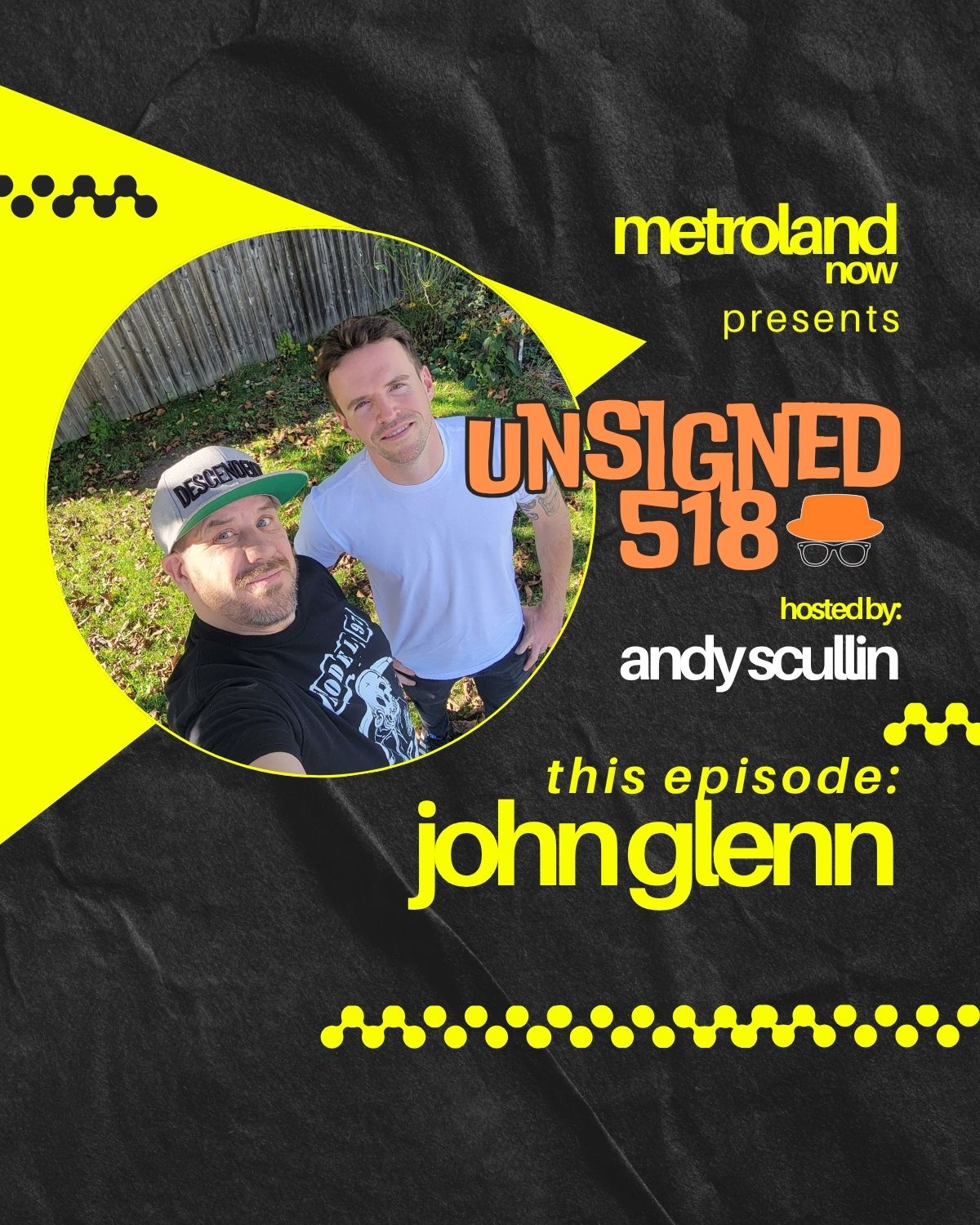
[00:00:26] Speaker B: Hats welcome to Unsigned 518. I'm here with John Glenn. How's it going, man?
[00:00:32] Speaker C: Great. Thanks for, thanks for having me. It's great to finally meet you and be here.
[00:00:36] Speaker B: Yeah. And, and you know, and I was going to say, you know, John Glenn of you know, like the astronaut. But then I was like, there's, there's so much more. Like you're not just, you know, like the astronaut. There's. There's a lot of things. So we do want to talk about all of those things and your different projects and your different collaborations and what's been going on.
But I think what we'll do to start is kind of go back and I guess begin telling the folks about your relationship with music, kind of how it became your thing.
[00:01:08] Speaker C: Yeah, absolutely.
I mean music for me, it's really been around from the very beginning.
I grew up in Austin, Texas.
My parents are both from New York, but my dad had a job out in IBM in Austin.
And my mom was always into musical theater and music. She played piano, she played violin and I did some like plays and stuff growing up. I also in Austin, there's a film school ut, so I was like in student films and stuff growing up. And yeah, music was always. My point is, music was always kind of in the, in the, in the house around me.
And I took, you know, violin lessons at a very early age and piano lessons. But for me, the real catalyst with music was actually when I was in.
At the end of seventh grade, we moved from Austin to Middletown, New York.
And that's a move.
Yeah, it was a big move and I was really homesick and I was like living with my grandmother and I had like no kind of outlets.
So I was getting like lunch money. I didn't have like an, you know, so I was like secretly packing lunches, saving lunch money. And I, I saved up and I bought myself my first guitar. And that was like an instrument I did not know. Like, I knew piano, I knew a violin a little bit, but. But guitar was like nice and compact and portable so I could like hole away in my room.
[00:02:44] Speaker B: Right. Or whole away. Anywhere.
[00:02:46] Speaker C: Yeah, anywhere.
[00:02:47] Speaker B: Fucking middle of the woods.
[00:02:49] Speaker C: Exactly. That's. That's one of the beautiful things about guitar, right, Is that and the Other thing, too, is that guitar kind of like piano is a great music or a great instrument for accompanying vocals. Right. So it became a really great songwriting tool as well. So I would sit in my room for hours and just come up with songs and.
[00:03:09] Speaker B: Or. And were you, like, kind of a vocalist first? I mean. Cause you've definitely got, like, I'm assuming, a trained voice. Or were you just naturally. Can you just naturally sing that well?
[00:03:19] Speaker A: Well, so I guess.
[00:03:20] Speaker C: I mean, there was some training. You, like. Because my mom was into musical theater. Right. But it, Like, I had done, like, some chorus and some musical theater stuff, but then, like, kind of a lot of that dropped off, you know, and then I, like, almost like, re.
I started singing on my own way and playing guitar and taught myself guitar. And it was all from ear initially.
And in fact, like, when I first tuned a guitar, I tuned it wrong. I tuned it into some kind of open chord, and I would play with my thumb, you know, and just like.
[00:03:56] Speaker B: Johnny Resnick, I don't know if he knew that the guy, the dude from Goo Goo Dolls, like, has. Has a tuning that, like, technically doesn't exist. You know, it's like, not a real tuning, but it's the way he tuned it because he had no frame of reference. And he still has a lot of songs. Yeah.
Bizarre tuning that he came up with when he was a kid.
[00:04:17] Speaker C: You know, I. It's funny, I didn't know who at first, but. Yeah, I remember seeing a documentary about Goo Goo Dolls and that song. Iris.
[00:04:23] Speaker B: Yeah, yeah, that one. That one specifically is a nonsensical tuning.
[00:04:28] Speaker C: And I was like, oh, that's an open tuning. And then there's, like, that mandolin. That's a beautiful song.
[00:04:32] Speaker B: Yeah, yeah. And it's. And it's cool when you. Because I've, like, fucked around with it. Like, my main instrument before I switched to bass, I play bass now, but was acoustic guitar. So, like, I've been playing acoustic for, like, 30 years. And like, that song is one of those that when you play it, you're like, holy. That sounds like, you know, like, that tuning is so bizarre in anything that you do. If you play that tuning and try to do a normal chord, it sounds like garbage. But when you play that Iris chord, you're like, holy. That's beautiful. Yeah, it's wild. So, like, that's a very creative way of doing it to just be like, I'm tuning it the way I want.
[00:05:10] Speaker C: Yeah.
And it took my. My friend Eric, he was like, what are you doing?
[00:05:17] Speaker B: You're like, I'm being a fucking artist.
[00:05:24] Speaker C: He taught me how to tune it properly. And then the first song I ever learned was Sweater Song by Weezer, which I don't know if you know how to play it.
[00:05:32] Speaker B: Sure.
[00:05:33] Speaker C: You literally. You move one finger, and then you slide it up, and then you slide it back. It's actually probably the perfect song to learn for a beginner guitarist.
So I learned that song and then kept writing music. And I remember this was a time when, like, AOL Instant messenger was really popular. And I recorded, like, this really awful high school, like, you know, emotional breakup song, you know, And I sent it to, like, a few friends on the. On AOL Instant messenger, and, like, they started being like, whoa, dude, this is really good. And, I mean. And they would share it, and it kind of evolved from that. And then actually, Eric and I, we. We started a band in high school, and we ended up, like, kind of. This was out in Middletown area, so this was near, like, the Poughkeepsie Chance.
Are you familiar with, like, the Chance Complex?
[00:06:27] Speaker B: I mean, a little bit, but mostly, like, through my wife, like, because she went to school at Marist and, like, down there. So she knows that area very well. And I've heard her talk about the Chance, like, a bunch. Like, you know, she listened to what you grew up on, like, emo. Emo music. Like, used to see a lot of. A lot of shit there. And, like, so I've. I've never been myself, but when you say the Chance, I know what you're talking about because of my life.
[00:06:53] Speaker C: It was definitely, like, the emo music mecca building of that area.
Yeah. And we would. We ended up playing a lot of shows as a high school band, opening up for, like, some of the emo bands that would be coming in. Like, we opened for Paramore, and.
[00:07:11] Speaker B: Oh.
[00:07:11] Speaker C: Man, I'm drawing a blank. But, like, My American Heart and a lot of those bands that were coming through town, and that band. We ended up kind of going to school together in Oneonta, and we kept playing music together, and we changed the name to the City Never Sleeps. And when we graduated from. From Oneonta together, we were kind of like, well, now what?
We want to keep playing music. Right? So we had a few friends that were going to school out in St. Rose in Albany, and RIP. Yeah. RIP St. Rose. Yeah.
And we were like, let's move out to Albany and let's just do the band thing.
Just really go for it.
So we moved to Albany, and then when we first arrived here in the area, we Were like, okay, well how do we like get any kind of traction? And we started by, we created a open mic tour.
We just looked up all the open mics in the area and we just went to all of them and we're, we're just playing open mics. That's how we started.
[00:08:30] Speaker B: And then it's a great way to do it though. Like, I mean, that's how you know that if you want to be a part of a community, you.
You mingle with the community, right? And like that's how you do it. Like, you know, I always say to people, either go to open mics or go to fucking shows. Just go into shows, like, does that too. But open mics is good as a musical act and you get to showcase your talent, whereas going to shows, you just get to showcase your personality and whatever. But those two things are all you need to do, right, to integrate in any music scene.
[00:09:01] Speaker C: Yeah, it's. It really started naturally from that. And actually at one of the open mics we met David Parker, who, you know, he was like, kind of just like he had, he. I don't know if you know who David Parker is.
He did a lot of like the synth work and sampling work for Coed and Cambria and he had like done some touring with them. And he was like kind of in this phase after that where he was kind of like living with his dad and he was like kind of looking at the music scene and trying to find some projects to get involved with. And there's a lot more to that story, but I'll let him tell that. But, but we just connected like right away and he really liked the music and we started collaborating and he became like the producer for the band. And in a lot of ways he refined us hardcore. It was like a music boot camp. He like came with a lot of like production wisdom and kind of music industry knowledge and he kind of really like put us into shape because we were just a bunch of, you know, aimless, like 20 early 20 year olds.
[00:10:14] Speaker B: And it's like that band they used and then John Feldman from Goldfinger. I don't know if you know that band.
[00:10:21] Speaker C: Yeah, I know the band. I didn't know the story though.
[00:10:23] Speaker B: Yeah, so he's a producer and he did this basically what you're saying, saying he did with that band they used. They were like 20 year old kids out of some town, you know, a city in Utah, I think, Orem or whatever. And he like flew him out to LA and whipped him into shape and kind of gave Him. The boot camp of here. You know, this. This business will chew you up and spit you out. So here's what you need to armor yourself. And then he produced their first album. And, like.
[00:10:51] Speaker C: Yeah.
[00:10:52] Speaker B: They're still making music 25 years later, so.
[00:10:55] Speaker C: Yeah. That's awesome. I didn't actually know that story, but it makes a lot of sense.
[00:10:58] Speaker B: Yeah.
[00:10:58] Speaker C: Because they kind of seem to come out of nowhere.
[00:11:00] Speaker B: They literally did. Yeah. He just. He, like, made that. Not made that. You know, like, he didn't put them together. They were a band, you know, like, they had recorded demos and. Or whatever, but he was their producer and he whipped him. Whipped him into shape and was kind of like, this is the shit that'll happen.
[00:11:18] Speaker C: That. That first. That first really popular album of theirs.
[00:11:21] Speaker B: Yeah.
[00:11:21] Speaker C: Like, Taste of Ink on it.
[00:11:22] Speaker B: Yep.
[00:11:23] Speaker C: It has this amazing, like, emotional RA with incredible production.
[00:11:29] Speaker B: Yeah.
[00:11:29] Speaker C: Which is kind of this perfect.
[00:11:31] Speaker B: It's all, like. That's all Feldman. Because, like, their. Their sound was very raw.
[00:11:37] Speaker C: Yeah.
[00:11:37] Speaker B: And, like, it was great. Like, I've heard, like, I used to be a big fan of that band. I haven't listened to them in years, but their early demo ship was so good.
[00:11:47] Speaker C: And, like, box of sharp objects.
[00:11:49] Speaker A: Yeah.
[00:11:50] Speaker C: Yeah.
[00:11:50] Speaker B: Like, the demos were so good, and it was like, oh, they just are missing one little thing. And then, like, once that element of John Feldman's production, it's like, fuck, there it is.
[00:11:59] Speaker C: Yeah.
[00:12:00] Speaker B: That shit is so good. And I'm not even, like, a huge, like, Goldfinger fan.
[00:12:04] Speaker C: Right.
[00:12:05] Speaker B: But, like, as a producer, he. The dude is. Well, I'm unreal.
[00:12:09] Speaker C: It kind of, you know, because, I mean, Goldfinger had a lot of, like, wind instruments.
[00:12:13] Speaker B: Yeah. Yeah.
[00:12:13] Speaker C: And if you're. If you're able to mix all those.
[00:12:16] Speaker B: That's true.
[00:12:17] Speaker C: All those wind instruments with the guitars, like, that's incredibly challenging.
[00:12:22] Speaker B: Yeah. Did you realize that was so hard.
[00:12:24] Speaker C: Because you have a lot of competing frequencies, Right.
[00:12:26] Speaker B: Because we have a trumpet player in our band.
[00:12:29] Speaker C: Yeah.
[00:12:29] Speaker B: And, like, when we were recording the album, like, that was like, the first time that I was ever. It was ever brought to my attention that, like, oh, a trumpet's fucking hard to mix. And I was kind of like, why?
Like, you know, made. Made, like, tj, the Guy Foster who produced the album. I, like, kind of was like, why? Like, I don't understand. I still don't understand.
[00:12:49] Speaker C: But, you know, if you think of it like lighting, right. It's like having a giant spotlight because it's like, just a really intense frequency. Right.
[00:12:58] Speaker B: Takes up all the space.
[00:12:59] Speaker C: So. Yeah. So you got to really sculpt around it, you know, so it's kind of. It sinks a lot of finesse, you know.
[00:13:05] Speaker B: I still don't understand, but. But now I get, like, you know, doing a ska band where you've got, you know, six.
[00:13:13] Speaker C: Right.
[00:13:13] Speaker B: I got a trombone, a saxophone, a. Two trumpets and whatever. That's got to be very hard to miss.
[00:13:19] Speaker C: Yeah.
And he come. So this is like, really. He was. He was whipped into really great production shape and then he found.
[00:13:26] Speaker B: Right, yeah, because I know he did it. He did all the Goldfinger shit, like, so.
[00:13:31] Speaker C: Yeah, it's a very similar story. He came. He came to us with just this incredible production knowledge. And the first, like, eps. It's almost laughable how little we had and how great, like, they came. Those, like, songs kind of came together because, I mean, we were like, literally, I think we had, like, two laps because we didn't have enough inputs for our interface. So we, like, had chained two laptops together and had two. Like, when we were trying to track drums, we were, like, putting two into this one computer and two into this other computer and trying to, like, sync them up afterwards. And it was just like, so. It was so quirky, but it worked. And he just was really. I mean, he's really, like, a genius producer, David Parker is, and he. He now works at over it and he's been doing some stuff with, like, Prize Fighter, Inferno and he's. Yeah, he worked on all of the City, the City Never Sleeps ep.
[00:14:31] Speaker B: All.
[00:14:31] Speaker C: Of the stellar Young albums, except for one that we did with the Dark Honey Boys.
[00:14:36] Speaker B: All right.
[00:14:37] Speaker C: We did that with, like, Dan and Jimmy, who are also incredible musicians and great producers.
Shout out to them as well. And.
Yeah, so that was really kind of how it started. And we were just really kind of went through the grind. Played every single show we possibly could get our hands on in the area, and just kind of did a lot of that for a while.
[00:15:00] Speaker B: And then, you know, when did, like, the Astronauts kind of. Kind of come out of that?
[00:15:07] Speaker C: Yeah, so, you know, the Stellar Young. I mean, it was five members. And it got really challenging keeping that momentum.
[00:15:15] Speaker B: Right.
[00:15:15] Speaker C: Because, as, you know, if you're, like, in a band with five members and.
[00:15:18] Speaker B: Especially as you get older, exactly, like, other responsibilities come in and, you know, it's fucking almost impossible.
[00:15:26] Speaker C: Yeah, it became. It became a immovable boulder is what kind of happened.
Became harder and harder to kind of keep the wheels from falling off, you know. But we're all still really great friends. We still hang out a lot.
We still can get together and play a show. So that's not, you know, off the table, but.
But yeah, I mean, that's kind of what happened. We, you know, we started. Members were getting married, having families, shifting, like, priorities and stuff like that, and. And then compounding that, like, Covid hit.
[00:16:01] Speaker B: Right, right.
[00:16:03] Speaker C: So that was just like the. That was like the kind of the last straw. You know, we, you know, we just kind of like got holed up in our houses. And then I was like.
But I was still kind of writing some music.
And then a few years after that, I found out that.
So my father had been kind of battling cancer for a while.
It was like a bladder cancer that had spread to pretty much every bone in his body over time. And they kind of gave him within a year. And I had. And I love my father a lot. He was always kind of a big figure in my life.
So I had a lot of bottled up emotions. And again, kind of like my outlet that I always would go to is music.
[00:16:56] Speaker B: Right.
[00:16:56] Speaker C: And.
And then I also found out that my wife was pregnant. So it was like I was losing my father. I was becoming my father. Stellar Young was kind of not doing its thing anymore. And I just was like, I have to get these.
I have to confront these feelings, right?
[00:17:17] Speaker B: And get them out. Get them off your chest.
[00:17:19] Speaker C: Get them out. Yeah, yeah. And the music's kind of always been that. It's always been this kind of canvas that I put my feelings onto. And so, like, the Astronaut was kind of a desperate attempt at creating a project to create a canvas to put some of these feelings onto. And actually reached back out to David Parker, who, you know, he hadn't been producing any of the Stellar Young stuff for a while. And I asked him, I was like, could you produce this EP for me? It's super important to me.
And I just. I had this sound in mind because he also, on top of being able to do rock music, he also has an incredible electronic experience with, like, synths, analog synths and stuff like that. And I was like, I kind of want to blend these organic and synthetic sounds because it's kind of like, I feel. I felt like at that time we were kind of in this weird world where we were all, like, interfacing, and it was like. But I was going through this deeply organic.
[00:18:23] Speaker B: Right.
[00:18:24] Speaker C: Stuff. And it was like, I just wanted to have, like, a mix of all these sounds and feelings and.
And he kind of was like, I got it. Yeah, I think. I think I can produce this well.
[00:18:36] Speaker B: I think we should hear a Song off the ep.
So which. Which one? And you were gonna do it live, right? Is this. Is this off the ep, the one you're gonna do?
I was like, wait, am I talking out of school? But you are gonna do it live, not on the. We're not gonna hear the alb. And you were going to hear it live here in the studio, just you and an acoustic guitar. So what's the first song you're going to play?
[00:19:01] Speaker C: So the first song I'll play, it's called A Part, and it's. Yes, it's off the ep. And it's really about that moment in time where I was mourning my dad also becoming a dad, and had to keep kind of pushing forward, even though I felt like I was getting a little bit torn apart, like, because I.
[00:19:28] Speaker A: Was.
[00:19:30] Speaker C: Wanting to feel so much joy but not able to process the grief. And it was just kind of like my head and my heart was just, like, being ripped apart. So that's kind of what the.
The song is about.
[00:19:42] Speaker B: All right, well, cool. Well, let's. Let's listen to John performing a part here live in the dazzle Den. And then we'll be right back.
[00:20:10] Speaker A: I'm not in the state to listen, but I'll play the part.
Go ahead and start it. You just need some venting oh, I just need somebody who could play the part could you understand it? Could you be contingent head? And I have come apart and there they go the space between keeps drifting Ooh, I let it, I let it Ooh, I let it, I let it not the one you're missing But I could play the part Go ahead and hold me there's love in your sadness oh, I just need somebody who could play the part could you want to study?
Could you use attention at.
And I have come apart and there they go the space between keeps drifting who I let in, I let it who I let in, I let it and I have come apart and there they go the space between keeps drifting Ooh, I let it, I let it oh, I let it, I let it.
[00:21:51] Speaker B: All right, that was a part. John Glenn, live here in the Dazzle Den from the, like the Astronaut ep. And I. I love, before we move on, the. The, like the astronaut moniker, you know, because, you know, I'm sure every time you're like, oh, my name is John Glenn, people. I was like, oh, Mike the astronaut. Like, yeah, like, so. But anyway, not only do you have, like, the astronaut, but you've got tons of collaborations that you've been doing, you know, stuff with. With Cam and other artists in the area. But let's. Let's talk about one in particular. Dayburn.
[00:22:29] Speaker C: Yeah, Dayburn.
This is the. This is the latest project I've been working on. And again, it was.
It was just. It feels like this kind of, like, moment where it just felt like fate in a way. I was.
I had been doing the, like, the Astronaut EP and recording these songs and going out and performing these songs, and a friend from Oneonta reached out, and he says, like, dude, I haven't seen you in, like, you know, 15 years or something like that.
I have this music that I really want to have vocals put onto. Would you be interested in checking it out? I was like, yeah, I'll check it out, man. Absolutely. And I put this track on, and it was huge. It felt cinematic and big and profound. And I was like, this is speaking to me, right? This is. This is some cool stuff.
And I felt like I was also in a point in my life where I was like, you know, I had just become a father. You know, I just kind of was, like, still kind of processing a lot of that stuff. And I was like, all right. Yeah, I have. There's a lot that I'm feeling here that I think we can, you know, make some music about. And we.
So it started with this one song. It was called Here Tomorrow.
And we were not really sure what to do with it.
We just really liked it. We were pumped on it. We didn't know what to do with it.
He saw these, like, submissions for compilation Emo Diaries through a record label called Deep Elm Records.
And he submitted the song to Deep Elm, and the owner wrote back. His name is John Zuch. He wrote back. He's like, this is awesome. Do you guys have more music? And we kind of like. We're like, no, we don't, but we'll work on it, right?
So we kind of. We kind of went back into this, like, writing mode.
I had a few things that were still kind of kicking around that I hadn't recorded or released. He had a few ideas, and we would record a song.
I would send. You know, I would record my vocals, he would mix it, and we would send it over to Deep Elm. And, like, this happened over and over again. We ended up from one song to, like, five songs to six songs, and then eventually 12 songs, and we had enough material for, like, a full album, right?
And they actually asked if we would sign to the label.
We said, yeah, because, you know, it's a really cool independent label. They're very like, you Know, they kind of really give the artists a lot of space to kind of do what they need to do. And we were just like, this sounds awesome. Let's just go for it. And then the idea was to break it actually up into two eps, so there's a part one and a part two. And by the time everybody hears our episode, both part one and part two will be out.
I am so excited for this music. I mean, I think some of these songs are just really. Some of the best.
Most just like, huge cinematic, like, rock songs, you know, it's just so much fun. So.
Yeah.
[00:25:49] Speaker B: Well, cool. Well, and I'll link, like, in the show notes here, I'll link, you know, to the Spotify page of, you know, like, the Astronaut and Dayburn so that people can. Can find it, because, like you said, by the time this comes out, they'll. They'll both be out in the. In the open to be listened to. But you were going to do a song, another one here in the studio. And this is going to be the one from one of the Dayburn releases, right?
[00:26:16] Speaker C: Yeah. So the song is called Everything After. It's from part one.
[00:26:21] Speaker B: Okay.
[00:26:21] Speaker C: Of Hollow Sounds, which is. So it's Hollow Sounds, Part one, Hollow Sounds, Part two.
[00:26:26] Speaker B: Cool. And then this is obviously a stripped down version of it that you're going to do here.
[00:26:31] Speaker C: Right. This will be the acoustic. Yeah, I'll just play it on the acoustic.
[00:26:34] Speaker B: All right, cool. And what was the name of the song again?
[00:26:36] Speaker C: Everything After.
[00:26:37] Speaker B: Everything After. All right, well, let's. Let's hear Everything After. It's a Dayburn song from John Glenn live here in the Dazzle Den. And they'll be right back to wrap.
[00:26:46] Speaker C: It up.
[00:26:58] Speaker A: For this once.
A prelude, a chapter and everything after Closed on a doggy afold I'm the.
[00:27:13] Speaker C: Strong.
[00:27:16] Speaker A: Make me your rhythm I'll be your atmosphere let's get the hell out of here.
The break, the bone the lovely home the atrophy the achy soul the mending cracks the way you roam As I remain right keep here I've become the scratch of a kiss the dig in my ribcage that lifted me in the air I've become the warmth in the.
[00:28:00] Speaker C: Chill.
[00:28:03] Speaker A: The voice in the darkness Slowed my heartbeat down the break, the bone the lovely home the atrophy the ache you sold the mending cracks the way you roll Cause I remain right here we made a family make something bigger than ourselves and we become the ones who are no longer here I've become the warmth of the chest the words of Our story I hear with my ear pressed down I've become.
[00:28:56] Speaker C: The tap.
[00:28:57] Speaker A: On the wheel the song in the speaker the warmth of a broken heart the break the bone the lovely home the atrophy the ache you sold the mending cracks the way you roam As I remain right here we made a family Made something bigger than ourselves and we become the ones who are no longer here we made a family.
[00:29:39] Speaker C: Made.
[00:29:40] Speaker A: Something bigger than ourselves and we become the ones who are no longer here Made something bigger than ourselves and we become the ones who are no longer here we made a family Made something bigger than ourselves and we become the ones who are no longer here.
[00:30:19] Speaker C: All.
[00:30:19] Speaker B: Right, that was everything. After the Day Burns song performed live here in the Dazzle Them by John Glenn. And John, you know, thank you so much for taking time out of your day, for coming up here and doing this. I really, truly appreciate it. And before we go, I want to give you a chance to say your gratitude. So microphone is all yours.
[00:30:38] Speaker C: Awesome. Well, thank you for having me. Of course.
I want to shout out to John Luby, the other half of Dayburn.
He's been a huge collaborator on these on this latest project and just I want to definitely shout him out. Shout out to my wife, my daughter.
Shout out to all the boys from Stellar Young. I love you guys. You're forever, my brothers.
Shout out to Camtron 5000 and Merc. Check out also the project Foster Planet, which you did.
[00:31:10] Speaker B: I did the review. Yeah. In Metroland.
[00:31:12] Speaker C: Thank you so much. That was such an awesome review. Yeah. Thank you.
Shout out to David Parker, you know, longtime friend, producer.
And shout out to Deep Elm Records, John Jute, John Zucch. And thanks for taking a shot on us and giving us an opportunity with Dayburn.
[00:31:35] Speaker B: Awesome. All right, so he is John Glenn. I am Andy scullin. This is unsigned 518.
I'll see you on the road.
Unsigned 518 is produced and hosted by me, Andy Scullin. New episodes are available every week wherever you stream podcasts. If you'd like to help support the show, please like and subscribe wherever you are listening. Or you could buy me a
[email protected] unsigned 518.
If you would like to advertise on the show, send me an email at unsigned518mail.com and to be a guest on the show, reach out to me through Instagram. Instagram @Unsigned518.
Take care of one another and I'll see you next week.
[00:32:22] Speaker C: And sculling.