[00:00:01] Speaker A: He was born on a Saturday in 73 he loves punk rock music fighting the 13 cabin the dazzle J rock now on the beat guitar with a short quick radio bass his motherfucking Andy Scrolling.
Look at motherfucker, cuz here he comes Andy Scrolling wearing his or his hats.
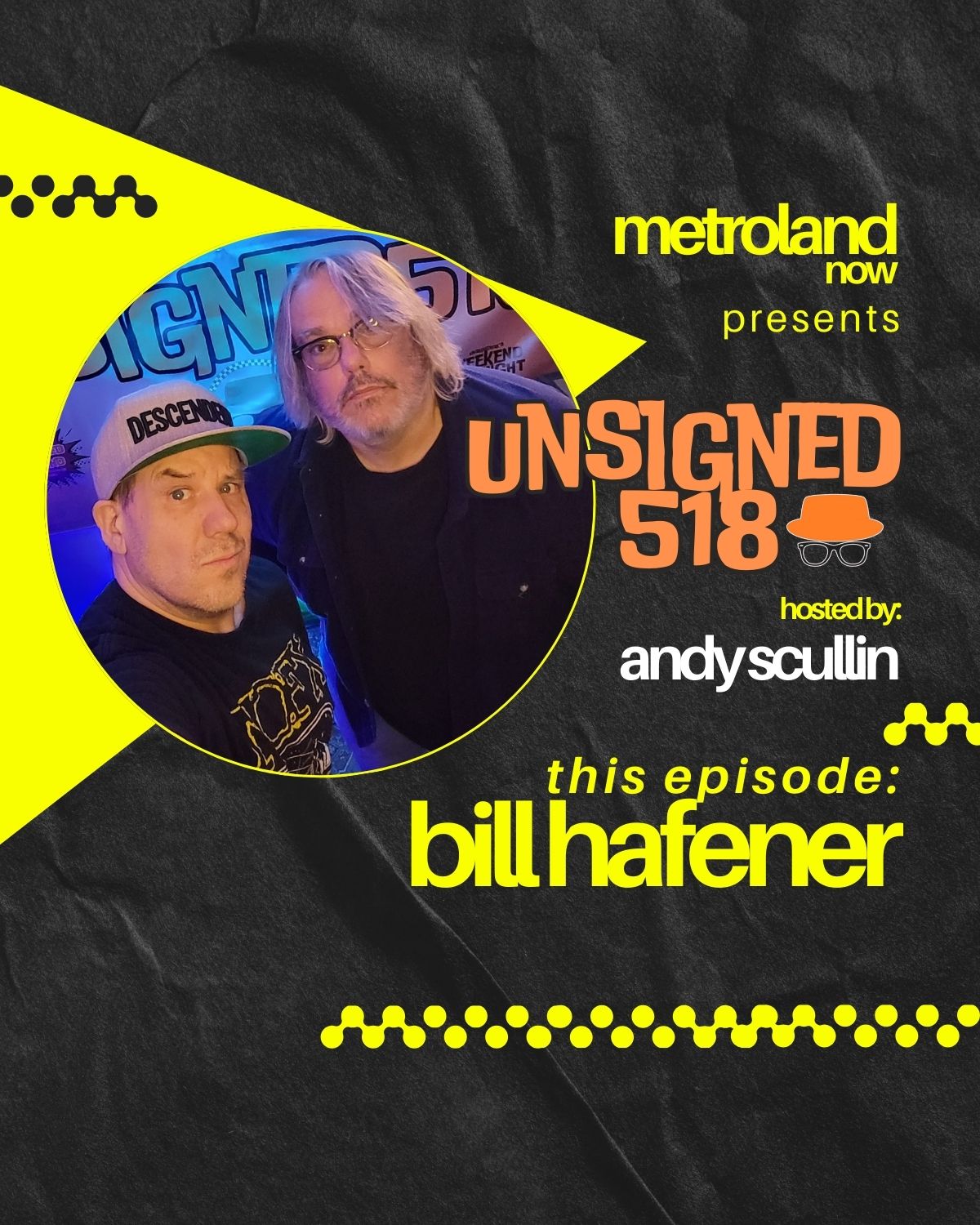
[00:00:27] Speaker B: Welcome to unsigned 518. I'm here with Bill Hafner. How's it going, man?
[00:00:31] Speaker C: How's it going, man? Man's going all right.
[00:00:35] Speaker B: And you know, we've actually.
We've like interacted online, you could say.
[00:00:41] Speaker C: Yeah.
[00:00:41] Speaker B: But we've never actually met until we.
[00:00:43] Speaker C: Did bump into each other at the Eddie's last.
[00:00:46] Speaker B: Yes.
[00:00:46] Speaker C: Actually earlier this year, I guess.
[00:00:48] Speaker B: So we met once.
[00:00:49] Speaker C: Yes. And it doesn't count.
[00:00:51] Speaker B: As soon as we started saying that, I was like, no, we did.
[00:00:53] Speaker C: Yeah, everybody was there. So.
[00:00:55] Speaker B: Yeah, everybody was there at this count. But, you know, first time on the show, first reason Conversation and, you know, Delaney was on the show like a year ago, maybe. Yeah, something like that.
[00:01:10] Speaker C: Yeah.
[00:01:10] Speaker B: I lose track, but I actually just recorded my 200th episode of Unsigned 5.
[00:01:16] Speaker C: Congratulations.
[00:01:17] Speaker B: An hour before you got here, in order. So it all. It all blends.
[00:01:23] Speaker C: Circle of life together.
[00:01:24] Speaker B: Yeah, but, you know, she was in there at some point. But, you know, we're here to talk about, you know, you have a new album out. Yes, we definitely want to hit upon that, but I also kind of want to, I guess, talk about, you know, you've got a long history with music. You were saying, you know, you're from Long island and you. Your band came up here and played in Albany in 1989.
[00:01:46] Speaker C: 1989.
[00:01:47] Speaker B: So, yeah, you've. You've got a long, rich history with music.
[00:01:52] Speaker C: Music and New York and all sorts of nonsense.
[00:01:55] Speaker B: And so I think I'm just going to kind of turn things over to you and let's just start fucking talking music.
[00:02:03] Speaker C: Okay, well, I mean, where do we begin?
You know, like I said, I'm from Long Island. That's why I talk like this.
I try not to. It's.
I started playing guitar when I was a kid. We should make that point, is that the album is instrumental guitar.
Music of all sorts of genre. Bouncing, you know, things.
I don't know really how to put it. Some of it's really loud, some of it's really quiet. Some of it's really, you know, arranged, and some of it's completely left to its own devices.
So, you know, it's a guitar album. It's something I've wanted to do for a long time. I've started it several times, but it just.
This is the opportunity since I stopped playing with Delaney earlier this year.
And so it kind of gave me the freed up the time to put the effort into this.
So that's where, you know, that's where it all came from.
And I don't know. We moved up here to the Capital District.
My wife and I, we moved up here about a year and a half ago. The rest of the family moved up here earlier.
We live with our oldest daughter in Niskiuna, and Shelby and Delaney live in Troy.
So Shelby also writes for Metroland.
[00:03:32] Speaker B: Oh, yeah. I guess we should probably mention that too.
Yeah.
[00:03:36] Speaker C: That's one big happy family.
[00:03:39] Speaker B: It is one big happy family. So. And then when you stopped playing with Bell Curves, like, I kind of, you know, in paying attention to, like, you know, obviously it wasn't like a. You fucking break up with the band, you know, it's your daughter. But like, you would kind of said, you know, you were focusing on some other things, and I was, like, interested in what those things could be. And I guess I didn't think a guitar. Like, I didn't think a guitar. I just, like. I just pictured you were like, oh, you're gonna start another rock and roll band, right?
[00:04:09] Speaker C: I've tried that. I tried the rock and roll band thing. I still have a band, technically, down in New York with my friends who I was playing with when I was living on Long Island. Technically, it's still a going concern, but being up here and then being down there, what the actual future is, I don't know.
But I tried the rock band thing on my own, but I'm not much of a songwriter, like, lyricist.
Like, there was a period where I was writing pretty consistently and I was writing some decent songs. And we tried the rock band thing, where I would front the band. And my singing voice is not very good. You know, it's. It's. I don't care for it very much, my pitches and. But the tone isn't that great.
[00:04:52] Speaker B: That's why I will say we're a punk band, because then I don't have to be held to the standards of somebody.
[00:04:57] Speaker C: But if I don't like it, then I don't really want it. You know, why would anybody else want to listen to it if I don't want to listen to it? Right. You know, So I was keeping track of all sorts of things I was coming up with, you know, thinking, all right, someday I'll get around to writing lyrics to this and that, whatever, and I just gave up with the idea of, you know, that they're going to be songs in that kind of, you know, classic, you know, lyrics and singing kind of sense. And I just went ahead and finished them as instrumentals.
[00:05:27] Speaker B: And when you finish them as instrumentals, like, what kind of shift did it go? You know, because a lot of times when you're writing songs and arrangements that are going to have vocal things, you kind of have the vocal melody in mind. Did you just kind of transfer that to an instrument?
[00:05:42] Speaker C: Right. There are some songs where I played melodies on a guitar and there are some songs where the chord progressions, I feel, are interesting enough, you know, that, you know, if you were singing over them, that would have been fine. But there's still, you know, enough movement and, you know, there's acoustic pieces that are folky and finger picked and it's melodies in there, so it's, you know, there's still melodies going on. Right. There were several tracks that we recorded with some friends of mine up here just back in November, the Last Things.
That was October, actually, and those were done live. And that was kind of like the Crazy Horse sort of jam kind of loud rock thing. Right. You know, most of the recording was done.
Some of it was started on Long Island. Some of them I did at home. Some of it I did it Birthday Land Studios in Voorheesville.
And some of it I did at Mount Ida Sanctuary in Troy by myself.
[00:06:47] Speaker B: And that was that, like the live.
[00:06:49] Speaker C: Yeah. That I just did by myself with one of, you know, those portable four track.
[00:06:54] Speaker B: Yeah. Which I'm using right now.
[00:06:55] Speaker C: Right. One of those and a couple of.
[00:06:57] Speaker B: Microphones and I mean, the room, you.
[00:06:59] Speaker C: Know, like giant, big empty church.
[00:07:02] Speaker B: It must have sounded so cool.
[00:07:04] Speaker C: Yeah, it was really. It was. It was very cathartic, let's say.
[00:07:07] Speaker A: Say.
[00:07:07] Speaker B: Yeah, that's the one thing, like I. I wish I had was a bigger room to do acoustic, you know, because we're sitting in a garage right now. And like when I'm sitting in here or when people do performances in here with an acoustic guitar, I always have to add room reverb. Like, it's so dead in here.
[00:07:24] Speaker C: Yeah, there. There was a lot. You know, that's one of the reasons I was looking for a space like that and somebody suggested it and I said, oh, yeah, okay. So I rented that for an afternoon and it worked out really well. Yeah, I was really pleased with it.
[00:07:37] Speaker B: That's a cool spot.
[00:07:39] Speaker C: And so, you know, that's where the album is coming from. I've already called it this is volume one, I've already started thinking volume two.
[00:07:49] Speaker B: And how many songs are on this?
[00:07:51] Speaker C: 15 on this one. Geez.
[00:07:53] Speaker B: All right.
[00:07:53] Speaker C: Some of them are short, you know, some of them are a minute and a half, two minutes, three minutes at the most. And some of them are a little longer. There's one eight minute track that's really nothing but guitar feedback.
[00:08:04] Speaker B: Now you say like, it's a bunch of different styles. And like me personally, I'm someone, you know, a lot of people are like album people that everything needs to fit together real nice in an album. And I've always been like, just put out what?
[00:08:17] Speaker C: Right.
[00:08:18] Speaker B: What makes sense at the time. And I love albums where from one song to the next, there's such a different style. Like, was that an intentional thing or were you listening?
[00:08:28] Speaker C: Yeah, it was an intentional thing. And there was all kinds of different ideas about how to approach that because like I said, there are some things that are very quiet, some things that are completely chaotic and some things that are straight, like rock music and, you know, some things there's a, like a surf punk, some number and you know, and then some sort of like progressive rock sort of playing and just all kinds of things in between.
And I was. One consideration was to put them in order, like from the quietest all the way to the loudest. And I didn't want to do that.
So what I decided to do is they'll be like, it opens with one of the quiet ones and then it's like one or two loud ones and then it's like a little, little acoustic nugget, sort of like to cleanse your palate before it gets loud again. It gets loud again, gets wacky. And then it gets, you know, there's another acoustic one, so get a breath of fresh air and it goes back to being loud. And just this way it's, you know, doesn't really turn anybody off for too long, you know.
[00:09:23] Speaker B: Right. And I love the disarmingness of having it like that, you know, because like you could hear a song on the radio and be like, wow, I really like. I really like that beautiful acoustic song. And then go hear it, be like, oh, wow, okay, that is not what I expected. And again, personally, my whole life, I've always loved that with bands that you hear a song on the radio and then you hear the rest of the album and you're like, no, the rest of the album sounds nothing like that one song.
[00:09:51] Speaker C: I mean, I feel that there is consistency to the way I play the guitar, whether it's really loud or really quiet.
I still think that the.
My chord inversions and, you know, the composition, the compositional way I move from one thing to another is similar.
I do approach each of the instruments differently. Like, I don't expect an acoustic guitar to do what an electric guitar does, you know, And I have. I have a few guitars, let's just put it that way. And like, I tried to let the guitars tell me what they are capable of, and then I use that, you know, to work around if I can, if that's making any sense.
[00:10:40] Speaker B: Yeah, now I know, like, a lot of people can't. Will write, like, songs on an acoustic guitar that later become bigger, you know, compositions like. Do you make a separation? Like, when you're writing a rock tune, are you always on the guitar, the electric guitar, or does it usually start with the acoustic?
[00:11:00] Speaker C: I always.
My initial approach is always the same. I always am either playing an acoustic guitar, an unplugged electric guitar, or a clean. If I'm plugging into an amp, I usually play clean or just slightly crunchy.
[00:11:14] Speaker B: Okay.
[00:11:15] Speaker C: And then I know in my head where that could go sonically, you know, because a lot of stuff, you can do both.
You know, there's a lot of stuff that are chord progressions.
Like, if you just play the same chord progression and you do slightly different, you know, the tone is obvious.
[00:11:37] Speaker B: I was just thinking, like, every single Pixies song.
[00:11:40] Speaker C: Yeah. Just exactly that kind of thing, you know, and it's, it's, it's, you know, the tone of the instrument dictates how you're going to play it, but the chords are the same, the notes are the same, and, you know, I mean, the.
[00:11:55] Speaker B: The change of amplitude.
[00:11:57] Speaker C: Yeah. You know, and the dynamics, you know, or what work into it. But, you know, a lot of the stuff that I come up with, I just come up with very quietly, you know, because I'm been sharing a house with other people, with the rest of my family forever, you know, I don't have a lot of opportunities to really crank it, especially nowadays where I'm in a much smaller space than I was back on Long Island.
So I don't have that kind of opportunities to really be loud like I used to.
[00:12:28] Speaker B: And is there anything, like, specific that'll make you listen to a composition and say, all right, this one needs. Needs to go louder, or this one can stay right in the pocket as a quieter song? Or is it just kind of a case by case?
[00:12:41] Speaker C: It's, it's just kind of like being open to listening to it. I don't have, like, a specific pattern. You know, this is what I'm going to do with this or whatever.
[00:12:52] Speaker B: Right.
[00:12:52] Speaker C: You know, and it goes also to having worked with songwriters for so long, working with Delaney and, you know, the other guys back in New York that we were creating with. These people are all great songwriters, and I come at it and I listen to what they have with their songs. And with Delaney and with Finn Miller, who's my friend back in New York, we were working together. Their songs usually have very simple initial ideas, and it leaves it pretty wide open for me to do something. So I'm left to think of what I can contribute.
So that kind of thinking, you know, comes across all the time when I'm creating, let's say, you know, I.
I try to just kind of step back and see what comes to me. There's no big agenda.
Right.
[00:13:49] Speaker B: Just what happened. So how would you feel about putting a song on right now?
[00:13:55] Speaker C: Yeah, sure.
[00:13:56] Speaker B: Which. Which one did you want to put?
[00:13:57] Speaker C: That's a fine question. Thank you.
[00:13:59] Speaker B: Thank you.
[00:13:59] Speaker C: Let's do something loud. There's a song on the album called More of the Same that is one of the tracks I did at Birthday Land with my friends Ryan, Peter, and Brandon.
And they are all guys. Well, Peter is Peter Laver. He plays in a band called Rover.
Who.
Peter is the husband of my daughter's best friend. Okay. That's how I met them. The other guys, they play like. Like a rock and roll band.
Play, like, covers and stuff.
And I met them through the old Instagram and love of Fuzz.
[00:14:42] Speaker B: Oh, nice.
[00:14:43] Speaker C: That's the common denominator, bringing people together. Yes. Awesome. Anyway, it's called More of the Same, and it's just.
It's just a chord progression, this one, but it's.
It's fairly succinct.
[00:14:57] Speaker A: All right, cool.
[00:14:58] Speaker B: Well, let's check out More of the Same Bill Hafner.
All right, that was More of the Same Bill Hafner. And, you know, you were saying that this album has been kind of brewing for a while. Like, a lot of these compositions and thoughts have been. Been around, I guess, kind of. Let's go back to the. The compositions that are on the album.
[00:18:58] Speaker C: There are 15 songs on the album, The. The oldest of which I'm taking my phone out to look at the track listing, the oldest of which goes back probably about 30 years. It was a little acoustic thing that I wrote for my daughter, who just turned 35 as a lullaby. So you get some idea.
I wasn't singing her lullabies when she was 20, so she's 35. The song is at least 35, if not older.
And other things I wrote earlier this year, you know, and just.
They were just ready enough to. To make into proper, you know, proper recordings. And some of the recordings go back as far as 2012, maybe a little older than that.
I started them.
Some of them were finished about 2012. 2012.
[00:19:54] Speaker B: And as they appear on the album.
[00:19:56] Speaker C: Like, because they were done on like a Fostex Porter studio thing which I no longer have and no longer have any way of remixing or so kind of what it is is what it was is what it was. Yeah, some of them were started, some of them are rearranged and re edited parts of other things that I've released previously.
The.
One of the tracks, one of my favorite tracks is the outro of a song I put out about 10 years ago that had, you know, like again with the proper singing and you know, lyrics and stuff for the first half. And the second half of the outro was this guitar solo composition thing that I put together.
And so that is that part of that.
Another one is a. The eight minute feedback thing I was talking about was actually something I recorded for another track with the band from New York that I was talking about the Finn and his Rustkickers.
That was the outro of another song that it didn't have a solo. It was supposed to be some sort of solo. And I didn't want to do a proper ordinary, you know, shred king guitar solo and thought about getting somebody to get do a saxophone solo. But they kind of flaked down on me. So I'm left with like two minutes to fill. And I had read about this art installation that Laurie Anderson had done after Lou Reed died, after her husband Lou Reed died, she got together with Lou Reed's guitar tech and friend and they. They got lose guitars and amps and plug the guitars in the amps and turn on the amps and just step back and let.
Let everything just, you know, start interacting together.
So I said that's a great idea. So I did the same thing. I took four guitars, tuned them all to the same chord, plugged each one into an amp and then turned on the amps and then just recorded what happened for the next eight minutes. And I edited down to two minutes to fit into this to the song. But what's on my record here is the complete eight minute, you know, feedback development from a low rumble to a screaming, squealing dystopian nightmare.
You know, and then there are Other tracks.
The last song is a cover of Amazing Grace.
And that's done in a style of Neil Young kind of thing. Well, loud guitar, electric guitar. And I've been doing versions of that kind of playing for a long time and finally made a decent recording of one. That's one of the things I did at Mount Ida also.
[00:22:47] Speaker B: Yeah, it sounds great.
[00:22:48] Speaker C: It's just a really.
You know. And some of the recordings were started on Long Island. Some of them I did. At least one of them was started, was taken from a demo I did on my phone.
I couldn't redo it because I just sold the guitar that I did it on to a friend of mine. So I didn't have the guitar anymore to redo the part. So I just took the phone demo, which I played well enough, sounded good enough, so I just worked off of that nice, you know, and then there's other, you know, everything in between, like I said.
[00:23:18] Speaker B: So there's some. Some recordings that. The full complete recording goes a decade or so. And then there's other people, parts that are stitched together from old things and new things. And like, I love that, man.
[00:23:32] Speaker C: And it just. You know.
[00:23:34] Speaker B: And that's the kind of lore that's cool to hear with an album, you know, because if you're just listening to the album, you probably wouldn't even.
[00:23:40] Speaker C: It's all in. I made a detailed liner notes for those playing along at home, you know, so there's. And there's also.
There's more of that. Like I said, I'm putting together volume two.
There's still more in the vaults, you know, stuff that I started and, you know, put aside, so. And there'll be more things that we re record and other genres that I didn't really touch on with these recordings, you know. I also like to play, you know, like, country and funk and stuff that I don't get to. Didn't touch on with any of these tracks that I'm going to, you know, get into more with these next batch, along with feedback and noise.
[00:24:20] Speaker B: Right.
[00:24:21] Speaker C: Quiet acoustic doodling.
[00:24:22] Speaker B: Yeah. And that. What? Kind of like the freedom of just basically being your own entity musically and like. Like you said, being like, oh, I want to do some punk shit and what. And like, how.
How do you approach it, like, on your own as opposed to, like, with a band where a lot of that has to come from everybody agreeing on something like.
[00:24:45] Speaker C: Well, the thing about the bands that I've always been in is that I always did my own thing, you know, I was always.
I always Respected the songs and. And made sure that at least my ears, if what I was doing was relevant and fit and, you know, and I was. I tried to remain restrained unless I was given, you know.
[00:25:12] Speaker B: Right.
[00:25:13] Speaker C: A little bit more carte blanche from the songwriters and, you know, and I like doing that. I liked producing and I like being, you know, given some guardrails, you know, to stay within, you know, and it's.
You know, and it keeps me focused, you know, and I do like that.
But there's. There's nothing compared to just like, you know, cutting loose and doing whatever you want.
[00:25:44] Speaker B: Right.
[00:25:44] Speaker C: You know, I did. There were times when I was doing these recordings where I thought, yeah, maybe I should, you know, edit that out or take this or shorten this.
I'm like, don't fuck it. This is. This is what it is.
[00:25:56] Speaker B: Yeah.
[00:25:57] Speaker C: You know, nobody's gonna listen to it.
[00:25:58] Speaker B: Who gives a.
I mean, you know.
[00:26:01] Speaker C: And actually I'm finding more people listen to it than I ever thought they would.
[00:26:04] Speaker B: And. But when you record with the. That saw of who the fuck cares? Nobody's gonna listen to it. That's when the really good shit that people want to hear.
[00:26:13] Speaker C: No, but I've gotten. I've gotten more feedback, pun intended, from. From people about it than I really expected. You know, people are actually people, you know, they were friends of mine, acquaintance, whatever. They've listened to it and. Which I, you know, I expected them to do out of politeness, but, you know, they've actually enjoyed it and we're into it and you give me all kinds of thumbs up and shit, and I was like, okay, I was not expecting that. And that's great. Yeah.
[00:26:39] Speaker B: But I really do believe that when you're making music for yourself, that's when the good shit comes out. And like, when you're trying too hard to, like, be like, oh, I want everybody to, like. Like, you're not gonna. That's not a great formula to make music to. Because you're never gonna please everybody.
[00:26:57] Speaker C: You're gonna please anybody. And I also don't buy that where people who tell you, oh, I never listen to my own stuff.
[00:27:05] Speaker B: Yeah, I listen to my own stuff all the time.
[00:27:07] Speaker C: Right.
[00:27:07] Speaker B: You don't want to listen.
[00:27:08] Speaker C: Yeah, Totally sense to me.
[00:27:11] Speaker B: Yeah. I listen to my own. Like, I listen to my own music all the time.
And, like, it's in my. Like, most listened to shit on Spotify is my own band.
[00:27:21] Speaker C: The only time it isn't is if it gets like, we sacrificed Delaney and I sacrificed a lot of our music to the process, when we first started back in, when she was a kid, right. I mean, we started when she was like 10.
[00:27:35] Speaker B: Right.
[00:27:36] Speaker C: We started. We made her first recordings when she was 14. We were in a studio, you know, wild. And that's not anything anybody wants to hear. We don't want to hear it anymore. But we were really happy with it at the time, you know, and we sacrificed a lot of that early music to the process. Process of production and learning how to do our own recordings and becoming proper engineers and producers.
[00:28:00] Speaker B: And I've always said, like, when you put out, when you, like, for people just starting, like, if you. When. When you start putting out music, you should be able to top that. Yeah. Like, you should be able to be like, my next one will be better. My next one. Like, it always kind of shocks me when. When bands have, like, you know, put out this great album and then can never match it.
[00:28:26] Speaker C: Never match it, you know, their own opinions about.
[00:28:29] Speaker B: Right, right. I love the, like, getting better and better. And with that, you have to eventually look back on your early stuff and be like, I don't really like that so much.
[00:28:39] Speaker C: Yeah, well, you know, there's a lot of the early stuff that I still think is valid as songs, and there. There's some decent recordings and a lot of recordings that I think people would be quite happy with, but we've done a lot better since then.
[00:28:50] Speaker B: Right. And I mean, when you said sacrifice to the process, like, the process is such a huge part of it that I don't think a lot of people realize, like. Like, just start. Basically what I'm saying is just start making music and putting it out. Just putting it out and then go from there.
[00:29:07] Speaker C: You know, just be proud of it because it is you and it is the process.
[00:29:13] Speaker B: And the process is not easy to start. From a song idea to something that you're listening to on Spotify is not easy to get there. So, yeah, be proud of yourself, for sure.
[00:29:23] Speaker C: And also, I mean, a lot of people like to. And moan about Spotify and the whole streaming payout process.
And, you know, some of our friends especially are kind of like, you know, militant about it. And I understand that, you know, they are ripping people off and stuff, but I. I asked them, our friends, I go, why are you making music?
Are you making music because you need to make music and you need to express yourself this way. Are you making music because you think you're still gonna be a rock star.
[00:29:54] Speaker B: Right, at 40 years old, you're trying to make money? Yeah, I'm 52. Like, my. My rocks are dreams are 30 years in the past.
[00:30:03] Speaker C: I'm 60. All right. So I'm like, why are we doing it? Because we love to make music.
[00:30:07] Speaker B: Yeah.
[00:30:07] Speaker C: We want to hear our. Our voices.
[00:30:09] Speaker B: And I want it, like, with the self distribution that we can do now. I want to, like, I. I want to be in like 20 or 30 years. I want to look back and be like, look at. Look at what, look at what I've got.
[00:30:22] Speaker C: And not just that. You are there on the same platform. Fucking Led Zeppelin.
[00:30:26] Speaker B: Yeah.
[00:30:26] Speaker C: It's right there next to each other.
[00:30:28] Speaker B: Yeah.
[00:30:28] Speaker C: You know. Okay. It doesn't fit into the. But get the same playlist action.
[00:30:31] Speaker B: And I also understand that I'm never gonna make any fucking money off it, and that's fine.
[00:30:36] Speaker C: Like, but again, why are you doing it?
[00:30:37] Speaker B: Because I would play gigs, Bill. I would play gigs for free.
[00:30:41] Speaker A: Yeah.
[00:30:41] Speaker B: I would go into the studio and record albums and give them away for free. Like we basically do.
[00:30:48] Speaker C: We bought.
[00:30:48] Speaker B: We bought a bunch of CDs. We designed them are. And we sell them for 10 bucks. But a lot of times we give them away.
[00:30:55] Speaker C: This album.
[00:30:55] Speaker B: Yeah.
[00:30:56] Speaker C: In the new year, once I have a few extra bucks, maybe 50 or 100 copies. Just.
[00:31:02] Speaker B: That's. I think we did 50.
[00:31:03] Speaker C: Yeah. Just to give away. To, you know, just. Just to give away. Right. That's all.
[00:31:08] Speaker B: I'm not. I'm not doing this for money. And I think if I was making money, it might almost like.
Yeah.
[00:31:13] Speaker C: You know, like one of the things that we experience back on Long island is. Long island is a very expensive place to live.
[00:31:20] Speaker B: Sure.
[00:31:21] Speaker C: So everything has to have some sort of return on investment. You can't, you know, can't have a space to just create music or art or something without it, you know, making some money to justify it, you know, So a lot of people do these gigs at, like, these wineries and breweries. There's a brewery on every fucking corner.
[00:31:43] Speaker B: Sure.
[00:31:44] Speaker C: You know, where they play for three hours and do Wagon Wheel and, you know, some Fleetwood Mac songs or some bullshit.
And, you know, it wears them down. It's like these. Very little energy for them to be creative because, you know, singing for their supper all weekend long, you know, and.
And doing a day job during the week and leaves them with no energy.
[00:32:07] Speaker B: Yeah.
[00:32:07] Speaker C: You know, it's just.
[00:32:08] Speaker B: That's a good point.
Like, we do, you know, we do gigs like, you know, around here locally or whatever. And what we do is none of us in the band take any money from it.
[00:32:19] Speaker C: Right.
[00:32:19] Speaker B: We just.
The band has, you Know, the band has the money. And then. And then when we want to record some songs, like, we have a little bit of money, we can pay a producer and go and get some studio. But, like, it's.
If there was. If it was more about the money, it would just fuck me up so much. Like you said, like, playing, like. And that's how the band started. Sitting in a fucking corner playing Fucking Wagon Wheels, Matter of Soul. Nobody, you know, being like, nobody's listening. The song ends and the conversation. There's no lull in it. Nobody looks, nobody claps. And, like, that shit hurts.
[00:32:54] Speaker C: It does. And so what are you here for? You're just a glorified jukebox.
[00:32:58] Speaker B: Yeah.
[00:32:58] Speaker C: You're not even that.
[00:32:59] Speaker B: Right.
[00:32:59] Speaker C: Nobody's choosing to listen to you.
[00:33:01] Speaker B: Yeah.
Just the fact that, like, and, you know, we played last night and, you know, there wasn't a ton of people that came out, but, like, 20 or 30 people coming to hear us play is huge for us. You know what I mean? We're like, that's amazing.
Like, we don't need, you know.
[00:33:18] Speaker C: You know, and they want to be there listening to you.
[00:33:22] Speaker B: Yeah.
[00:33:23] Speaker C: You know, and that's really what is fantastic. You know, there's just. You want to share it with people.
[00:33:30] Speaker B: Yeah.
[00:33:31] Speaker C: And that's. That's something up here that, you know, is a lot more prevalent than it is in New York. For sure.
[00:33:39] Speaker B: For sure. There's definitely people more willing to go out and play even though there's not going to be a paycheck.
[00:33:45] Speaker C: Yeah, well, even, you know, also, the.
The desire to listen to original music is much more prevalent to you.
[00:33:54] Speaker B: Have you gone to any of the super dark shows?
[00:33:58] Speaker C: We played one. Yeah.
I couldn't believe it.
[00:34:01] Speaker B: It's unreal. And I was talking to, like, totally. I was talking to, like, one of the organizers. We played Das, and I was talking to Chris and, you know, and I was like, do you think there'll be a good crowd tonight? Because it was, you know, again, a Monday night.
And he was like, there's a good crowd every Monday. He's like. Because there's just an ingrained group of people that just want to hear live, original music. They're like, they don't care what style it is. They're coming.
They're coming to find out exactly what style it is. And it was exactly like that.
[00:34:33] Speaker C: You know, it was one of the last gigs I think I did with them, and it was. Blew us away. Yeah. It just was Monday night. Okay, we're going to go up to Saratoga Here we go.
And you get there and you set up, and then they're setting up their lights and stuff. And there's, you know, three or four people.
[00:34:48] Speaker B: Yeah. There's like, hardly anybody.
[00:34:49] Speaker C: Like 9 o'.
[00:34:50] Speaker B: Clock.
[00:34:50] Speaker C: All of a sudden, it's like the floodgates open. Everybody's there. I'm like, this is. This is fantastic.
[00:34:55] Speaker B: Yeah. And like I said when I was talking to Christopher, I was. It was the early part of the night when no one was there, and he was setting up the lights. And I'm like, what do you think that. And he's like, oh, they'll. They'll be here.
They're here every Monday, blown away.
[00:35:07] Speaker C: It was fantastic.
[00:35:07] Speaker B: Yeah.
[00:35:08] Speaker C: And they're, you know, and. And it's the other things they do. Like, it's the other.
I get no fun. They have such a diverse calendar of events, you know, and, you know, all the. All the other places too. You know, I think we played at.
What was the other one we played One Had a Fire.
[00:35:26] Speaker B: El Dorado.
[00:35:26] Speaker C: El Dorado. We played there, like, less than a week before the fire.
[00:35:30] Speaker B: We were scheduled to play the night of. The night after the fire.
[00:35:35] Speaker C: That was a fun night, too. Again, you know, people just want to hear original music. And I'm back in New York.
The booking system in New York is really bad. All of the bars are hand over their booking to independent bookkeepers.
[00:35:52] Speaker B: Dude. Like, some of the. I get emails, you know, of people being like, hey, we want you to come play at this. This place in the city. And I'm like, first of all, how do you even fucking know my band's name? But then when you look at what they want, right? I'm like, I can't bring you a hundred people. Like, I can't bring. I can't bring a hundred people to my home fucking town.
[00:36:13] Speaker C: I just want you to be responsible for 100 tickets.
[00:36:16] Speaker B: Right, right.
[00:36:17] Speaker C: Want to give them $400 to play there?
[00:36:19] Speaker B: Yeah, that's true. That's true.
[00:36:21] Speaker C: That's all they want.
[00:36:21] Speaker A: Yeah.
[00:36:22] Speaker C: You know, and the bars don't care, you know, and so some of these bookers, they'll. They'll either, like, you will sell you the tickets for $2 each, and you can sell them for as much as you want. You'll be able to, you know, make all kinds of money. I'm like, okay, that's bull crap. They've been doing that since the 90s.
[00:36:38] Speaker B: Yeah.
[00:36:39] Speaker C: And the other one is. Is.
Where was I going with this?
Oh, I was. I was local.
[00:36:46] Speaker B: Local place, supportive of Music.
[00:36:48] Speaker C: Yeah, just.
Oh. And some of them will book, like, eight or nine bands.
You know, I'm like, that's just. That's bull crap.
[00:36:56] Speaker B: I'm just too old for that.
[00:36:58] Speaker C: Yeah.
We found a home out in Long Island City and Astoria, they got a nice little scene out there. But Manhattan is.
There's actually. There's two places in upper Manhattan in Harlem whose names escape me right now.
Sylvana is one of them, and there's another one, but they're okay. But anything that's the Lower east side, anything that's downtown, that ship sailed at the turn of the century, right?
[00:37:27] Speaker B: Yeah. Up here. It's great.
[00:37:29] Speaker C: It is great.
[00:37:30] Speaker B: And so many. And it's. You know, it sucks that so many places are closed, closing. But, like, the places I think that are, you know, like Ophelia's comes to mind.
Like right there. They've been doing really great with. With music, you know? And who else? Like, God, now. I can't fucking think.
But there's a lot of them. They're everywhere. And, you know, it's a bummer, that single Cut Clothes, because that was my joint. Like, they were. They were so nice. But maybe they'll pop up.
[00:38:00] Speaker C: There'll be another one. You know, they come and go, and for various reasons. The reasons aren't always horrible.
[00:38:07] Speaker B: Right, Right.
[00:38:08] Speaker C: Sometimes people just get older and they need to do something else.
[00:38:12] Speaker B: Yeah.
[00:38:12] Speaker C: That's the way it goes.
[00:38:14] Speaker B: Well, I think we should play another song.
[00:38:18] Speaker C: Yeah, let's do another track. Yeah.
[00:38:19] Speaker B: Yeah. What do you want to do? What do you want to do for this one?
[00:38:22] Speaker C: Let's see. We did one with the band. Let's do.
What do we want to do now? Let's see. Thinking, thinking. Buffering.
Looking at the list.
You know, I've been talking about this cover of Amazing Grace, which is really short.
It's not even two minutes, so let's play that. All right. It's the last song on the album, and it is what it is.
[00:38:51] Speaker B: Cool. Well, let's check out Amazing Grace. Bill Happener. And this one was recorded at Mount Ida Preservation in. In Troy there, so it's gonna be really cool. But, yeah, let's check out the song, and then we'll be right back to wrap it up.
[00:40:40] Speaker C: All right.
[00:40:40] Speaker B: That was Amazing Grace, Bill Hafner. And, Bill, I want to thank you so much for coming all the way out here to, as you refer to it, God's Country.
[00:40:47] Speaker C: Oh, it's beautiful. I am little snowflakes falling from the.
[00:40:50] Speaker B: Sky I am removed from any city.
[00:40:54] Speaker C: Curry and Ives postcard.
[00:40:55] Speaker B: I always say I'm in horse country. Yes, there's a lot of. There's a lot of horses.
Yeah, A lot of farms. But anyway, before we go, I want to give you a chance to say what I refer to as your gratitudes. So the microphone. Microphone is all yours.
[00:41:09] Speaker C: My love for my family is without equal. No, I just wanted to thank my wife Kathy, my daughters Kaylee Delaney and Shelby, my granddaughter, my son in law, my friends who. I could not have made some of these recordings without those, those are musically, those are the real thank yous. So.
All right. And you know, keep on rocking.
[00:41:41] Speaker B: All right. So he is Bill Hafner. I am Andy scullin. This is unsigned 518.
I'll see you on the road.
[00:41:48] Speaker C: Bye.
[00:41:49] Speaker B: Unsigned 518 is produced and hosted by me, Andy Scullin. New episodes are available every week wherever you stream podcasts. If you would like to help support the show, please please like and subscribe wherever you are listening. Or you could buy me a
[email protected] unsigned 518 if you would like to advertise on the show, send me an
[email protected] and to be a guest on the show, reach out to me through Instagram.
Signed 518 take care of one another and I'll see you next week.