[00:00:01] Speaker A: He was born on a Saturday in 73 he loves punk rock music fighting the 13 cabin in the dazzle Jazz rock now on the beat guitar with a short with radio back his motherfucking envy scrolling look at motherfucker cuz here he comes Andy Sculling wearing his or.
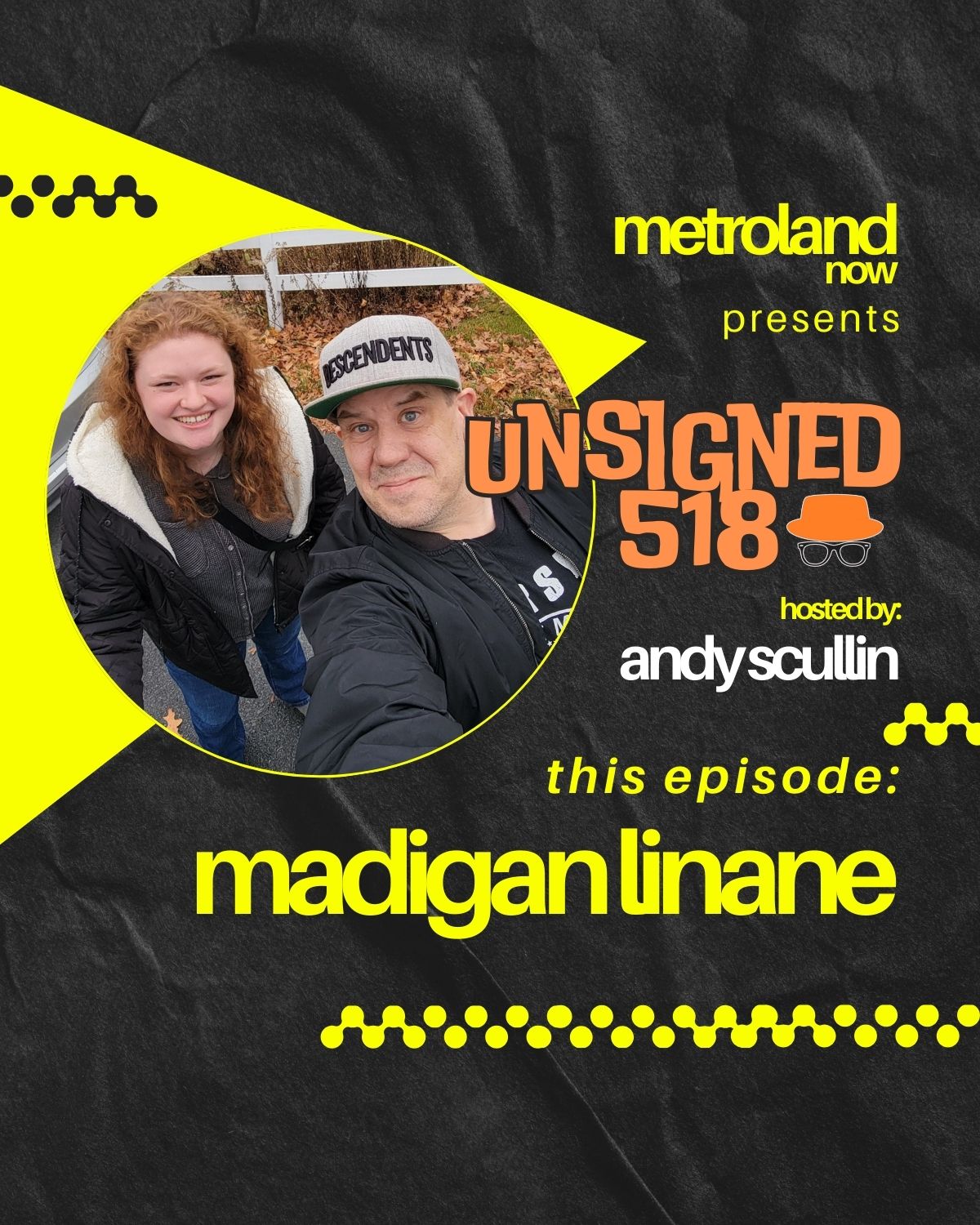
[00:00:26] Speaker B: His hat welcome to unsigned 518. I'm here with Madigan Linnane and I pronounced the name correctly, did I not?
[00:00:33] Speaker C: Flawless.
Flawless doesn't happen very often.
[00:00:36] Speaker B: It doesn't?
[00:00:37] Speaker C: Yeah.
[00:00:37] Speaker B: You know, I mean, and it's easy to pronounce, but I feel like it's one of those names that if you fall out of cadence, it could be wrong.
[00:00:44] Speaker C: Yes. I've got a lot of Lenan.
Lenani, you know, I've had all sorts of things written on coffee cup over the years.
[00:00:53] Speaker B: Right. Well, anyway, I got it right and I'm super stoked about that. But you know, we have been in communication for like a couple weeks about you coming out to do this. And you're, if I'm not mistaken, from the great state of Vermont. Correct?
[00:01:08] Speaker C: I am. I am local to the Mad River Valley area.
[00:01:12] Speaker B: Well, I don't know if you. Well, you probably didn't know this about me, but I'm a Vermonter as well.
[00:01:17] Speaker C: No way.
[00:01:18] Speaker B: Yeah. I lived in Vermont for the first 32 years of my life.
[00:01:23] Speaker C: That's incredible.
[00:01:24] Speaker B: Yeah. And then I still currently work in Vermont. I drive to Vermont from here.
Over by Stratton Mountain.
[00:01:32] Speaker C: Yeah, yeah.
[00:01:33] Speaker B: That's like where I grew up area and where I work now. But yeah, it was cool. I was like, yeah, Vermont, can't wait to connect. Because we got that. But you know, we're not here to talk about the great state of Vermont. We're here to talk about you and your music. So I think, you know, to get the conversation started, I guess just kind of tell us how your relationship with music began.
[00:01:58] Speaker C: Yeah.
Really? It began probably with voice where I. All throughout school, I was always in choir, always loved the choir. You know, there's that mandatory choir attendance in like the second grade. But then. But then I stuck with it.
[00:02:19] Speaker B: I did as well. Yeah, I was in chorus all through school.
[00:02:23] Speaker C: Yeah, exactly. And so that's where my voice part of things kind of began.
And I also played piano. I took some piano lessons as a child. I was horrible at practicing.
So over the years I've gotten better.
[00:02:42] Speaker B: Because a lot of people start with the piano and that comes up so much that they hated practicing it. And, you know, it's ironic that I.
[00:02:51] Speaker C: Choose to do this for a living. And I'm horrible at practicing.
It's.
But yeah, so I took piano lessons for a couple years. But that gave me a nice foundation, I think, music theory wise. And also just getting a sense of chords and what I could build out of it.
So I'm very grateful for.
For those years in piano.
[00:03:19] Speaker B: Do you still go back to piano? Because I noticed guitar is your instrument now.
Do you write songs on the piano or do you still dabble or you just guitar?
[00:03:30] Speaker C: Usually to write. It's mainly guitar, but I do.
When I incorporate some of my upcoming music, I'll have piano pieces in there. And that's kind of where the piano comes back into play for me, is where I do, you know, piano in some of my songs or little trills here and there, licks or chord progressions just to sort of fill up the space of a song.
[00:03:59] Speaker B: Piano isn't like people. Some people may not realize, like, how much piano appears in contemporary music. Like, shit that you wouldn't even think of. Like in a lot. You know, even like punk rock shit like blink, you know, blink 182 songs have piano in almost every song. Like, you hear it in there. In almost every song.
[00:04:17] Speaker C: There's such a foundational piece to piano and just. Even if it's like in the background, it just adds something.
[00:04:26] Speaker B: It touch it, like. Yeah, you're right. It hits something even if you don't hear it or even recognize it.
[00:04:31] Speaker C: Right.
[00:04:31] Speaker B: Like, if it's in there, it does. Does something.
[00:04:34] Speaker C: Yeah, exactly. And. And then I picked up the guitar a little bit later around probably 8 years old, and started. Started guitar lessons.
Was still pretty bad at practicing at this point and kind of, you know, But I was.
I'm so thankful for my guitar teacher and all that. She taught me. Her name's Joy.
She was my first guitar teacher and taught me. So strumming patterns, chords, just all the foundations that have made my playing into what it is today.
[00:05:10] Speaker B: Did you like, immediately feel that connection between the piano chords and the guitar chords with sound?
[00:05:19] Speaker C: A little bit, yeah.
I definitely felt a connection with rhythm is something I've been able to sort of.
For some reason that's been really easy for me to translate between instruments. Is rhythm what was. So like, strumming patterns came more naturally to me than like picking patterns or soloing kind of like that. But yeah, the chord structure definitely was more familiar to me after the piano and just even talking generally about music, I could kind of follow along because, you know, at that point I had a little bit of A foundation in the theory.
[00:06:04] Speaker B: Right. Even just like, you know, every good boy deserves fudge. Exactly. Whatever. Like, knowing that, like, you kind of had that now when you went from, like, you know, piano to guitar. Because, like, I went from percussion to guitar.
I didn't start playing guitar until I was, like, 18 or whatever.
[00:06:23] Speaker C: Yeah.
[00:06:23] Speaker B: But, like, I had such a hard time with, like, my. The hand work, you know, like the fretting hand, like, pressing everything down properly so that, you know, you're not hitting the strings that are supposed to be open and whatever.
[00:06:37] Speaker C: Oh, yeah.
[00:06:38] Speaker B: And I just remember the cramps and, like, the pain of going through it. Was that something that was hard as someone coming from piano where you're like, shit, I can make these sounds on a piano and it doesn't hurt? Or were you just like, I'm powering through?
[00:06:54] Speaker C: Well, it definitely. I mean, definitely at first, it was pretty painful. And especially when we hit bar chords, I was like, what the hell are these things? And, you know, when you had to press all six strings down with one finger kind of thing.
So that part was generally hard for me. But I also grew up. I mean, I'm part Dutch, and so my, like, big hands and long fingers playing the piano and the guitar kind of helped in doing that and, like, stretching along the fretboard or making big octave jumps on the piano or anything like that. So that kind of helped.
And I also feel like it's a strange, very strange thing, probably unique to a few people, but I'm a type 1 diabetic and have always, you know, checked my blood sugar on my left hand. So I kind of had calluses in a way already and then just sort of built, so it was a little less.
[00:08:02] Speaker B: I was like, ah, it's fine.
[00:08:05] Speaker A: Yeah.
[00:08:06] Speaker C: It was like a weird thing that kind of made me already accustomed to pain on my left hand, I guess.
But. Yeah. Which is a weird thing. But.
[00:08:16] Speaker B: No, I love it. That's, you know, it's somehow extra tough, you know. Oh, yeah. I mean, I guess that kind of her, but not compared to what I've already done to it, you know.
But, you know, when you first started, when you, you know, piano lessons for the most part are. You're learning other people's compositions, you're learning scales and you're learning chords or whatever. But when you first picked up the guitar, was it.
Were you immediately drawn to writing your own stuff, or did you kind of start with the.
Figure other people's songs out and roll into your own songs?
[00:08:51] Speaker C: I kind of.
I did start with Other people's songs.
I felt a little bit more freedom in learning guitar and being able to try the songs that I wanted to try. I think as a kid, I was so, you know, learning the piano, I was trapped into.
Not trapped, but strongly encouraged to go towards, you know, Bach or, you know, Beethoven or the, you know, the classical area of things, which are all beautiful compositions, of course, but, you know, I always gravitated towards the songwriters. You know, I said, can I do some Sara Bareilles or can I do some Adele or that. That kind of thing? And so when I picked up guitar, my.
My teacher was so open to what I wanted to try. And so I did try those things, you know, with my. With my voice and my guitar. I started singing together and singing and playing together then.
And then probably one or two years down the road, I started getting interested in writing, like those songwriters.
And I wrote my first song when I was 10.
And I said, mom, dad, I have.
I have a song that I wrote. And they went, oh, boy.
They said, this might. This might be a test of our parenting right here.
[00:10:28] Speaker B: It's good no matter what.
[00:10:29] Speaker A: Yeah.
[00:10:30] Speaker C: And then they're like. And, you know, I played it for them and they go, wait a minute. That was.
That was pretty good for.
And so I started to just latch onto that. And my first song I wrote about, I was inspired by my neighbor who felt she had to be someone else around certain people and couldn't entirely be herself.
[00:10:58] Speaker B: You were thinking these thoughts.
[00:10:59] Speaker C: Yeah.
[00:11:00] Speaker A: All right.
[00:11:02] Speaker B: That's some advanced thinking.
At 10 years old, I was like, like, ah. You know, I really, really hope I get Castle Grayskull for Christmas this year.
That was about the height of my. My intellect at 10.
But, yeah, all right.
[00:11:18] Speaker C: But, yeah, that was the. That was the type of deep thoughts that were rolling through my head at 10. But it was. I was. I felt like I was always observing and observing others, and I was a very emotional child. Emotional person growing up, I think, and just connected with them. Yeah.
[00:11:44] Speaker B: Like, that's. That's what it takes. You know, a lot of people are like, yeah, I love music. Be like, are you super emotional? And they're like, no. And like, then you won't.
[00:11:51] Speaker C: Yeah.
[00:11:53] Speaker B: This isn't for you if you don't stop rehearsal to cry at least once. Like, seriously?
[00:12:02] Speaker C: Yeah. So I started sort of getting in touch with that emotional connection and trying to make, you know, others feel something when I created that music. And I, you know, I started to really get interested in it When I made my neighbor cry, I said, oh, this is great. And I played it for her, and she goes, oh, my God. That's. You know, that's my.
What. That's exactly what's been happening and what I've been feeling. And I said, I want to. I want to be able to do that for people or to connect on this level that music offers.
[00:12:44] Speaker B: And, you know, being that your first song was, like, deeply, like, personal and, like, a real event and, like, real emotions tied to a real person who you could then share with and get that feedback from, Is that something that you found writing songs for the masses that you can kind of still chase by?
I don't know, almost like injecting ambiguity into it. You know, like, just putting out emotions and not necessarily having it be something, because that's what music is, is. People get their own shit from it. But, like, to have that start of, like, something deeply personal specific and be able to share it with that person, it's almost like, all right, I peaked. I'm out.
I'm gonna go try something else. But, like, did you find that as you started writing songs that were just a little more general?
[00:13:38] Speaker C: Yeah.
[00:13:38] Speaker B: Was that easier or a little more difficult?
[00:13:44] Speaker C: I think I was able to find a balance to still.
You know, I write a lot of songs about either, you know, people I observe or things that I experience myself, but so I try to inject some of that personal feeling that I have into those songs, even though they can be applied to other people. So I was trying to find that balance where it's not like you mention some personal fact about your life or.
[00:14:18] Speaker B: Yeah, it is like something personal or that means something direct and specific to you. Like, other people aren't going to know that.
[00:14:26] Speaker C: Right.
[00:14:27] Speaker B: So, like, they, you know, then have the freedom to take it however they want.
[00:14:31] Speaker C: Exactly. Yeah. So it's like, you know, writing a song that can be that. That is obviously about a certain thing, but can be taken in different ways by different people, I think, is what the balance that I've strived to find in the music. So it's often I write about certain topics that I observe around me, you know, experience myself, and I write about the topic and how, you know, it's affected whoever I observe.
And in that way, it's kind of the topic is a general thing that touches a lot of people, but I still have that personal touch to it.
[00:15:14] Speaker B: Yeah.
[00:15:14] Speaker C: Yeah.
[00:15:16] Speaker B: So I think, you know, you. You brought along your guitar.
[00:15:19] Speaker C: I did.
[00:15:19] Speaker B: And we were gonna have you play a couple of songs here live, I guess. What's the first one? That we're going to hear.
[00:15:26] Speaker C: Yeah, the first one you'll hear. It's called you'd for your.
It's a song I wrote a few years back now.
I observed some of my friends in my life, came out to the people close to them and weren't met with the sort of welcome that I thought they. That they deserved. And I wanted. I wanted them to know really through this song that.
That I was there for them.
And then it became kind of, you know, a bigger song to just say to everybody, you know, be prideful in who you are. Don't be afraid to love who you love and wear it proudly. And so this is speaking to that. That pride.
[00:16:20] Speaker B: Hell yeah. I love that. All right, well, let's check out you for you, Madigan Linnane, live here in the dazzle den. And then we'll be right back.
[00:16:41] Speaker D: I don't like that world has become this way.
I wonder what it would be like without all the hate.
If only we took some time to ponder what we say.
Think of all the lives we could have saved.
Show the colors of your soul.
[00:17:20] Speaker E: Who you love should not be contro.
[00:17:26] Speaker D: You are wonderful so don't hide.
[00:17:32] Speaker A: Break.
[00:17:33] Speaker E: The black and white to show your pride.
You be you and I'll be me. Cause together we're better than them, you see. Let them watch as we move on. It's nothing they say or do prove who we are is wrong. Drown out the noise, I know it's hard to do.
Cause all you need to hear is I love you for you, You for you.
[00:18:22] Speaker D: Strangers pass in judgment on someone they have not met.
[00:18:27] Speaker E: Love is love, which part did then I'd get?
Not everything is black or white, not everything is left or right.
[00:18:38] Speaker D: If everything was just up and down we'd miss our love. The other things around.
[00:18:50] Speaker E: You be you and I'll be me. Cause together we're better than them, you see. Let them wash as we move on. Nothing they say or do will prove who we are is wrong. Drown out the noise and know it's hard to do.
All you need to hear is that I love you for you, You for.
I hope they brace themselves for impacts For a tidal wave of change. If they don't go along with it they're the ones who will be strange.
All I hear are excuses that they make up in their heads to help them justify something evil that they say.
You be you and I'll be me. Cause together we're better than them, you see. Let them watch as we move on. Cuz nothing they say or do Will prove who we are is wrong Drown out the noise I know it's hard to do Cuz all you need to hear is there I have you for.
[00:20:19] Speaker A: You.
[00:20:24] Speaker E: You for you.
[00:20:34] Speaker B: All right, that was you for you. Madigan Linnane live here in the Dazzle Den. And now Madigan, that song, you know, obviously you performed live here, just you and a guitar, but you actually have an album coming out tomorrow, and that song is on the album. So I just think the timing is so crazy, but, like, as this episode airs, your new album will be out tomorrow, so you'll be able to hear. So I guess. Tell us. Tell us about the album.
[00:21:03] Speaker C: Yeah, no, it worked out. Couldn't work out better.
[00:21:06] Speaker B: Literally, could not.
[00:21:09] Speaker C: Yeah. I'm so excited about this album. It's been a labor of love for some time now.
You know, I was working on it through school, but, you know, my attention was kind of divided and so I finally got to finish this and I. It's a real something I'm proud of and something that is probably the biggest collaboration I've done with different musicians, whether that be performers on the album, like instrumentalists or background vocalists.
Mixing and mastering.
I've had people chant. On this album, I've had. I worked with a rapper for the first time ever.
[00:22:00] Speaker B: Nice.
[00:22:01] Speaker C: That went to school with me.
Her name is Poppy Pion.
She's amazing. And worked with her for the first time on this album. So it was a lot of firsts, I think, and it was the first time I sort of spearheaded an album and kind of directed it.
[00:22:23] Speaker B: So you, like, from my own. Controlled it from a creative aspect, like 100%, you know, because. And not like, you know, obviously, not that there's anything wrong with one way or the other, but a lot of the times musicians kind of have to free themselves to other people to help them create things. So it's different when you're conducting and directing. You know what I mean? You just feel like you do this. Ooh, I want you to do that.
[00:22:48] Speaker C: Exactly.
[00:22:49] Speaker B: And not having someone tell you no has got to be awesome. Because in some projects you might be like, hey, I want a rapper on this song. And someone might be like, nah, it's not gonna work out. And you'll be like, okay.
[00:23:00] Speaker C: Exactly, exactly. And it was.
Because my first album was in 2019, and it was kind of my first experience ever recording my music, and I was new to the scene, and I had a great person, great producer, engineer, performer that I. That I worked with in the studio, and he really taught me Sort of the ropes of figuring out the studio and that kind of thing.
And this, you know, I was the one heading the recording sessions or, you know, getting the people to play all the, you know, fill all the parts and I produced it myself. Oh, no shit. And so that was, that was.
[00:23:47] Speaker B: How did you, how did you learn to do that? I like the production side of things. Yeah, that's, that's a different, you know, and anybody who's a musician knows that like the two don't go hand in hand.
[00:23:57] Speaker C: Yeah.
[00:23:58] Speaker B: You know, like you could have a producer who knows jack shit about music.
[00:24:02] Speaker C: Oh yeah.
[00:24:02] Speaker B: Other than the nerdy stuff. And they'll be amazing. But how did you learn to do that?
[00:24:08] Speaker C: Yeah, I will say it's not my, you know, writing and performing are the first thing that comes naturally to me, but I went to music school, so it kind of helped me learn a little bit of everything kind of here and there. I went to Berkeley in Boston. Oh, okay. In math.
[00:24:30] Speaker B: There you go.
Yeah, the drummer, the drummer in my band, his daughter is currently going there.
[00:24:36] Speaker A: Oh.
[00:24:37] Speaker B: And like we talk about how us as old men are super jealous. We're just like, I want to, I want to go to berkeley as a 19 year old. What the hell?
That had to have been so cool.
[00:24:49] Speaker C: It was, it was very cool. And I, I majored in songwriting and I also majored in business. So I kind of got both sides of the, of the industry a little bit and, but in the songwriting portion, you know, I was introduced to production and mixing and mastering and how to, you know, record everything properly and, and daws like Logic Pro or you could study Ableton or Pro Tools or, you know, whatever you liked to use.
I used Logic Pro because it was, I think it was the most songwriter friendly, at least to me it was. And so I started recording things in there, but really learned through all of my courses how to do all of that stuff.
Really got, you know, a ton of projects where I just had to produce a song and bring it to class or, you know, that kind of thing and.
[00:25:56] Speaker B: Yeah, so do you think, you know, having that like in your quiver, in your talents, like being able to do all that, like, do you find that that is freeing or is it more restricting because you can't, does it take away your focus on the creative part? I guess, like the technical aspect of it, you know?
[00:26:19] Speaker C: Yeah, I, I, I don't, I don't think that it does, I mean, the creative part has always come first for me. I, instead of going to the DAW right away, like going to Logic Pro and putting something down first. It's always been me and a guitar first, you know, that's how it starts and that's how I, you know, grow my songs from there. And then I kind of head to the production aspect of things. And I've been so lucky work with people who have mastered those things where, you know, I feel like I have a great understanding of the writing and the performing and it's the thing I love most.
But then, you know, other people who have mastered the production or the engineering or the mastering, I've been so grateful to have them jump in.
[00:27:20] Speaker B: That's like where kind of like my stance is. Like, you know, I mean, I'm a. I was a radio producer. So like, if it's, you know, fucking 30 second commercial, like, I got you or you know, like just book. But like the, the music side of it just, even for someone that's been doing this, it confuses the shit out of me. Like there's so many, so many things and I'm like, what are you even talking about? Like, I don't even know what you mean.
[00:27:44] Speaker C: Yeah.
[00:27:44] Speaker B: And so as a performer and, you know, a songwriter or whatever, to be able to just kind of create and then bring someone in.
[00:27:53] Speaker C: Yeah.
[00:27:54] Speaker B: That knows the other part is very nice. But like, I can see where it would be freeing to just be in control of it, you know?
[00:28:03] Speaker C: Yeah. It's like learning those things, learning the production and learning the mixing and mastering. You know, I learned to a certain extent to where I was comfortable doing it by myself, but it wasn't my expertise.
So, you know, that my, I guess, quote unquote, I don't feel I'm ever an expert, but my skills sort of lied primarily in the songwriting and the performing of it.
But I still have that background in those other things, so I'm able to do it on my own. But I can still reach out to the folks I know who.
[00:28:46] Speaker B: There's still more. Every detail more that you don't know exactly.
You can get it to a certain level, but there's always.
[00:28:54] Speaker C: And I know people who are like, who can zoom in and they, they know every, as every inch of the production world or the mastering world.
[00:29:03] Speaker B: And that's like, you know, one of my friends who's a producer and that's like his thing, you know, he's also an excellent musician, but like, he knows about production that I like, would never.
[00:29:14] Speaker C: Yeah.
[00:29:15] Speaker B: Ever, ever be able to comprehend.
[00:29:17] Speaker C: Yeah.
[00:29:17] Speaker B: And it's just such a different skill.
[00:29:19] Speaker C: Right.
[00:29:20] Speaker B: Sometimes, you know, like People think, ah, yeah, you just hit record and play and it's like, no, no, no, no.
Definitely not. Yeah, but it is cool to have that. Yeah, to have all of that, you know. And do you record the stuff you said? Like, when you record the scratch tracks or the beginning of a song, are you doing it yourself at home or.
[00:29:44] Speaker C: Yeah, so a lot of the. The scratch tracks I often just recorded and, like, my own bedroom or that kind of thing.
Actually, all of the vocal takes of this upcoming album are in this little studio in my basement that I have. So that's where all that went.
And most of the guitar work as well. And. And then some of the. The stuff that I had friends and fellow musicians play, you know, the instrumental parts were sometimes in studios or even sending files back and forth because, you.
[00:30:24] Speaker B: Know, day and age we're in.
[00:30:26] Speaker C: Yeah, we can do that. And so it's been a little bit of either meeting in the studio and setting them up and recording or, you know, sending them the session and they can record in it and we can.
[00:30:40] Speaker B: Chat about it and. So what's the name of the album?
[00:30:43] Speaker C: It's called Rise.
[00:30:45] Speaker B: Rise. And it comes out tomorrow. And I'm sure it'll be, like, on all the streaming.
[00:30:49] Speaker C: Yeah, almost all the. All the streaming platforms that you can. You can find out there.
[00:30:54] Speaker B: And are you gonna do any physical copies?
[00:30:57] Speaker C: I.
I've debated. I've gone back and forth, I'll be honest.
[00:31:01] Speaker B: Yeah, it's such a. Such a tricky thing.
[00:31:05] Speaker C: I know.
You know, I feel like there's such a.
A fluctuation in physical media now that I don't know where to fully commit and.
[00:31:16] Speaker B: Yeah, because it's like one of those things where, you know, like, CDs are, like, the better audio quality, but who has a CD player anymore? Like, I know more people with a record player, myself included. Like, I have a record player, but I don't have. I don't think I have a CD player anywhere in this house.
But, like, I bought, like, for our last album, we did physical CDs, and we did it basically just like kind of as a.
You know, it's a little keepsake for you. Sure, I'll autograph it and you can have a little keepsake. But nobody's listening to these.
[00:31:48] Speaker A: Yeah.
[00:31:50] Speaker C: Or they're, you know, plugging them or putting them into a computer slot and downloading music off of it.
[00:31:57] Speaker B: To be my. I don't even have a disk drive on my computer anymore, so I'm like, I don't know. But it's Good. But, like, at the same time, vinyl is so goddamn expensive. Oh, it's such an investment, you know, who could afford to, like, Yeah, I have $1,000 to invest in, like, 10 albums. Sure.
[00:32:18] Speaker C: Yeah. And it's. You know, I have a bunch of people who are. A handful of people who are like, oh, I'd buy, you know, a vinyl from you. And I said, well, I have to buy 100 at minimum.
And I'm doing the math in my head. I'm like, okay, I'd have to sell them for this much, and then I'd have to sell enough of them to break even and not be broke. And then.
[00:32:43] Speaker B: So I was like, I don't know why I said, ten for a thousand dollars.
[00:32:50] Speaker C: That's the gold. Platinum.
[00:32:52] Speaker B: I bet it was like a hundred for, like, 800.
Whatever it was, it was so expensive that I was like, no, but the CDs were pretty cheap, right? Just for, you know, for. For everybody listening. If you want physical stuff, if you're not taking it too seriously and you don't want to, like, break the bank, like, you can get. I think we. I think the smallest amount you can get was 25 CDs.
[00:33:15] Speaker C: Yeah.
[00:33:15] Speaker B: And it was like a couple hundred bucks, 200 bucks or something like that. Yeah, that was. That was doable. But vinyl.
[00:33:22] Speaker C: More doable.
[00:33:23] Speaker B: Even though vinyl would be cool, but.
Because I also. I do have a pretty solid collection of local vinyls.
[00:33:30] Speaker C: Yeah. Like, yeah, I would love to do vinyls maybe down the road a little bit. I. I think I'm still more comfortable with the CD section. And I made some stickers the other day. So, yes, going down this. I mean, everybody loves stickers.
[00:33:47] Speaker B: Everybody loves stickers. Stickers are a great thing.
So the album comes out tomorrow. You can find it everywhere. And we heard one song from it already, obviously, the acoustic version. But can you do another song from the album while you're here?
[00:34:03] Speaker C: Yeah, for sure.
[00:34:04] Speaker B: Which one are you gonna do?
[00:34:05] Speaker C: So it's called We Rise.
It actually came out previously. I have it out on streaming platforms as a single. And so now it's part of this album.
It's sort of a thematic album of social change. And so this song is out currently, but will be a part of this. This upcoming album. But it's about just standing up for justice and standing up for what's right and, you know, doing right by others.
Yeah, this is We Rise.
[00:34:45] Speaker B: All right, awesome. Well, let's check out We Rise live here in the Dazzle Den from Madigan Linnane. Then we'll be right back to wrap it up.
[00:35:19] Speaker D: I wanna run away.
Put on my tennis shoes.
[00:35:31] Speaker C: What have.
[00:35:31] Speaker D: I got to lose?
I wanna see the light this time it's our turn to choose.
[00:35:43] Speaker B: Out of.
[00:35:44] Speaker E: The darkness yes we rise.
Here in the distance you can hear.
[00:35:56] Speaker D: The rallying cries we don't have to justify it no longer be quiet unto.
[00:36:04] Speaker A: You.
[00:36:08] Speaker E: Out of the darkness we rise.
[00:36:18] Speaker D: My energy wears thin Hours waste away Exhaustion creeping in Taking it day by.
[00:36:32] Speaker C: Day.
[00:36:34] Speaker E: Watching the walls break down the.
[00:36:38] Speaker D: Foundation starts to crumble no one likes the sound as the mission starting to.
[00:36:48] Speaker C: Stumble.
[00:36:51] Speaker E: However, darkness we rise.
In the distance you can hear the.
[00:37:04] Speaker D: Rally in Christ we don't have to justify it we will no longer be quiet unto you.
[00:37:15] Speaker E: However, darkness we rise.
[00:37:24] Speaker D: No time to hesitate this is not a debate it is time to race our voices loud no time to hesitate this is not a debate it is time to raise our voices loud no time to hesitate this is not a debate it is time to raise our voices loud no time to hesitate this is not a debate it is time to wait Raise our voices.
[00:38:00] Speaker E: Out of the darkness we rise.
In the distance you can hear the.
[00:38:13] Speaker D: Rallying cries we don't have to justify it we will no longer be quiet unto you.
[00:38:25] Speaker E: Out of the darkness we rise.
[00:38:35] Speaker B: All right, that was We Rise. Madigan Linnane. The album that comes out tomorrow just called Rise, right? The album, yes.
And it'll be out tomorrow. So if you're listening to this, the second it comes out, you have a few hours to wait. But anything after that, it's. It's already out, so go check it out. But, Madigan, I want to thank you so much for coming out and doing this. This was really fun. Had a great conversation. And before we go, I want to give you a chance to say your gratitude. So the microphone is all yours.
[00:39:03] Speaker C: Sweet. Well, you know, first of all, thank you for. For having me in the dazzle den. It's been a blast.
Yeah. I just want to say, you know, thank you to everybody who's had a part in this upcoming album. This. The album coming out tomorrow.
It was such a collaborative, wonderful project that I've had, you know, instrumentalists on. I had a co writer on one of the songs. I worked with a rapper.
I had people chanting on it. I had people helping to master it, and I just had so many wonderful people involved in this project, and it couldn't have been done without them. And thank you to.
Yeah, thank you to my teachers growing up that accepted me for not practicing as much as I should have and teaching me the foundations of what I know and to, you know, to the venues who have allowed me to play in any area I visited. I'm so grateful for them because I get to share my music with people and that's what I love to do. So a big shout out to those businesses. And thank you to my family and my girlfriend and my friends for being just the biggest supporters in my life, always showing up to performances, always encouraging me and supporting me from the start. So thank you to all of you.
[00:40:43] Speaker B: Awesome. All right, so she is Madigan Linnane. I am Andy scullin. This is unsigned 518.
I'll see you on the road.
Unsigned 518 is produced and hosted by me, Andy Scullin. New episodes are available every week wherever you stream podcasts if you'd like to help support the show. But please like and subscribe wherever you are listening. Or you could buy me a
[email protected] unsigned 518 if you would like to advertise on the show, send me an
[email protected] and to be a guest on the show, reach out to me through Instagram signed 518 take care of one another and I'll see you next week.
[00:41:30] Speaker A: And sculling.