[00:00:01] Speaker A: He was born on a Saturday in 73 he loves punk rock music fighting the 13 cabin in the dazzle Jazz rock Now on the beat Guitar with a short wind radio bass.
[00:00:15] Speaker A: His motherfucking envy scrolling look at motherfucker cuz here he comes Andy sculling wearing his orange.
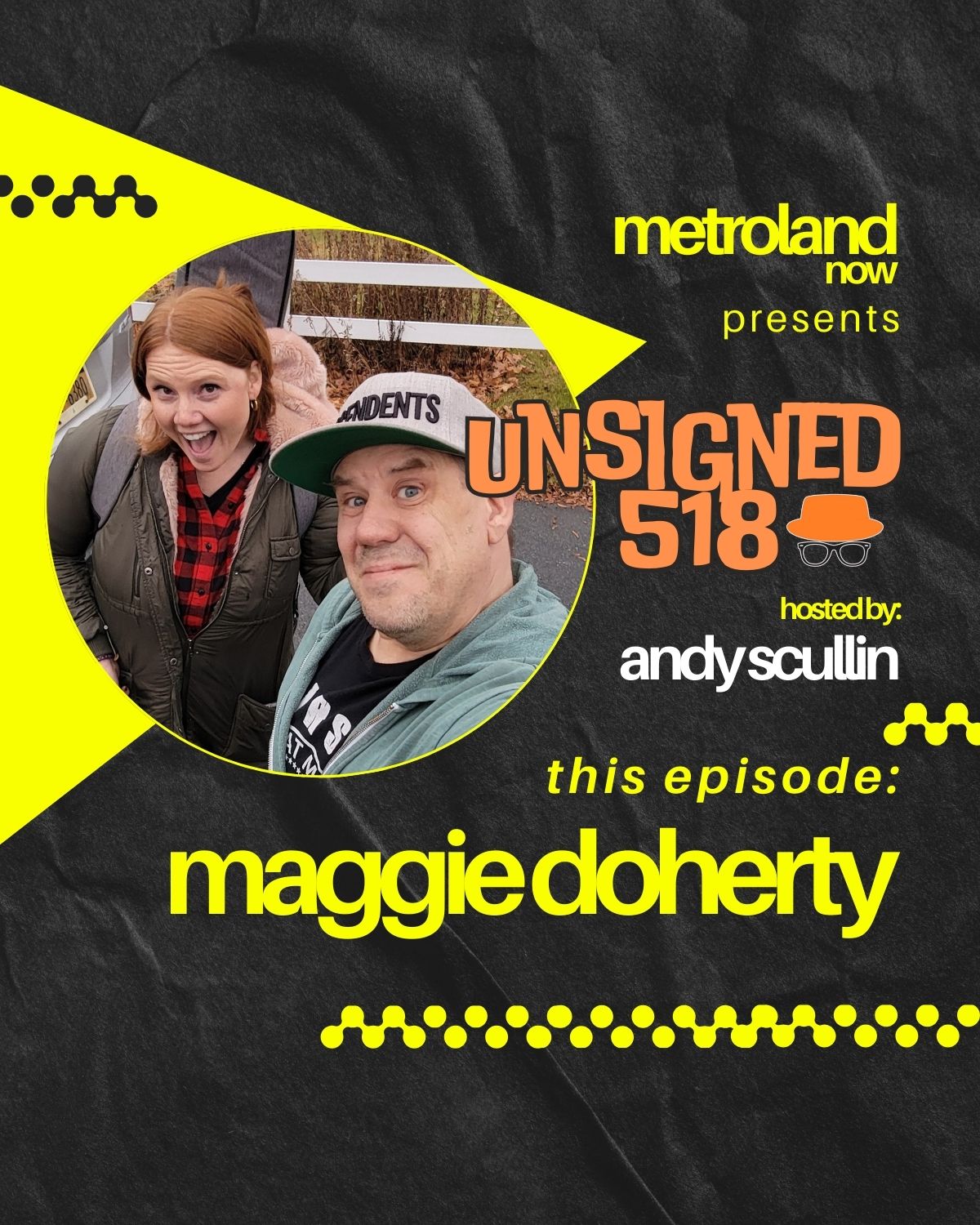
[00:00:26] Speaker B: Hands welcome to Unsigned 518S. I'm here with Maggie Dougherty. How's it going?
[00:00:31] Speaker C: Hey, Andy.
[00:00:33] Speaker B: You know, we were just talking before we got rolling, literally like 30 seconds ago. And I was kind of saying like, we're just gonna, we're just gonna roll with the flow and like talk about music and whatever, I guess. But like I kind of do with everybody. I wanted to start with like how your relationship to music got going and then we'll, we'll, we'll go from there, I guess.
[00:00:58] Speaker C: Yeah, yeah, that sounds good.
I come from quite the lineage, I would say.
[00:01:05] Speaker C: Very musical family on the mom side. So my maternal grandmother, she was in the Sweet Adelines when she was a young lady, and so she was in the barber shop and then so she had three daughters, one of which was my mother.
And they all grew up singing together in this beautiful like Sister Harmony thing.
[00:01:30] Speaker C: And then they ended up forming bands. They all moved back to Saratoga. That's where we're from. Historically. I'm, I'm fourth generation Saratoga Spring.
[00:01:40] Speaker B: Oh, wow.
[00:01:41] Speaker C: Yeah. And.
[00:01:44] Speaker C: So they kind of like were fixtures on the local 518 scene in the 90s, the 8 or late 80s 90s.
And so they sung together, they sung separately, like their different acts and stuff. And.
[00:02:01] Speaker C: Then my aunt Sharon, the oldest, she married a folk musician named Rick bolton, a local 518er.
[00:02:07] Speaker B: Okay, I know that name.
[00:02:10] Speaker C: Yeah. Yeah.
Rick is a fixture on the scene and, and he had this band, Big Medicine, and there were various female singers in that band.
And I just grew up listening to it all.
You know, we'd jam around the house at holidays, we would be out in the bars.
Me at nine years old.
[00:02:33] Speaker C: Out there on the scene with them.
And Rick had this open mic night at Bailey's Cafe on Sunday nights in Saratoga, and it was a fixture.
And so I got up there one night and they were like, why don't you try Bobby McGee? And I'm like, yeah, I'll try Bobby McGee. And so here I am like this nine year old belting it out.
But I got hooked and I came back and back and Rick would play for me on the guitar.
[00:03:01] Speaker C: And you know, there were some, some figures there. Jeff Brisbin was there, Garland Young, Garland Nelson was There, you know, first coming up. So. So I got totally inspired there.
I met another young guy named Zach Rossi who played the guitar, and we formed a little duo together when I think I was 14, he was.
[00:03:27] Speaker C: 17. Yeah. So in high school, we were playing together out on the town.
So, yeah, it's been a part of my life and childhood and everything.
[00:03:36] Speaker B: And was it something, you know, because some people take, like, to the songwriting first and, like, the performing is almost like a.
[00:03:44] Speaker C: Not.
[00:03:44] Speaker B: Not necessarily evil, but, you know, it's something different. Like, first they learn their craft and learn to sing, and then, like, I got to do this shit in front of people, you know, and, like, that's tough. But you sound like you just right out of the gate were in front of people performing. And I wonder if you, I guess, know how much of a leg up that gave you with everything, because, like, there's. I know a lot of, like, great musicians that are still terrified to play in front of people, and they don't.
They can't quite get everything out because they're so fucking nervous.
[00:04:18] Speaker C: No, you're so right. And it's really interesting that you say that, because you're right. Like, I got over my stage fright.
[00:04:26] Speaker B: When you were fucking nine years old. You know, like, that's crazy.
[00:04:31] Speaker C: Yeah. And kids are fearless, so it's like. It's like, you know, the earlier you do something, the easier it just becomes in adulthood and beyond. And.
But no, I think you're right. But it did take me so long to be comfortable enough to do my own stuff. Like, you know what I mean? I was that.
[00:04:51] Speaker B: I mean, that's a whole. That's. That's come up, I mean, so many times on this show. Like, you know, the difference between. Or, like, the. The almost, like, armor of doing another composition because you're like. You're learning someone else's work. You're doing something. It's fine. You know what I mean? If someone doesn't like it, you're like, that's fine. You might not be a fan of that song, but, like, when it's your.
[00:05:11] Speaker C: Own stuff, when it's your own stuff.
[00:05:13] Speaker B: It'S a whole new ball.
[00:05:14] Speaker C: A whole new ball game. And when I was that young, you know, you're a teenager, and, like, everything is new and, like, the emotions and everything. I just couldn't, like, I couldn't fathom being that vulnerable, that young.
[00:05:25] Speaker B: Right.
[00:05:26] Speaker C: So it definitely took me a long time to, like, have it go from private thoughts that only I knew about. And, like, is it going to be Good enough and is it going to sound right? And like, you know, and I teased them out, like, very slowly over various gigs. You know, I've been gigging all through my twenties doing different projects here and there and everywhere.
And I met a friend in college, so I went to Hofstra University, and I was part of the music program.
I was a music minor and. And a journalism and communications major.
So I always kind of had this different calling too. Like multiple callings. And I had my hands in all kinds of different things.
But I met my friend Erin Willett in college, and she was a super talented singer. Vocalist and songwriter. And I just idolized what she did. Cause she was so comfortable and kind of knew who she was as an artist. And I watched her do it. And then I got involved with her band and, like, I was doing harmonies with her and playing keys in her band.
And I was happy to support and watch and play that role on the side to kind of watch an artist blossom with original stuff.
And that finally kind of inspired me to go over the line and do it myself.
[00:06:56] Speaker B: And I think that's a good, like, a good headspace to be in, like, at the time that a lot of people may not have been able to be like, hey, I'm gonna watch this person and I'm gonna.
And I'm gonna encourage my friend and, you know, watch that. Like you said, watch them blossom. Like, a lot of the times musicians, when they're trying to come into their own, are just so focused on themselves that it's hard to.
[00:07:23] Speaker B: You know, not. Not appreciate, but it's hard to encourage someone else because you're almost like, I need all that for. For you, you know, for me. I need that all for me. And if I put out. So I love that you were like, I'm gonna take time to watch my friend and encourage my.
[00:07:39] Speaker B: Up giving you a nice foundation because.
[00:07:42] Speaker C: Yeah.
[00:07:42] Speaker B: And you know that I was kind of thinking when you were talking about that, like, talking about other people's songs in your own compositions, like, and you said you would kind of leak some out here and there.
[00:07:53] Speaker C: Yeah.
[00:07:53] Speaker B: Would you.
[00:07:56] Speaker B: Would you bring attention to the fact that it was like, one of your own compositions, or would you try to sneak it in and just kind of.
[00:08:03] Speaker C: Totally snuck it in.
[00:08:04] Speaker B: Yeah, perfect. Because that's exactly what I would have. What I would have done too. Like, you know, it's like, just play one and then hope that someone's like, hey, that. That one. Who. Who. Who wrote that one?
[00:08:14] Speaker C: Right?
[00:08:15] Speaker B: That was me.
[00:08:16] Speaker C: Yeah.
[00:08:17] Speaker B: Yeah, that's Great. But I.
[00:08:20] Speaker B: Did the confidence come? Like, I guess. How, how quickly did the confidence come? You know, because you obviously have the chops. You have the ability to get in front of a crowd. Yeah, I guess that one missing piece was the ability to write or put your own heart and soul and original compositions in front of a crowd.
[00:08:40] Speaker C: Yeah, totally. And I think the sticking point for me was.
[00:08:46] Speaker C: I historically.
[00:08:49] Speaker C: Was just a vocalist and not a musician. Well, you can debate what.
We can debate what is what, but, you know, I had this insecurity, oh, I can't play for myself, so have to rely on somebody else to do it.
And then 2020 happened, and we were all in our little pods and I picked the guitar up and I was like, no one else is going to do it for me.
[00:09:15] Speaker B: Was that a necessity? Necessity fuels creativity time and time again. Like, I love that. You're like, no one else is going to do it, so no one's coming over.
[00:09:25] Speaker C: That's 100% what it was. And it was, it was necessity and it was by force and repetition. And there was that virtual open mic night Rick was involved with putting on.
[00:09:37] Speaker C: And I had a slot and I was like, all right, here we go. This is. It's me and it's the guitar and it's my laptop and we're gonna do it.
But I had the time to kind of like get those. It's the classic singer, like, you know, gcd, E minor, like, learn your. Your campfire chords and you've got the whole fire chords.
[00:09:58] Speaker B: I love. I love that term. Like, I love that so much because, like, literally you'll know three chords and you can play 10,000 songs the entire American pop.
Yeah, yeah, absolutely.
So you were kind of, you know, it was like quarantine style. So you almost like had like a. A little buffer between you and a in person audience, which is kind of cool.
[00:10:26] Speaker C: Yeah.
[00:10:27] Speaker B: Because I think that's.
[00:10:30] Speaker B: Easier because I did the same thing where I was like, you know, during COVID I was like doing like little acoustic videos and putting them on Instagram or whatever of just me doing cover songs or whatever. And I would never have done an unoriginal song, like, even in video, because I would have been like, nope, nobody gets to see this.
[00:10:51] Speaker C: Right.
[00:10:51] Speaker B: But I don't know, I think it's. I think it's cool to talk about that transition from, you know. Cause everybody has that, like, curious observer of music.
[00:11:00] Speaker C: Yeah.
[00:11:01] Speaker B: Tinkering in music, starting to figure shit out. And then now I'm doing this, you know, and it's different for everybody. So I love that.
[00:11:09] Speaker C: Yeah.
[00:11:10] Speaker B: So, you know, playing.
[00:11:12] Speaker B: I guess, out and around in Saratoga. And then in college, like, were you mostly doing, like, solo acoustic stuff? Did you do a lot of band work?
[00:11:23] Speaker C: Yeah, it was.
Well, I had a cover band, so I had my duo with Zach, and then I had a cover band, Maggie and the locals.
And it was drums, bass and guitar. The guitarist swapped between guitar and piano.
So it was like full band stuff. Full band, quote, unquote covers. And then when I got into college.
[00:11:47] Speaker C: I joined the acapella group and it was the singing thing. And that actually helped with my harmony and my blending and improved the vocal stuff. I took my first voice lessons with an opera singer, like a trained opera singer, who taught me all the techniques, how to breathe, how to just think about singing, which is super cool.
And then I kind of took that, all of that, and brought it back home to Saratoga when I played out and around around holidays with Zach, with Rick, and then. So it was a mix of both things. And then when I was in the city, in New York, that's where I lived after college, I supported Aaron and her band and we did full band stuff. We did acoustic trio stuff.
[00:12:35] Speaker C: And then I joined this wedding band, which was like a big, big production around 2017. So I always had musical stuff going on in various forms.
[00:12:49] Speaker C: And then when I came back to Saratoga full time, it became like a solo thing, which was terrifying.
[00:13:00] Speaker C: But.
But ultimately good because it set me up to.
[00:13:05] Speaker C: You know, to do this original thing and.
[00:13:07] Speaker B: Right.
[00:13:08] Speaker C: Yeah.
[00:13:09] Speaker B: And. And it sets you, like, even though it is terrifying to, like, do it on your own, like doing it on your own, once you get, like, into the rhythm, it's gotta feel just good to know that you can do whatever you want and you don't have to play any place that you don't want to play or any music that you don't want to play. You can just be like, I want to do this. I want to play here. I want to play for these people at this time. And I don't know, people take for granted, I guess, how much that means to someone to be able to.
[00:13:38] Speaker C: Yeah. You know, it gives you a lot of power. It gives you a lot of agency.
[00:13:41] Speaker B: Yeah.
[00:13:42] Speaker C: Which is. Which is important. And, you know, and I love the big band. I love, you know.
[00:13:48] Speaker C: I just love it all. So having the option to do larger scale stuff or to just do a quiet, you know, intimate thing, it's like that variation is so what it's all about, I think.
[00:14:02] Speaker B: Yeah. And it keeps it Fun and it, like, because, you know, unless people are making, you know, their living doing music, it's, it's got to be fun.
[00:14:14] Speaker C: Totally.
[00:14:15] Speaker B: Or else it's, you know, it's. I mean, I guess even if someone's making a living, they would want it to be fun. But once it becomes that level, you know, there has to be a certain level of seriousness to it and a certain level of business to it.
[00:14:29] Speaker C: Right.
[00:14:30] Speaker B: That I kind of personally don't ever wanna find out. I'm like, I just love doing it.
And I would hate to be in a situation where I'm like, ugh, gotta go play my fucking bass. This sucks.
[00:14:42] Speaker C: Yes. And that's never what I wanted music to be for. Me neither. You know, like I said, I had the calling for other stuff. I was a writer, a reporter.
I was an intern for Billboard magazine.
[00:14:58] Speaker B: No way.
[00:14:59] Speaker C: Yeah. When I was in college, I was an editorial intern. It was super co.
[00:15:04] Speaker C: And I thought I was going to be a music journalist and that would be my career. And then music would always be, you know, on the side.
[00:15:11] Speaker C: And I did cool stuff as an intern. It was, you know, it was like the recession was happening. We were just out of school and it was like a freelance game. And because I didn't get hired on staff, it was super competitive. Like that intern class was amazing. And they all had their niche of the different genres that they reported on. Like there was the K pop guy, there was the like, you know, emo guy. There was the, you know. And I was like, I think I'm.
Where's the Bonnie Raitt girl?
[00:15:45] Speaker C: I think I'm a pop girl, but I'm more of a generalist, I don't know. So like, it was like, okay, I got to get hired somewhere like on staff because I have student loans and I have rent and it's New York and I'm poor and out of college, so. So yeah, the first place that hired me on staff was a trade magazine for the food and beverage industry.
So I've done that as a full time job ever since. Marketing communications for.
[00:16:12] Speaker B: Oh, cool.
[00:16:12] Speaker C: Yeah. For hospitality brands.
[00:16:15] Speaker B: Yeah. That's not music related, but the same thing. Like a lot of people think that I do like this full time and I'm like, no motherfuckers. I have a 40 plus hour a week day job that has nothing to do with music in any way shape perform, you know, that's how I make my money.
[00:16:33] Speaker C: You gotta. Yeah.
[00:16:34] Speaker B: All this stuff is just fun.
[00:16:36] Speaker C: Totally, totally.
[00:16:37] Speaker B: And I love it.
But yeah, I, I do want to talk, maybe even off, off air, about some music journalism stuff. Totally pick your brain on that, because I'm trying to pretend that I'm a music journalist and I'm.
[00:16:50] Speaker C: You definitely? Are you definitely?
[00:16:53] Speaker A: Yeah.
[00:16:53] Speaker B: Well, yeah, I guess. But, you know, I do want to hear some music from you. And you brought your guitar. We're gonna hear live here in the Dazzle Den, and then something from an album, if I'm not mistaken, right. Later on. So I guess. What's the song you're gonna play right now?
[00:17:12] Speaker C: First song is called Night Words. It's the lead single off my debut EP called Night Words, and it's got a little bit of a double meaning. So the. The words for the ep, I wrote the majority of them at night in my phone as sort of like journal entries in the notes app, when I could find a quiet moment to get them out of my head and, like, in the world.
And then I would hum a little piece of it and catch it.
And that's what became this album eventually.
And. But the song itself is about.
If you're kind of out somewhere and you run into somebody that you have a history with or whatever, and they say these things to you, they're gassing you up, like the things that you've always wanted to hear them say, and then they don't hold any weight the next day. It's like, did that even happen? Like, so.
Yeah. Night Words, double meaning.
[00:18:12] Speaker B: Gotcha. All right, well, cool. Let's check this out. Night Words. Maggie Doherty here live in the Dazzle Den. And then we'll be right back.
[00:18:30] Speaker D: Drove out to the edge of the night with the dawn at our heels I could see the change in you and you told me how you feel Told me I was something I got away.
[00:18:44] Speaker D: Been here the whole time but you looked another way these were the words that I've been waiting for so long still now the well is dry and everything's wrong and I know these are just not words.
It'll be different in the morning. You still love her and I know it. Well, I'll go to bed.
You won't leave my hair but I leave yours. I try to forget what we said.
[00:19:27] Speaker D: At the bar to air I'm talking all day long Lullabies and widening eyes Going on and on One more time before we say goodbye Old friends are watching us from the corners of the rock they don't know what I know When I listen to you spell our dreams Dance away from me like a weave in the wind I fears her networks It'll Be different in the morning you still love her oh, and I know it where I've go back you won't leave my hair but I'll leave yours Try to forget what we said.
[00:20:40] Speaker D: Drove out to the edge of the night with the dawn at our heels.
[00:20:45] Speaker C: I could see the change in you.
[00:20:47] Speaker D: And you told me how you feel oh, and I know these are just a night word It'll be different in the morning you still love her when I know it well and I'll go to bed you won't leave my hair but I'll leave your.
[00:21:12] Speaker D: Try to forget what we said these are just not worked. It'll be different in the morning you still love her when I know it when I go to bed you won't leave my hair but I'll leave yours I'll try to forget what we said.
[00:21:40] Speaker B: All right, that was night Words, Maggie Dougherty, live here in the dazzle Den. And you know that song is the first song off your album that came out in October. And I know you worked with Chris Carey, who, you know, like is everywhere, doing everything at all. I swear that dude is like seven people at once.
But yeah. So I guess tell a little bit about the experience of working with someone like Chris on the album.
[00:22:07] Speaker C: Yeah, yeah, yeah. So met Chris, I don't even know when. Long way back.
He subbed in and out for Big Medicine, which is the band that I play in with Rick now and Tim Weckler, Jeff Walton, all those guys from the 90s era, you know, keeping it going.
I joined the band when I moved back home to Saratoga, and then Chris was on the scene and I would always see his duo with Tim Wechler, and they're just awesome and, you know, same kind of wavelength stylistically as the original music that I wanted to put out there.
And I knew that Chris had a studio and he's an engineer and this is kind of what he does. And.
[00:22:54] Speaker C: He'S like, you know, I do originals and I'm like, I know, we'll do it.
And then finally it was the beginning of last year. So I had my daughter in April of 2024. Then I found my groove in motherhood a little bit. We were rocking and I was like, okay, New Year's resolution. It's time to lay down the originals. And so I got in touch with Chris and that's what we worked on.
We found time to have studio time.
I recorded some scratch tracks for him. I had pre existing scratch tracks from past eras of life, and he took a listen to all of it. And started to get ideas for vibes and feels. And so he played the instruments on the recordings from, like, top to bottom.
[00:23:44] Speaker B: So, like, you kind of had. Or like the two of you basically had the idea that this was going to be, you know, you were going to put an album together and started immediately thinking of, like, a theme for the album and how things can work together. So it wasn't. Wasn't just like, hey, let's make music and. And see what happens. But, like, yeah, it had. You had, like, not, like. I don't want to say like a concept album, but like, you had the idea of cohesive material that was going to fit on this one album.
[00:24:12] Speaker C: Yes. Yeah.
[00:24:13] Speaker B: Right from the start. That's interesting because, like, I. I'm always, you know, like, I'm not like a quote unquote songwriter per se. You know, I've written a couple songs, like, here and there. But I always just found it interesting how someone can have the fucking vision to be like, I'm going to get 10. So that are kind of the same, you know, Like, I'm like, yeah, let me find two notes that work together, and if I can do that, maybe I'll add a third in some. But, like, I just. I admire the ability to be like, let's make an album.
[00:24:44] Speaker C: Yeah.
[00:24:45] Speaker B: And start looking at the blank space.
[00:24:48] Speaker C: Yeah.
[00:24:49] Speaker B: As an album right out of the gate. Like, it's a cool way of looking at it.
[00:24:53] Speaker C: Very, very cool. Yeah. Yeah. And it's like that I leaned into my influences, so I mentioned Bonnie Rape, like, you know, that kind of folky Americana, but, like country leaning and with some soul in there. Because just the vocalist voice and singing and connecting that way was always kind of my thing.
And then Brandi Carlisle, like, came out of nowhere. Like, I saw her live, I think.
[00:25:24] Speaker C: Here at proctors circa 2014, and then for free at the Prospect Band Shell in Brooklyn. And I'm like, this gal. Is it like, oh, my God.
And her style and everything? I just. I'm like, that's what I want to do. And.
And then her trajectory was so cool. Like, she had the twins and they had that sound like they locked in with the harmonies and everything.
[00:25:49] Speaker C: And it was kind of this wave of like, new Nashville, you know?
[00:25:53] Speaker B: Yeah. It's kind of that very fine line, like you said, like, when you said country leaning. Because, like, it's not country. It's not straight country music.
[00:26:03] Speaker C: Correct.
[00:26:04] Speaker B: It's not rock and roll. It's not.
But it's just enough of all of those things that it will Attract fans of country, it will attract fans of rock and roll. Whereas if something's too country, you're gonna lose some of the rock and roll people and vice versa. But, like, you know, Bonnie Raitt and Brandi Carlisle especially. I almost said Belinda Carlisle have that ability to use all those aspects in a way that works for everybody.
[00:26:35] Speaker C: That's 100% kind of. Yeah. What the vision was to create, like, my own interpretation of that, like, sub genre.
[00:26:44] Speaker B: Right.
[00:26:46] Speaker C: And there were other. Other players there too, like Casey Musgraves.
Even Miranda Lambert's more central stuff, like Tin man is a cover that I've always played, but it's such a. Like, it's just a folk song. It's just, you know, like an everybody song that can get. Grab anybody and it's just her and the guitar. And it's.
That's. That was the sound.
[00:27:13] Speaker C: You know, that. That was my vision when I was humming melodies into my phone and writing stuff into my phone. And I knew Chris could help me get there, and he very much did.
[00:27:23] Speaker B: And so did you, like, have a lot of conversations with Chris about stuff like that? Like, hey, I wanted to sound like this, or a little bit of this, a little bit of that, or.
[00:27:34] Speaker C: Yeah, yeah, definitely, like. And it was a lot of, like, emails back and forth and text and like. But he also has such great instinct and intuition, too, on his own.
[00:27:46] Speaker C: You know, lived musicianship that I was very open to as well. So it was both of those things, I think, coming together to create the final project.
[00:27:56] Speaker B: Yeah. And so, like I said, the looking at something as a whole, like, that is something that I can barely wrap my brain.
And I mean, we put. My band put out an album, I don't know, less than a year ago.
And it's not cohesive, you know, it's not cohesive. It's a bunch of different.
That's like how we are. But it's. It's.
It makes me think I'm like, how do people make songs that are the same but different or.
[00:28:24] Speaker C: Right.
[00:28:24] Speaker B: You know.
[00:28:25] Speaker C: Yeah, yeah, yeah, yeah. And, like, there's one track that's a little bit more poppy and a little bit more RB and like, Maren Morris influenced with what could feasibly be on the radio. I don't know. They're not really radio tracks, but, you know, I wanted to make sure that there was something for various types of fans on the collection.
[00:28:51] Speaker B: Yeah, that's a good way. Good way to do it. A good way of looking at it. And I think, you know, having Chris on Your team is a solid decision as well.
And so that's how many songs are on the album.
[00:29:05] Speaker C: So it's five on the ep and then there's sort of like a part two that is, you know, for to come.
[00:29:13] Speaker B: Okay.
[00:29:14] Speaker C: Yeah.
[00:29:14] Speaker B: Are in the works. Are you working with Chris again?
[00:29:17] Speaker C: Oh, I'll definitely go back to Chris.
And we. We had an EP release show at the Cock and Bull back in October, and the Rodeo Barons, Chris's bigger band, folk folk band.
[00:29:30] Speaker C: They backed me up, and we played a couple of the forthcoming songs as well, so.
[00:29:37] Speaker B: That's awesome.
[00:29:37] Speaker C: Yeah.
[00:29:38] Speaker B: Do we want to play another song, like, from the. The album, like the. The recordings?
[00:29:45] Speaker C: Yeah. Yeah, I think that would be great.
Yeah.
[00:29:48] Speaker B: Which one do you want to do?
[00:29:50] Speaker C: We could do the last one on the EP is called Winnie Girl, and it's about my daughter Winnie, and she's a year and a half now.
[00:30:00] Speaker C: This one is a bluegrass song in spirit, and it definitely has that. That sound on the ep. Sarah Milanovic plays the fiddle on the track, and she did an amazing job. It just was the perfect, perfect sound that I was going for just to capture, like, pure joy and kind of, you know, sing along harmonies and, you know, you can clap along. And we closed the live show with it, and it's just. It's a great end note.
[00:30:33] Speaker B: Cool.
[00:30:33] Speaker C: Yeah.
[00:30:34] Speaker B: All right, well, let's check out Winnie girl Maggie Doherty, and then we'll be right back to wrap it up.
[00:30:47] Speaker D: My winniegirl.
[00:30:49] Speaker D: I dreamed the day I'd meet 2009 who you'd be and who you look like I would try to paint a picture but a picture wasn't even half a high I love the way your life lights up our lives.
My Winnie girl.
[00:31:10] Speaker D: You'Re strong and steady even as a child.
[00:31:15] Speaker D: Just thinking, smiling and laughing all the time.
[00:31:20] Speaker D: Couldn't ask for anyone as bright the honor of my life to feel you're alive oh, look at you if you only knew it round my heart just like a pendant you're being the sweetest way I've known.
[00:31:38] Speaker D: A few days in somehow you're already independent I know that you'll be just fine in this world my Winnie girl.
[00:31:51] Speaker D: My Winnie girl.
[00:32:05] Speaker D: I look at you if you want to round my heart just like a pendant Heavy in the sweetest way I've known.
[00:32:15] Speaker D: A few days in a time are already independent I know that you'll be best friend in this world my.
[00:32:24] Speaker C: Winning girl.
[00:32:27] Speaker D: My job is to make sure that you will know how precious that you are to everyone. You know only one child deserve the very best I know someday you won't settle for less My baby girl, you're my sweet pearl I love you more than you imagine Tiny hands so light upon my chest I look into your eyes and I just know that you imagine your only child deserve the very best My Winnie girl.
[00:33:07] Speaker D: My mini girl.
[00:33:12] Speaker D: My Winnie girl Ooh, I can't wait to watch your life untold My Winnie girl My Winnie girl.
[00:33:25] Speaker B: All right, that was Winnie girl, Maggie Dougherty. And Maggie, I want to thank you so much for taking time out of your day to come out on this, this rather unpleasant Sunday afternoon. The weather out there is freaking terrible.
[00:33:38] Speaker C: November rain.
[00:33:38] Speaker B: Yeah. Anybody. Anybody listening? In the future, just know that she braved a little bit of freezing rain and snow to get here. And uphill both ways. No?
So before we go, like I do with all my guests, I just want to give you a chance to say your gratitudes. So the microphone is all yours.
[00:33:56] Speaker C: Oh, well, thank you to you, Andy, for having me. This is so awesome to be on unsigned 518. And I want to say thanks to Aaron and TJ. They covered my single in the paper, which was awesome. And Aaron had me on the the October Lena Go Round, which was amazing.
[00:34:16] Speaker C: And obviously huge. Thanks to Chris Carey, producer, engineer extraordinaire. The EP wouldn't exist without Chris, so infinite gratitude to him and the rodeo Barons for learning all my songs and helping me sound legit live.
[00:34:34] Speaker C: And the gratitude dates back to, you know, Rick Bolton and my. My aunts Sharon and Katie and my mom Molly and that community of ladies that inspired me ever since I was a little kid to do this.
[00:34:50] Speaker C: And I always gotta thank my husband Josh, because he lets me go out and do this, you know, let's. But.
[00:35:00] Speaker B: Oh, I get it.
I use.
[00:35:03] Speaker C: It's a partnership and, you know, anytime I can get out of the house and do music stuff, you know, it's time away from him and Winnie.
But it's. It's a special place for me, so I appreciate his support too.
[00:35:18] Speaker B: Awesome.
[00:35:19] Speaker C: Yeah.
[00:35:19] Speaker B: All right, so she is Maggie Doherty. I am Andy scullin. This is unsigned 518 and I'll see you on the road.
[00:35:28] Speaker B: Unsigned 518 is produced and hosted by me, Andy Scullin. New episodes are available every week wherever you stream podcasts. If you'd like to help support the show, please like and subscribe wherever you are listening. Or you could buy me a
[email protected] unsigned 518.
If you would like to advertise on the show, send me an email at unsigned518mail.com and to be a guest on the show, reach out to me through Instagram at unsigned518.
[00:36:00] Speaker B: Take care of one another and I'll see you next week.
[00:36:05] Speaker B: Andy Scullin.