[00:00:01] Speaker A: He was born on a Saturday in 73 he loves punk rock music.
On the beat Guitar with the short with radio back his motherfucking envy SC Here he comes, Andy Sculling wearing his orange hat.
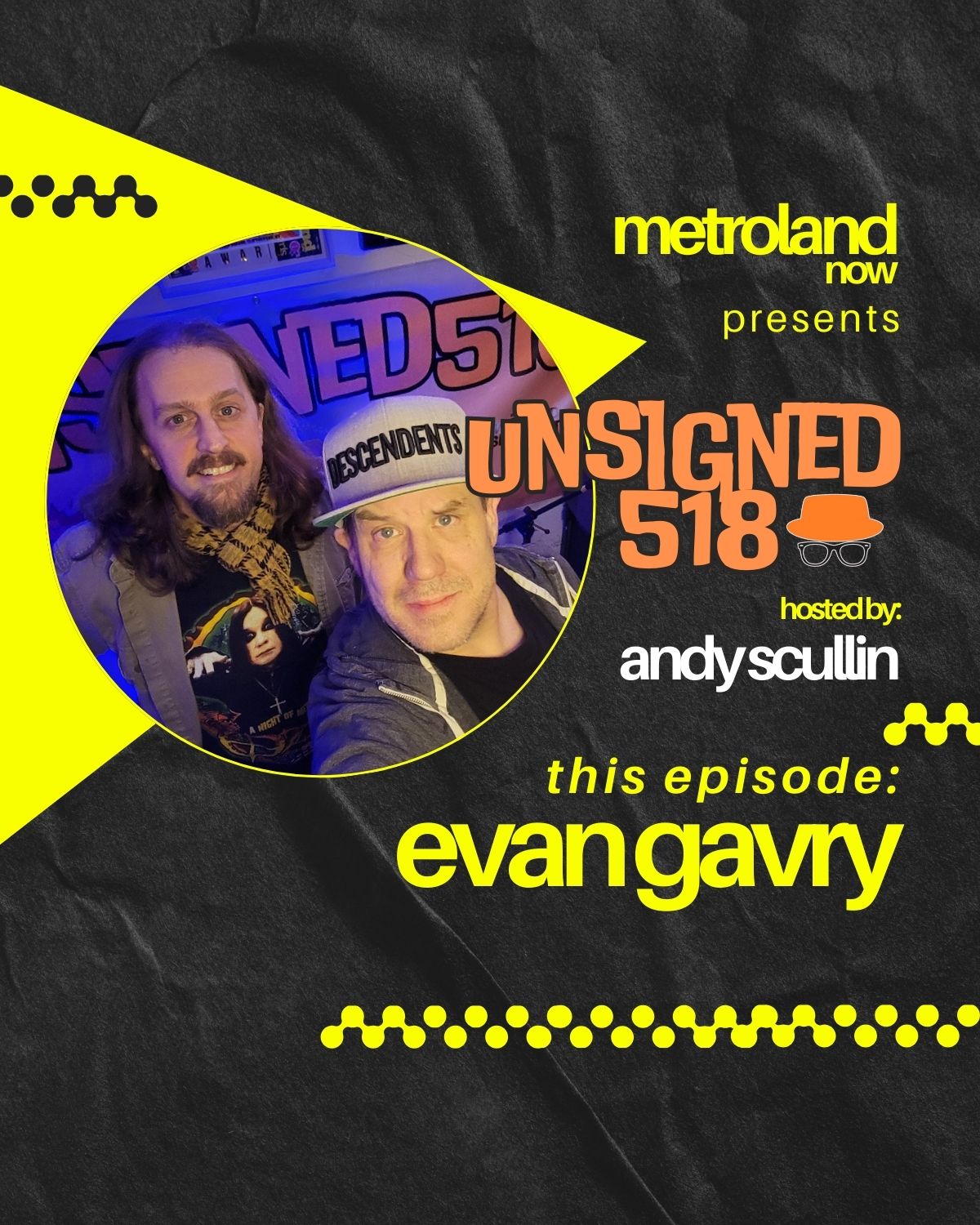
[00:00:27] Speaker B: Welcome to unsigned 518. I'm here with Evan Gabry. How's it going man?
[00:00:32] Speaker C: Pretty good. Beautiful Sunday.
[00:00:34] Speaker B: It is a beautiful sun, but it's cold. We were just like literally just talking about it and you may actually, as we're recording you'll hear clickings and blowings of an old ass furnace because we're, you know, the dazzle then is for all intents and purpose it's a garage and it's cold in here. If we turn these garage.
[00:00:55] Speaker C: So I would take one.
[00:00:56] Speaker A: Yeah.
[00:00:57] Speaker B: So you either get the sound of the furnace or we would freeze. So that's, you know, that's the, the trade off. So we just want to talk. You know we've been talking a little bit before we got rolling and I kind of gave like the overview of what we're going to do. And that overview is basically like I never have a plan. So I think we'll just start with like kind of tell us, tell us your relationship with music. Kind of how, how or when you knew it was your thing and like, you know, whether you want to go all the way back to the very beginning. Kind of when you got serious. Totally up to you.
[00:01:35] Speaker C: I'm gonna be floating around in the amniotic fluid. No, I. Pretty young. It was pretty young. I grew up south of Amsterdam.
[00:01:43] Speaker B: Okay.
[00:01:43] Speaker C: New York. Out in the town of Florida, which is kind of. It was kind of like a Huck Finn childhood out in like cornfields.
I think my nearest was like an hour bus ride to school and like the. Near the nearest. The next bus stop up. The next kid in my grade was like three miles away. So like I never.
I. I wasn't like running off to play with kids my own age. They were too far away. Like I same. It was like I was just running around the woods. I mean I was like shooting arrows and throwing tomahawks at trees and stuff. Like, you know.
[00:02:11] Speaker B: Crazy.
[00:02:11] Speaker C: Yeah, crazy.
[00:02:12] Speaker B: I grew up in woods kids, the sticks of Vermont. Yeah. Like I go, you know. Yeah. I was seven miles from the closest commerce. Like the closest store, the closest gas station was. Yeah. So go ahead.
[00:02:24] Speaker C: I get really just full Huck Finn running around the woods childhood. And then so like.
[00:02:30] Speaker B: But.
[00:02:30] Speaker C: But my, my parents both had really good record collections. I remember there always being really good music in the house. My mom was more about lyrics. And my dad still to this day can't really pick out lyrics. He's more. He was.
[00:02:41] Speaker B: He.
[00:02:41] Speaker C: He was a musician. He played.
He grew up playing accordion. And he learned. I think he taught himself to play guitar in college. And when I came around, he was teaching himself fiddle. He's one of those guys that's always learning new instruments, even still.
And shout out to Pop because I still play an insolent Willies with him. He's the accordion player. Sometimes I introduce him as my younger brother or this is my nephew because it's hilarious because he's obviously not. But.
But yeah, shout out to my dad because he taught me a lot. And.
And yeah, I remember. I remember them having like cocktail parties and barbecues and stuff. And like, my dad's friends, they'd get a couple acoustic guitars and they'd like bang out Rolling Stones covers and. And like, I would kind of sneak down out of my bedroom and like, peek down. You know, they put me to bed and then I'd hear drunk people making noise downstairs. Come check it out. So that. That was pretty young.
I.
I remember pretty distinctly, like four or five years old. I had this old marching snare drum, which actually one of those patches we made.
I just put out a record. And we didn't press any vinyl or CDs or anything. It's just a download code on the back of these canvas patches and the tags to the T shirts and stuff.
So, yeah, with that one print there, the one song Hornet's Nest is about, I had this marching snare that it was too loud to play in the house, but I have a real clear memory of sitting on a hill hitting this snare drum. And I didn't really know how to play it, but I was just whack it and listen to the echo back across the.
You know, across the field.
And I just remember being real fascinated with music and recording and like tape decks and stuff. I would always take apart Walkmans and stuff when I was a kid.
And then so fast forward into when I was in like high school. Like the year before I got my driver's license again. I'm still out in the middle of nowhere. No driver's license. No, you're not.
You can find trouble, but, like, I'm not going into town and getting into trouble.
So I started playing guitar, my dad's guitar, just for something to do. And if it had been a year later and I had a driver's license, I might have never. But so I started playing guitar and like, I was Trying to learn ACDC songs, but he was learning fiddles. So I learned a bunch of Irish stuff and went to a lot of bluegrass festivals. So that's like. That's kind of all in my background without thinking about it. Irish and bluegrass and all the country folk and. And I grew up in the middle of nowhere, so it just felt natural. There's talking about, you know, down in the Holler stuff. It's like, oh, yeah. Vibe with that. But then when I was 16, we went to. I moved closer into town to be closer to the high school.
And I started playing, like, heavy metal and punk, like, learning electric guitar and started playing with a band in my high school that was like a hardcore band and playing people's basements and VFW and stuff. So that's like kind of my. There's kind of two strand streams in my.
In my musical life. And one is like this, you know, the noble folk music headwaters of, you know, Pete Seeger and whatever. Like, it's this, you know, straight flow right back to the old blue, old Delta blues and stuff. And then there's this other, like, scuzzy punk rock, heavy metal side. Like, to this day, I was going to say, to this day, I've seen Ozzy live more than I've seen anybody else. Like, I've seen him five or six times.
[00:05:58] Speaker B: All right.
[00:05:59] Speaker C: And so that was like my college. That was like my high school heavy metal period.
[00:06:04] Speaker B: And then.
[00:06:05] Speaker C: And then I played in a bunch of bar bands in Boston for a bunch of years. And I moved to New Orleans for a couple of years, tried to. Tried to pick up a couple of jazz licks, but.
[00:06:16] Speaker B: And how do you think, like, having, you know, those, like, two personalities that are not personalities, but like two musical identities that are so fucking different from each other.
Like, how does one. Like, do they influence each other? Or is it like, you know, you play one?
[00:06:33] Speaker C: I mean, because, like, I think, like, Hank Williams is a punk rocker.
[00:06:35] Speaker B: Sure.
[00:06:36] Speaker C: Even if it's all.
[00:06:36] Speaker B: I think Pete Seeger is a.
[00:06:39] Speaker C: Like, there's a lot of overlap in the attitude and then the. Like. Yeah. Musically, a lot of the stuff that I really love is like, Sun Records, where it's like one guy's playing acoustic, one guy's playing electric. I like trying to figure out how you make that work or like. And it's such a headache in a lot of bands that I've been in. Like. Oh, you got. Oh, yeah, sorry. So. No, but I was. That's exactly the thing that I was going to say is, like, oh, this guy's playing a ukulele, and this guy's playing electric bass. Like, and you got to get them to work on that. And there's drums and there's an accordion. Like, how do we get all this stuff to work together and not feed back and sound like garbage?
[00:07:13] Speaker B: But I mean, and even just, like.
Like, stylistically, I guess, like, you know, a lot of, you know, like, even just. I hate to go back to Pete Seeger constantly, but, like, you know, Pete Seeger and, like, folk music, it's very true. You know, it's even called, like, traditional, and it has, like, these roots that are very traditional. Whereas a lot of metal music comes from, like, classical and, like, symphonic and, you know, it's just a different.
Yeah, different vibe. And I think even mixing any element of one into the other is fascinating to me.
[00:07:49] Speaker C: Totally.
[00:07:50] Speaker B: And.
[00:07:50] Speaker C: And, yeah, like, for a long time, like, I grew up, like, when I was learning to play electric, I wanted to play blues stuff. I was a big Muddy Waters fan. I had my Stevie Ray phase. You know, Everybody wants to be like, oh, he's the fastest note per minute guy. Like, yeah, just do I want to do that?
And then I went from, like, pentatonic, like, bluesy guitar playing to, like, trying to be more notey, more on the scale and, like, know what notes. And the things that I find that I like the best are kind of where you start on one and end up on the other one, whichever direction you're going in. I teach a bunch of guitar lessons, and that's kind of what I. I'm trying to tell kids when I'm like. I'm like, I'm gonna teach you the scale, and I'm gonna teach you the pentatonic scale. But the really fun stuff is in between. Like, you're. You're kind of. You're using. If you're using all of one or the other, you're kind of not using your whole palette.
[00:08:40] Speaker B: It's almost like, you know, I always compare it to, like, a music to cooking. Because, like, I like to cook, you know. Yeah. And when I cook, I don't really like to follow a recipe. I like to follow a guideline to taste. I like, you know, hey, kind of do this or whatever. But I. I don't like a recipe telling me, use a quarter teaspoon of this. It's like, go fuck it.
[00:09:00] Speaker C: That's not what you got into this.
[00:09:01] Speaker B: I want to use more than that.
[00:09:02] Speaker C: That's not what we get into.
[00:09:03] Speaker B: So, like, I love that comparison with, like, cooking and music. And I think having.
It's almost like having the. The guideline of a recipe. You've got this stuff that you can use, but I'm not going to tell you how much of each to use. You got to come up with that yourself, and that's your own flavor.
[00:09:22] Speaker C: Well, and I kind of did that a little just on my record that just came out.
I had TV doctors back me up on half of it, and I had the insulin willies back me up on half of it. Cause, like, half of them are more acoustic, kind of a little more bluegrassy, folksy, and a couple of them were a little more rocking. So, like, I kind of sprinkled the ingredients around even on the track list on the album. So.
Yeah, yeah, no, I. I'm all about that. Like, it's got to be. To flip to, you know, season to taste. And it's good to have different pockets and pallets to pull from too.
[00:09:57] Speaker A: Yeah.
[00:09:58] Speaker B: You know, and it's good to recognize them because I. And I've said this on. On other episodes, like, it bothers me when almost kind of like, oh, you know, I don't really have too many, you know, like.
Like there's. Yeah. I'm just. Me. I'm just creating this music from my head. Not. It's not based.
[00:10:15] Speaker C: Oh, no. I'm very conscious too, about which things I stole from. What. Which. There's a song on there, Let It Ride that.
Oh, I think that's the second single, but it's. It's like line for line. There's a couple I like. That one's from Bob Dylan. That one's from Towns, Van Zant. That one's from Tom Waits. And like. And to me, that I'm kind of. I'm kind of challenging. Like.
No, so far nobody's come up and called those out to me. And that's really what I was going for, for somebody to call me on my.
And so far, nobody has. It's been a little disappointing, but. But no, like. Yeah, like, what did Bob Dylan said? If.
Steal big steal. Like, if you're gonna steal, steal something good. Like.
[00:10:53] Speaker B: But that's how beautiful shit is made, you know? And I mean, even in.
You know, not to go to. Into another medium, but even with movies, like, I'm a horror movie dude. And we wouldn't have Friday the 13th without Halloween.
Because when John Carpenter made Halloween, Sean S. Cunningham, admittedly, has gone on record many, many, many times.
[00:11:16] Speaker C: I love that.
[00:11:16] Speaker B: And said, I want to do that. Yeah. So what can we do? He Used Halloween. What other holiday can we use? Oh wow. And then he went, wait, Friday the 13th. They came up with the logo.
[00:11:28] Speaker C: Yeah.
[00:11:29] Speaker B: Took out an ad in like Hollywood magazine and we're like the most terrifying thing ever coming next summer. And they were like, we had no.
[00:11:37] Speaker C: Idea what it was going to be.
[00:11:38] Speaker B: Didn't have any idea what it was going to be. And they were like, it was a direct ripoff, you know, like that, that.
[00:11:44] Speaker C: I loved when I was. When I was a little kid. I loved he man. And then when I grew up, I found out he was basically just like a Conan the Barbarian rip off. It was like a Conan slash Star.
[00:11:53] Speaker B: Wars ripoff but like lighter and more. But they palatable.
[00:11:56] Speaker C: They totally designed the toys first and then made up a character to go with it. Like, like, you know what I mean? Like, and it's all of the things that as like a grown up and yeah. As like a little, you know, like real, you know, rule following punk rocker, you know, orthodoxy, whatever thing. It's like, oh, that's. They, you know, they. You should have come up with the character and it should be a deep and nuanced character. And that's what we fall in love with. Like. No, they came up with the toy first and you're a sucker. And I'm like, oh, okay.
[00:12:21] Speaker B: Yeah, they absolutely. Did you see that they have a new masters of the universe.
[00:12:25] Speaker C: Oh, they have a new movie.
[00:12:26] Speaker B: Like a new cinematic liveaction movie. I saw the trailer for it the.
[00:12:29] Speaker C: Other day of it and I was, huh.
[00:12:31] Speaker B: I had no. No idea. And like, you know, it looks and.
[00:12:35] Speaker C: And you know, everything.
[00:12:36] Speaker B: Obviously, obviously people were, were coming out of the woodwork about the pronouns.
[00:12:42] Speaker C: Yeah.
[00:12:44] Speaker B: Because it was like a seat. I think it was like a seed or something in the trailer. Like, you know, where they ask the pro, you know, and he's like he, you know, he or whatever. And like, you know, people were like, everything's woke now. It's like his name is he man. Yeah.
[00:12:57] Speaker C: That's funny.
[00:12:58] Speaker A: Yeah.
[00:12:59] Speaker C: I love it. But yeah, everything comes back around. That's the, that's the point. Actually. No, no, there are no new ideas really.
So.
[00:13:06] Speaker B: Well, I mean there's been. There's been new. Newer takes on all the ideas that I really like. Like there's been some really good new punk rock coming out. That's like kids.
[00:13:18] Speaker C: Yeah.
[00:13:18] Speaker B: That are like teenagers making punk rock. That sounds like it was fresh in 1978 and shit. And you're like, what the fuck?
[00:13:26] Speaker C: Totally. No, my guitar lessons are that I don't find new stuff for myself anymore. I just have my kids come in and I guess especially this one. What's up, Edie? If you're listening, my. I got this little. What colors are here now? It was green for a long time. She was my little like green haired punk rock bass player. But she like the stuff. She comes in and asks me to play and then I have to listen to. I'm like, I'd never even heard this band.
[00:13:50] Speaker B: And like, I had like. And again, you know, I mean, I'm in my 50s.
[00:13:55] Speaker C: She's a big germs. She's like. She's a big DC lady punk scene. And I tend to be more like New York, London.
[00:14:02] Speaker B: Yeah.
[00:14:03] Speaker C: I like the Clash. I love the Dolls, but. Yeah, so. But that's cool. So I get this, this other insight from kids that come in and ask me to teach them to play stuff that I never would have even listened to or the other thing that's crazy now is like, kids will come in and be like, yo, how do I sound? Like Thursday. And I'm like, I spent way too much time figuring that out back in the day. And I know exactly, you know, like, I know exactly how to do it.
[00:14:30] Speaker B: Yeah, totally. Yeah. It's good to know that, like, there's a new generation, you know, because how.
[00:14:35] Speaker C: Old are your parents? Your parents are exactly as old as me.
[00:14:39] Speaker B: I'm probably. I mean, like I said, I'm. I'll be 53 in like a couple months or whatever. And a buddy of mine who I went to high school with sent me music that his daughter who's just graduated high school is showing him. And he's like, dude, check this out. And I'm like, do you realize how like our kids are turning us on to cool music? Like, well, not art. My kids. I don't have any kids, but.
[00:15:02] Speaker C: Well, that's how I don't. I don't have any kids myself either. That's kind of. That's where I got a couple of nephews who I love.
But I don't have any kids. Like, if I have any influence over a younger generation, it's from guitar lessons. So.
[00:15:14] Speaker B: But I mean, even just knowing that they're getting, you know, they're getting it. There's at least some of them that are still like, no, no, no. You need, like, you can just push a button and create music.
Prompt, get some music.
[00:15:28] Speaker C: Exactly.
[00:15:29] Speaker B: But like, that's not rewarding and.
[00:15:31] Speaker C: Exactly.
[00:15:32] Speaker B: So it's good to know that that analog will win over the AI.
But anyway, we should hear a song. Yeah. Now you just put it. No. Is it out or.
[00:15:44] Speaker C: Yeah, it came out last Thursday.
I. We had a release event at the Cock and Bull, and it's out on my website, which is evangaverymusic.com the name of the album is the Lonesome Death of Bunny Danger Fingers, which is like. I had a. For a little while when I was in New Orleans, I had an alter ego. It's kind of like a Ziggy. Ziggy Stardust thing.
But then I move. I moved back home to where I grew up, and everybody was like, what the are you talking about? So, like, I was like, it's time to put that. Put him out to pasture. So that's the kind of homage in the record. And, yeah, the first single is called Crying Shame, and, like we said, is take your influences right on your sleeve. It's like my most.
Tom Petty and the Heartbreakers. I hope you hear the organ in there. My buddy Evan Conway from TV Doctors produced it. He's got all the good microphones and he plays that cool Benoit Tench organ part in there. And, yeah, Crying Shame, it's about.
I don't know, the whole record kind of is about the things that leave a mark on you in your life for good and ill and. And hopefully you learned something along the way. So that's. I guess that's. That's the best lead into it.
Crying Shame, the first single off of the Lonesome Death with Bunny Danger Fingers.
[00:16:58] Speaker B: All right, cool. Let's check out Crying Shame and then we'll be right back to talk some more with Ev.
[00:17:21] Speaker A: I been trying Found out what went wrong I've been trying, baby Find my way back home no stranger crying Lord, don't you hear me weep?
Since you said your goodbyes, baby I've been losing sleep Ain't bound to cry and say all your head fades away all your love is gone and it's time to move along.
And I've been a long time Trying to find my feet I know you're weary I'm sorry I am weak Ain't better Crying strange all your hair fades.
[00:18:44] Speaker B: Away.
[00:18:47] Speaker A: All your love is gone.
[00:18:51] Speaker C: And.
[00:18:51] Speaker A: It'S time to move along Sam.
[00:19:49] Speaker B: All right, that was Crying Shame, Evan Gabry. And that's the first single off and tell me that I totally lonesome.
[00:19:56] Speaker C: Death of Bunny Danger Fingers.
[00:19:58] Speaker B: So tell me, I guess a little bit more about. About the album.
[00:20:04] Speaker C: It's a. I got a, first of all, shout out to Saratoga Arts. I got a grant to fund the production of it, so thanks to them for doing it. And Evan Conway, like I said, produced it for me and a couple guys from TV Doctors and the guys in Insulin Willys played on it. So I should thank all of them there.
I. It's kind of all the songs that I had finished and not released from my journey. I moved, I went to.
I went to college in Boston after. I grew up around Amsterdam, New York, and I played out there for about 10 years and then I was in New Orleans for about three years working odd sound gigs and fry cook jobs and trying to. And trying to make enough gigs to justify staying there.
[00:20:50] Speaker B: Can we, can we decide side brand or branch options? A little bit? Because I've been down in New Orleans like a bunch of times. Just like for, you know, vacation purposes. I went down there for Mardi Gras one year. One of my friends lived down there. Yeah, like, what was the, what is the experience like as a musician?
Being in a place that's very music centric but also very crowded? I guess what I'm trying to say.
[00:21:19] Speaker C: You know, like, and the talent pool is.
[00:21:21] Speaker B: Yeah.
[00:21:21] Speaker C: Some of the people you're trying to get gigs. Yeah, yeah. I mean, like, oh, you know, you look up the block and down the block and you could point to three people that got a Grammy. Like, oh, that guy. You know, like, it's. Oh, that guy over there is serious. But. But also it was very welcoming. And actually I've never been to some place that I felt like, valued the culture and the arts scene as much as that city, took great pride in it and took a personal, you know, stake in it.
[00:21:51] Speaker B: So I remember, like, and I loved. I want to go back to, like, and I want to hear how, like, they were accommodating and like, you know, very supportive. But, like, one of the first things, like, I noticed about New Orleans is like, I was down there with my buddy and it was just like a normal fucking Tuesday, you know, like two o' clock in the afternoon, traffic was at a dead standstill and a parade went by.
[00:22:14] Speaker C: Yep.
[00:22:15] Speaker B: And I noticed as like a New Yorker, like, or Vermont or New Yorker or whatever, an east coast person.
Nobody cared. Nobody was bothered at.
[00:22:28] Speaker C: No, because you're gonna be. You figured you were gonna be late anyway and now you got a good excuse. Yeah, I moved there. I moved, I moved there from Boston and we used to call it. A couple of us moved down at the same time and we used to refer to it as Yankee rage because we would just be like, doesn't anybody else. We're all going to Be late. We're all going to be late, but nobody cares. What I figured out was you got to be down there.
If you're down there in the summer a couple of times, if you make it through a couple of summers, you literally. I call it reptile speed, because it gets. It gets so hot in July and August that, like, if you go at the same pace you try to go out in the Northeast, you will drop dead.
[00:23:03] Speaker B: Like, there's.
[00:23:04] Speaker C: There's a certain point of the year, we just got to slow down and maybe have a drink and maybe a nap, and maybe we'll be two hours late to that thing we were going to, and it doesn't matter. Yeah, we'll just get there when we get there.
[00:23:16] Speaker B: Like, traffic's just at a dead stop. And this, you know, parade.
[00:23:20] Speaker C: So there was this great musical culture. Yeah. The parades could walk through the street at any time, and you can just walk off your front porch and join it, and you can just fall in with them and end up wherever they end up.
[00:23:30] Speaker B: It's.
[00:23:31] Speaker C: It was really a magical place that way. And that. That's kind of what brought me back, is I was there for Covid. So it was kind of like, I always say it was like being at. Like living at Disneyland and having the lights cut off because it was like all of a sudden, the Ferris wheel stopped turning, you know what I mean? For like a year. There weren't any gigs. There weren't any. They were arresting people for having parades because they would. Obviously they were super spreader event. It's a terrible idea. But, like, that was the. And the culture was very like, well, we're going to do whatever the hell we want anyway. And then they, you know, arrested a couple people for having parades, and they were like, oh, oh, they mean it.
So. But yeah, so it was kind of. That was kind of weird and being that far away from home for that long, too, because I had always meant to come home quarterly or whatever on holidays. And I was. I was down there for, like, 14 months straight without coming back to see my.
My mom, my dad, my sister.
[00:24:18] Speaker B: Right.
[00:24:19] Speaker C: So.
Yeah, still. Still one of the greatest as far as musical cultures. I don't. I haven't lived any place that holds it closer to their heart.
[00:24:28] Speaker B: And as far as, like, being a quote unquote outsider and, you know, going.
[00:24:32] Speaker C: There, everybody's from somewhere else. They don't. Can you play? Are you an. Can you play? Those are the only two questions. And sometimes I love that. And, well, and sometimes you can be a little more of an. If you can play a little better. Like, there's plenty of those guys too. But also there's some of those guys that are just like, well, he's okay.
[00:24:48] Speaker B: Yeah. I'm like, I'm mediocre at best, but I'm really friendly.
[00:24:52] Speaker C: I'll show up on time. I got some good weed. Yeah. Like, yeah. So, yeah, no, it was. It was very welcoming and a very easy to get in and everybody. One of my favorite things, one of the first times I went down to visit.
I don't know if you know Kermit Ruffins. He's a trumpet player.
[00:25:06] Speaker B: I've heard the name.
[00:25:08] Speaker C: I went to see him with a buddy of mine and I was.
[00:25:11] Speaker B: Well, we were. We were.
[00:25:12] Speaker C: We were pretty cooked. Yes. Yeah, yeah. He was in Treme.
And I went. But we went to his gig. We had been out drinking all day, and we were listening to bands and I was whistling something from the band I heard before at the urinal.
And he came in, stood at the urinal next to me, and he cocked his ear over to hear what I was. He want this guy, I'm not playing an instrument. I'm not on the gig. I'm taking a piss next to him. But what's this guy got to say? Like, is there something here I can, you know, I can use? I was like, oh, this guy's listening all the time in the bathroom at his gig. He doesn't need to be listening to some guy that just paid the COVID to get in. But I was like, oh, they. They listen around here and they'll steal. They'll steal anything that's not nailed down, like.
[00:25:56] Speaker B: But again, yeah, it's a good thing.
[00:25:58] Speaker C: Exactly.
[00:25:58] Speaker B: Fucking take it and make it into something different. Now we have two things that are cool. Then if somebody steals something of that, we have four things and six things and ten things and just.
[00:26:06] Speaker C: And I think that's kind of what I tried to take from being down there too, is like. I think I was a little too rustic, little too punk rock. Like, it's not the jazz funk brand that the city. That's. That's the thing is the city has a real pride in an identity of being a music city, but they also kind of have an idea of what it. They do.
And if you're a little bit off of it, you're never going to quite fit.
[00:26:27] Speaker B: Right.
[00:26:28] Speaker C: But. But yeah, that's kind of what I tried to take from it is the attitude of there's all. Listen, there's always something to check out from Everybody.
So it's good.
[00:26:40] Speaker B: I mean, it's cool to know, you know, because I've been down there just as a observer, you know, a spectator or whatever, and I, you know, realize.
[00:26:47] Speaker C: Yeah.
[00:26:47] Speaker B: That there's a lot of talent and there's a band on every corner and on every level of every bar. And I was like, it. I was.
[00:26:54] Speaker C: And. Yeah, but it's like anything else. Like, people. People are from all over. Everybody's from everywhere down.
[00:26:58] Speaker B: But I feel like, you know, even in like, you know, like a scene like Nashville, like, you know, and I've never even been to Nashville, but I've. I've always heard that it's like, you know, it's pretty hard to.
[00:27:08] Speaker C: Yeah.
[00:27:08] Speaker B: To make. I feel like yourself and that competitive.
[00:27:11] Speaker C: I feel like New Orleans is a little more easy going.
[00:27:14] Speaker B: Right.
[00:27:15] Speaker C: You'll help somebody out. People put each other on as, like, subs for gigs and stuff. Because, like, I'm hungover. I don't feel like going. I'm gonna.
[00:27:21] Speaker B: You know what I mean?
[00:27:22] Speaker C: Like, where. I feel like Nashville, people are more, like, trying to hustle up and cut each other out.
It's a little more easy going down there.
[00:27:29] Speaker B: Totally. All right, well, anyway, well, back to. Back to the album. And I told you that I would sidetrack the conversation. That's.
[00:27:36] Speaker C: Every good side conversation has a side trip.
[00:27:38] Speaker B: So, like, you. You know, you spent that time in New Orleans, you were coming back, and like, that kind of fueled the idea of the album because some of the songs.
[00:27:46] Speaker C: Yeah, some of the songs from.
[00:27:47] Speaker B: From.
[00:27:48] Speaker C: From the Journey from, you know, bouncing around and playing in different places. And to be honest, it kind of was. These are the songs that I had finished, and I hadn't been writing much new stuff since I've been home, so it was kind of like, I just want to clear the decks of the finished stuff because I felt like the new stuff wasn't coming because there wasn't an outlet valve for it. I was like, we got to record the ones we got done and tell that story.
[00:28:13] Speaker A: Right.
[00:28:14] Speaker C: And start thinking about a new story.
[00:28:15] Speaker B: And so that's like the. Where the title comes from.
[00:28:17] Speaker C: Yeah. Kind of kill off that era.
And. Yeah, there's. There's a bunch of unfinished projects that. That character. I was working on a comic book. There's a. There's unfinished songs. He was going to have a heavy metal band that was like a.
Yeah, because it was like a whole sci fi, time travel concept. Ziggy Stardust thing. Like, overly convoluted and, you know, you never Finish a project like that. So it's.
It's kind of like closing the book on everything that came out of that chapter, you know, is. It is a work on its own, whether it. Whether it hit the mark of the. The whole scope of the thing you were trying to make and.
And, yeah, just to. Just to make some room to tell some new stories the next time.
[00:28:58] Speaker B: I love that. Yeah, Great. Great concept and, like, a. Cool. And I love the, like, how, you know, you said overly convoluted like that.
To me, that's a very daring.
[00:29:08] Speaker C: Oh, alternate realities. Okay, well, you've just tripled the timeline for finishing your project. Congratulations.
[00:29:13] Speaker B: But it's a very daring and, like, you know, it's. It's fucking ballsy. I love that. Thanks. You know, take. Take risks in your art is what I'm saying.
[00:29:21] Speaker A: Yeah.
[00:29:22] Speaker B: So do we want to hear another song from the album before we go?
[00:29:26] Speaker C: Definitely. Yeah. So I think the second single is Let It Ride, which I. The one I mentioned before that I stole a couple of lines from a couple of my favorites. See if you can spot them in there. And that. That one kind of is a couple of them. Tell the story of the album inside of one song. But if there's one that kind of encapsulates the whole thing, the whole journey from, you know, hometown to go out to, you know, test your mettle in the world and come back, it's. That one tells the whole story in one shot. And it's backed up by the insolent willies. So it's a pretty fun track.
[00:29:57] Speaker B: Yeah, it's called Let It Ride.
[00:29:58] Speaker C: Let It Ride.
[00:29:59] Speaker B: All right, well, let's check out Let It Ride, then. We'll be right back to wrap it up with Evan.
[00:30:08] Speaker A: Sam.
The gypsy told my mama yeah I could be a king if I could find a little woman when my grandmama was lame so I searched the store town over I lurks to the doctor Found that women's eyes were only changed Things were only like Till I went seeking comfort if I don't move a glass I said I find my peace of mind in the place I saw it last I turned myself so far all I could ask is something Our days really here to stay and the good times all gon pass don't put me in the ground you buy another round I want to hear that tick mark singing out I lost some sound I got nothing in my pocket I got nothing on my mind but to try and feel that good again one more time I don't know if this is living or just waiting around town One day at a time.
If my life is on the line let it arrive.
Well, I stumbled in the darkness Lost and alone I tried to play by someone's rules.
Well, nine well, the sticks was much too high we had everything loose House was only an yeah, I was holding twos But I laid it all out there on the line Too late to cut the car so stupid D think twice B It's all right.
Let it ride.
[00:33:14] Speaker B: All right, that was let it ride. Evan Gabri and Evan, I want to thank you so much for coming out and doing this.
[00:33:20] Speaker C: Thanks for having me.
[00:33:21] Speaker B: It's a cool conversation. I really, really enjoyed it. And we'll. We'll maybe hang out for a couple minutes after the episode wraps up before you hit the road and. And talk some more shop.
[00:33:30] Speaker C: It's gonna take me five minutes to get my coat and boots on to get back out of here.
[00:33:33] Speaker B: Yeah, totally. It's freezing. But before we go, I want to give you a chance to say what I refer to as your gratitude. So microphone is all yours.
[00:33:41] Speaker C: Yeah, gladly. Like I said, shout out. Thanks so much to Saratoga Arts for the grant funding. Thanks to Evan Conway for producing it and Consolidated Groove Production.
Rob Morris played drums.
Frank Dever and Bill Ackerbauer and Paul Gavery from the Insolent Willies all backed me up on it.
Thanks so much to Mel Bailey for helping me get all the artwork organized and the merch made and make sure I made all the phone calls to make the.
Thanks to Rick Sleeper over at the Cock and Bull for the debut event and everybody that came out to that.
And if I'm leaving you off the list, it's not on purpose. I love you all. Thank you. I couldn't have done this by myself and I needed every ounce of help I could get. So thank you to my community.
[00:34:26] Speaker B: Awesome. All right, so he is Evan Gabry. I am Andy scullin. This is unsigned 518.
I'll see you on the road.
Unsigned 518 is produced and hosted by me, Andy Scullin. New episodes are available every week wherever you stre podcasts. If you would like to help support the show, please like and subscribe wherever you are listening. Or you could buy me a
[email protected] unsigned 518 if you would like to advertise on the show, send me an
[email protected] and to be a guest on the show, reach out to me through Instagram at unsigned518.
Take care of one another and I'll see you next week.