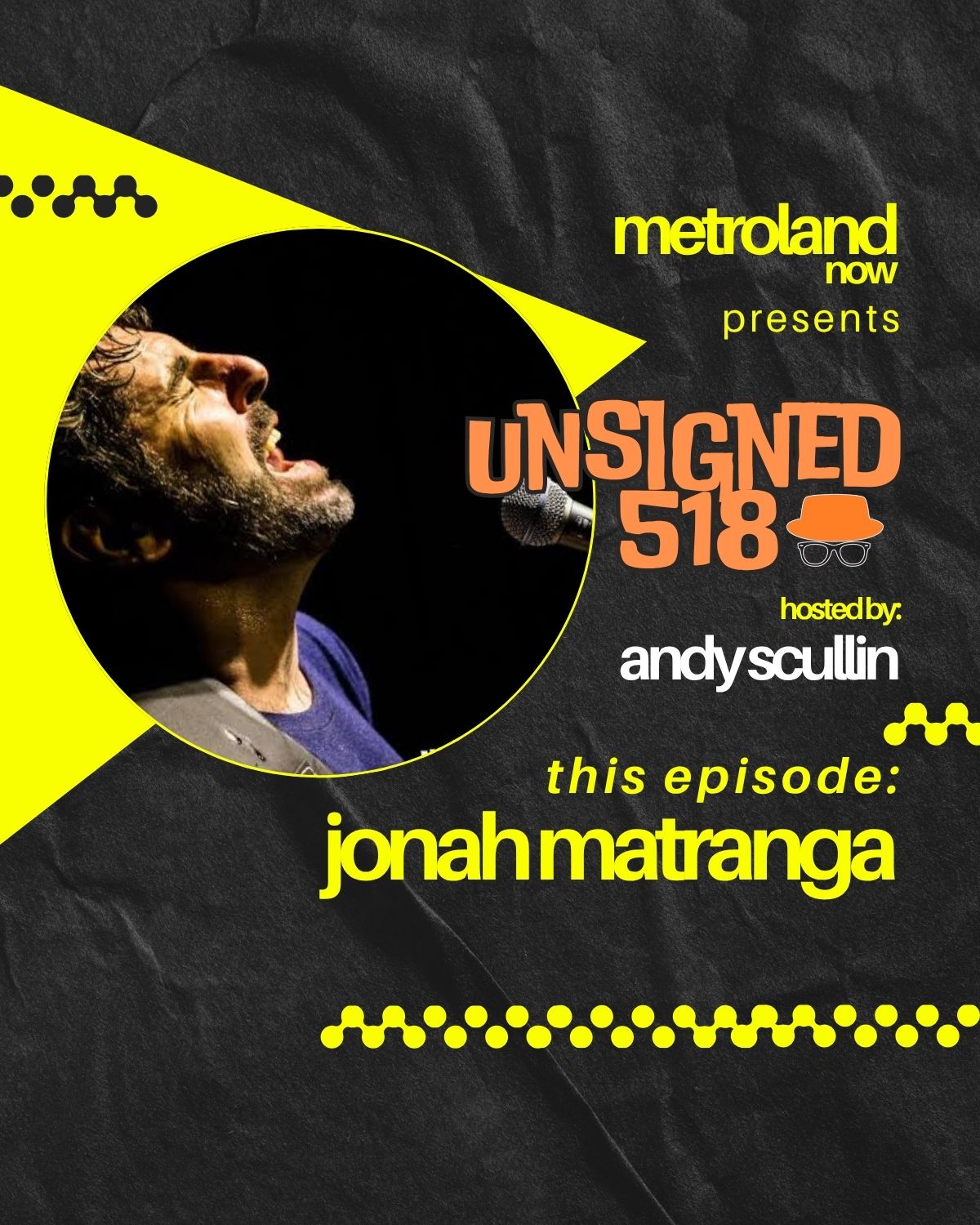
[00:00:00] Speaker A: Welcome to unsigned 518, this very special episode. I have literally one of my favorite musicians of the last several decades, Jonah Matranga on the show.
Their work with the band far was some of the most important music to me, you know, in the. In the late 90s through the early 2000s up to now, basically. It was amazing the effect that this music had on me and I've been a huge fan. So to be able to just have a conversation with Jonah was amazing. So you'll definitely notice in the beginning, I do sound nervous. As I was editing the episode, I could 100% tell that I was nervous. But as the episode went on, it smoothed out a little bit. And I feel like by the end of the conversation, Jonah and I were friends.
We had a great conversation. It was really cool. Everything that I hoped it would be. You know, they say don't meet your heroes, but in this case, it just. It just really worked out. So I guess without further ado, we're going to get into the episode with Jonah Matranga. It kind of will just pick up kind of mid conversation as I'm giving the. The. The breakdown of. Of the show and then it just rolls into it, which is kind of why I did this intro. But anyway, enough of me. Let's get into it. Jonah Matranga on Unsigned.
[00:01:29] Speaker B: He was born on a Saturday in 73 he loves punk rock music. I need the 13 jabbing in the dazzle Jazz rocking out on the beats Guitar with the short wind radio back his motherfucking Andy Sculling look at my pocket cause here it comes Andy Sculling wearing his or his hat.
[00:01:56] Speaker A: So now we are. We are on.
And basically when I was talking to Rachel and you know, she hooked this up. When One line drawing has new music coming out, we are going to do an actual legit review. Once I have music that I can review. And I'm going to do that for print and everything.
But basically this is just going to be a conversation.
I do a weekly music conversation with artists, mostly local, but kind of wherever.
And like I tell everybody, I want you to feel like this is your episode.
This isn't an interview. I do not have any questions.
We're gonna kind of just. Just talk. But I do want to just start it off just to get this out of the way.
[00:02:48] Speaker C: Is.
[00:02:48] Speaker A: It is no understatement to say that you and far and One Line drawing has been some of the most important music to me personally for my growth as a human being. Like, it is to me. It's music that transcends sound and art, and it literally helps me become a better human being.
I found far.
It was unfortunately just after you disbanded.
And when I say, like, just after, I mean within months.
A buddy of mine had given me, you know, and I was a big Deftones fan. I'm still a huge Deftones fan, but at the time was a big, you know, Deftones fan. And my buddy had given me a tape and been like, you love Deftones. You're gonna love this band. And I, like, fell in love. It was.
It was tin cans and water and solutions, and those two albums became my absolute everything. So getting that out of the way, that's just to let you know how cool of an experience this is right now for me to be able to talk to you. So with that out of the way, I kind of want to open it up to allow you to get some thoughts out.
Obviously, with new music coming up, we've heard some of it and it is.
[00:04:18] Speaker C: Yep. Just a little. A minute and 47 seconds worth. Yeah, yeah.
[00:04:21] Speaker A: And I've heard that minute and 40 seconds probably about 40 times.
[00:04:27] Speaker C: That song loops pretty good because it kind of ends before anyone thinks it's gonna end. That's like. Okay, let's go back to.
Yeah, I love that song.
[00:04:35] Speaker A: Yeah, it's. It's great. I'm excited for new.
[00:04:37] Speaker C: I was gonna. I was gonna. I mean. Yeah, so we're talking about this song. This is the warning.
And I.
I definitely.
I thought about doing a bridge for that or something like that, but sometimes the song is just done. And honestly, that I'm releasing a song that's under two minutes, I feel very 1979 post punk. I'm pretty into it.
[00:04:59] Speaker A: And how was the. Like, the writing? Not that it sounds different than previous one line drawing stuff, but to me, it does. Like when you said 1979 in under two minute, like, it feels.
It feels like it was written in, like, the 90s or not even written in the 90s, but it feels like it has that, you know, I'm right around the same age as you. Like, it feels like, you know, something from, like our early 20s. Like, it has that urgency and that, you know, something needs to be said. Is that. Was that an intentional thing or is that just what's happening at the moment in, you know.
[00:05:39] Speaker C: No. Yeah, it's never intentional. This song has been with me for 10 years plus.
Yeah, I think this might be true for. I don't know if it's true for a lot of songwriters. And. Wait, let me Just circle back real quick because it does kind of address all of this in a way and say that the thing you said about the music.
First of all, transcend is one of my favorite words. I love artists that transcend genre. I love art that transcends art. I love sports that transcend sports. I love when, when any one thing becomes a universal thing.
And again, I don't plan for that. It's not my intention with the music or anything.
And I've never. I'm in love with music. I am as in love with music as anyone who has ever heard any of my music. So when people say they love it, I think I know exactly what they mean because I'm a person that completely falls in love with music.
So I dig that. And I guess as I've gone on in life, for me it's. It's not even. There's just a feeling of devotion and love that I feel a lot when I'm singing or listening to music.
I think that other people feel when they're, when they're playing sports or some other people feel when they're doing whatever it is that they love to do. Being a teacher, being a plumber, being a lawyer, being a dancer, being. It doesn't matter.
There's just something about devotion and surrender and it's all to say that. And of course, you know, those two words are very religious sounding words. So for some people it's religion and a lot of people give that a bad name and it certainly can be awful.
But frankly, obsession of any sort has its dangers.
And for me there's really just either choosing surrender and mystery and love or there's choosing like fear and uncertainty and just sort of anger and a lot of things that get chosen. So it's all to say that if anything I've ever been a part of has helped anyone have a more peaceful, joyous, free, less shame filled, more curious life. And frankly, I think I will say, especially those of us that will would either be identified as a male and you know, traditional gender things, or identify as male or whatever it is.
I'm so fucking. I'll say it simply.
Burly dudes that fucking have loved my music are my favorite because they are invited, generally speaking, to a party that is much less vulnerable, that is much more violent, that is much more just stoic and. And not stoic in the good way, but stoic in the repressive way.
[00:08:32] Speaker A: Right?
[00:08:33] Speaker C: And it just warms my fucking heart to hear of people having this music in that way in their lives. So I Just wanted to just not let that go by. Because the way you said it, it's not just that you're kind about it, but the way you said it is everything to me. And extending from that, I'll say that, yeah. There's no songs I've ever written that were ever a song for a project or for a thing.
There are songs that I tried to show to far in the mid-90s that didn't end up coming out until the mid aughts because Far didn't like them and they didn't. It just didn't happen to fit into that time. But for me, the songs are always just arriving, thank goodness.
And so this is a warning to circle all the way back to that one.
Is one about. Yeah, it's about a level of desperation and an overwhelm, which is a feeling I feel a lot. And songs that help me through that. I mean, that's how these songs come to be, is I'm just trying to get myself through this shit.
And somehow they arrived to help me out. And so, yeah, this one's been sitting around a long time. I actually wrote it from the perspective of a character.
I was working on a movie at the time, a short film. I've had this. This idea in my head for over 10 years now that's either a book or a movie or a show or something. I've tried a graphic novel, maybe a video game. I've tried it in some different forms. But long story short, there's a character in it. The central character is a musician, I suppose is sort of close to me, sort of based on me or whatever, but not really at all. It's just. There's some superficial resemblances, I would say, but this is a character who's been through more than me. More. More horrors than me, more trauma than me, and who didn't find or seek out the support that they needed.
I'm a person who really believes in that phrase. Hurt people, hurt people. I don't think there's evil in the world. I just think there's pain that gets passed along from generation to generation. And it mounts and it gets to these horrifying levels where a person is hardly even a person anymore because they're so taken over by their trauma.
And that, as we can see in our world, can go a lot of ugly ways.
So this person that I was writing in the voice of when I wrote this as a warning or when the song appeared or whatever fuck happened, however songs work it, this was their. The first alarm bell that came out of that person's mind, that character's mind.
And there's another one on the record coming up. The next single or whatever is going to be called Failures Virgin and it's a fucking weird one too. And that one I know is from the character's mind and has also been sitting around for a while.
So to get back to your thing of what is this record about? Why. Why these kind of 90s sounding songs? The funny thing is this movie book, whatever the character is indeed from the 90s.
It's a little bit. It's kind of a character who.
This character was in a band that got bigger than any my bands ever got.
So this character had a taste of fame and that's also part of what fucked them up so much.
One of the things I'm the most grateful for in my life is that I've never had that just that crazy 60,000 person arena, blah, blah, blah, like fame, fame. And I'm sincerely, completely grateful because I have seen that level of success, frankly in any industry, but music is the one I know the most.
Destroy people.
[00:12:22] Speaker A: Yeah. That actually is something that terrifies me. Like it always has. Like, I've never wanted like even like doing this. Like what I do, you know, gives me a certain level of visibility, but it's mostly local and like I sometimes get fucking terrified that
[00:12:44] Speaker C: anyone has had a taste of public notoriety.
[00:12:47] Speaker A: Yeah.
[00:12:47] Speaker C: Especially in this day and age. It's, it's. I mean, if you get off on it, cool. And some people are built for it and they really thrive. And I, I admire those people and even envy them sometimes. I do not.
[00:12:58] Speaker A: No, my anxiety would never allow that.
[00:13:00] Speaker C: Yeah. I like being. I mean. Yeah, it's.
It's funny though, as an artist. I mean, any one of these songs and this would be a cool thing. It'd be a cool problem to have.
Could become all over the world in ways I could never possibly understand.
Anything I say or do, anything you say or do. We could trip on the sidewalk and hit our heads on a banana and someone would make a meme and all of a sudden you know I mean it.
So this can happen in a lot of ways. So long story short, this character who kind of is the character that is saying this is a warning is someone who has had a taste of that and it broke them basically. And now they're sort of trying to pick up the pieces and they just don't have the resources. They've had all this privilege and all this entitlement and all this stuff that comes from success. But it's all papering over this really intense trauma. And so when you see all these artists that commit suicide or get really rapey and horrifying and, you know, just. Just all the things that have happened in rock and roll.
And again, I would say in any industry where there's a lot of wealth disparity, power disparity, this tends to happen. But we're in music, so here we are.
There's a reason that stuff happens again, I don't think people are evil. I don't think anyone got taken over by the devil at the crossroads. I just think there's a lot of entitlement and a lot of trauma.
And then once a success gets going, then there's managers and agents and artists that want this person to keep going. And maybe they even want to continue their headline behavior because it's making everyone
[00:14:36] Speaker A: more money and then everybody telling you yes, it's very hard to tell yourself no, or to even hear no or even to hear fucking maybe from anybody.
[00:14:46] Speaker C: I mean, we talk about. We talk about consent. And for me, when it comes to, you know, this, this, the me Too culture and all this reckoning we're doing, it's all about consent.
And when there is a huge power imbalance, again, with fame, with money, with power, it really. And when there's a bunch of trauma involved, much less when there's substances involved and intoxication involved, consent becomes kind of impossible.
[00:15:12] Speaker A: Right?
[00:15:13] Speaker C: On any level.
And yeah, when I'm shit, one of the reasons that I'm not, you know, potentially as famous or whatever is that I've said no to a lot of things, and I didn't say that of any righteous thing. I just. A lot of times I said it because I was like, no, that scares me. I think I will break, basically.
And that has limited me in some ways in life. And also I think it's freed me because again, I look around at people more successful than me who do what I do, and they've said yes to a lot of things.
And when people start saying yes, it gets harder and harder and harder to say no.
And one would think that as the money piles up, but eventually, again, when there's all these hugely powerful entities around an artist saying, go, go, go, go, go, go. Keep fucking it up. Keep doing the things.
It. It's really tough to say no.
And, yeah, I think honestly, that's what the character that is involved and this is a warning was thinking about was just.
It's a very disoriented song. And I think a lot of success and a lot of trauma can equal a lot of disorientation. And to circle back to present day. I think the song is a universal freakout song as well.
And it's a song that does speak to this moment.
It just the anxiety in the song that. Just the nervousness of it is.
I think it speaks to these times. And I didn't mean for it to do that. It's more like the song showed me how I was feeling, maybe inside these days.
And so I let it out. And there's a middle part in this is a warning right after the first chorus where it hits this halftime breakdown. A. It's a halftime breakdown that's so fucking 90s, which I just adore. The original halftime breakdown that I love is Texas is the reason if it's here when we get back, It's Ours, I believe is the title. It's on their ep. And that halftime breakdown is, to me, that it's the top of the mountain.
And so I did this one, like, as a little homage to that one in some ways. But also it was just. That's where the freakout explodes and the anxiety just, like, just spills over. And a guy called Denver Dali, he does a thing called Statistics. And he's done a lot of things over the years, but he sent me some guitar parts of the record. And I took a guitar part that wasn't for that part at all and basically flew it over to that part.
And so that chaos, that cacophony that lasts about nine seconds is this person's anxiety breaking. And I hope it's a time when people can just let their bodies just lose control.
Because for me, that's what animals do when they have trauma. And that's what more people, I think, should do is just lose their fucking shit. And that's one thing that I think loud music is really good for.
[00:18:15] Speaker A: And I think that's something like, you know, I'm like, in my era of no.
Because I've to build, like, what I've got now. Like, I've done this all myself.
I'm sitting out in the middle of horse country, like an hour from Albany. Like, I'm out in the middle of nowhere and I've built all this from my room. I call it the Dazzle Den because I think the word man cave is sexist and implies that. Like, that's. But that's a whole. That's a whole other story.
[00:18:46] Speaker C: Can we call it the Creature Cavern? And we got a creature.
Let's do that.
[00:18:50] Speaker A: Yeah, but, like, I, I've said yes to so many things, to absolutely everything where it's basically gotten to a point where I can't say yes to anything more and it breaks my fucking heart. You know what I mean?
[00:19:03] Speaker C: Yeah, but that's called, that's called an addict hitting their bottom in sobriety. Is that you hit the point like, oh, I've said yes to so many things. Like, it's actually, if I say yes to more, the, the returns will be diminishing. I will start over promising and under delivering. So good on you. I probably said no too much in my life, so I'm working on actually bringing a little more yes into my place. I'm so reflexively protective. So I love that you found though that you were saying yes too much and you had to just. So.
[00:19:32] Speaker A: Yeah, but it came from, it came from a freak out. Like, it literally came from like too much, too much in. And I had like a little bit of a, like, you know, luckily it was with a good friend but like I, I let one of my good friends know everything, you know, I was like, hey, I'm just going to tell you all this trauma that I'm having and it was a fucking freak out and he helped me through it. And from then I'm like, okay, now I'm going to start saying no to some things because I need to like, you know, need to focus on what's happening here.
And yeah, and, and plus, I'm like, you say sobriety. Not like I was ever, it was never like a huge issue, but like I quit drinking a couple years ago.
[00:20:13] Speaker C: Yeah, I use sobriety in the broadest possible terms. Any word, religion, politics, sobriety. I know they have specific context, but I use them all in much broader ways because I don't think there are these separations. Yeah, that's sobriety.
[00:20:28] Speaker A: But like not having alcohol in my life has been one of the fucking greatest. Like, and it wasn't a problem for me, but it was a problem for my body.
Like, you know, I was, I had turned 51 and like I was having heartburn and I was like, this is not fucking fun. You know, I mean, it's not fun. And so I just, it's not cute anymore. It's not. And like I remember and it. One thing that really helps, I remember when I was a little kid, like, I don't know, maybe 10 or 11, seeing adults drunk, I was always like, isn't that like a kid that, you know, like, I was like, what, there's a 70 year old man who's fucking hammered, you know, And I was always like, you stop. You stop at some point. Right? Like, you know, no.
[00:21:13] Speaker C: And see, again, those moments, I just want to say, those moments of clarity, those moments of awareness, those are life shapers.
[00:21:21] Speaker A: Yeah.
[00:21:21] Speaker C: Some people don't have that. Some people don't know when their body is breaking down and they can't. They don't connect to the drinking or they won't or whatever it is. Some people don't know when they're saying yes too much. Some people don't know when they're saying no too much.
[00:21:33] Speaker A: Yeah.
[00:21:33] Speaker C: And those are people who die.
[00:21:36] Speaker A: Right? Right. And it wasn't just the drinking. Like, it was also dying. Like, I needed to get rid of a lot of things.
[00:21:44] Speaker C: Anything someone does, whether it's sex or food or drinking or drugs or fame or whatever the people are chasing, this is a medication. We're trying to heal ourselves. Again, we're not trying to hurt ourselves, and we are, but we're trying to help something. It's just that it's like we're. We're in a hole and instead of reaching for the rope, we pick up a fucking shovel.
[00:22:06] Speaker A: Right.
[00:22:06] Speaker C: You know, and it's just. It's just sort of the way it goes sometimes. So good on you. You. I've heard two amazing moments of clarity that I don't want to go by. Because this is the stuff where we. I mean, shit, we're in our 50s, right?
[00:22:20] Speaker A: Yeah.
[00:22:21] Speaker C: So I just read a book called Life Reimagined. And the crux of the book says how we treat ourselves between 40 and 60 disproportionately affects the statistical likelihood of us having a cool life past 60. Like, because that's where the body starts breaking down, it's where the brain starts breaking down. It's where the heart starts breaking down. And I mean, the emotion center starts breaking down. And so move it or lose it becomes a real fucking thing.
That's so way to be.
[00:22:48] Speaker A: Way to be the moving and, you know, like, since not like I'm like, you know, now like super fit or whatever, but in the last.
[00:22:55] Speaker C: Not about that.
[00:22:56] Speaker A: In the last, like two years, I'm 40 pounds lighter than I was.
[00:23:00] Speaker B: Wow.
[00:23:01] Speaker A: You know, I'm. I'm feeling like, I'm.
I'm feeling like I should have felt in my 20s and like, it, it does with me a little bit to be like, you know, I spent a lot of time, you know, getting hammered and drinking beer with my buddies. And like, I, I really wish that like 53 year old me could talk to like 23 year old me and be like, dude, stop now.
[00:23:25] Speaker C: You know, I am, I'm so grateful for my dad that drank himself to death and some of my friends that really fucked themselves up because they showed me some cautionary tales that I couldn't look away from. I mean, I got, I was in high school getting, I was on probation, I was, I was almost in jail. Like it was a, it was a crazy time. And so there was a lot of drinking and a lot of every drug then.
And I was watching my dad drink himself to death from, you know, from a long distance. I hadn't seen him in a long time. And somewhere along the line I figured out, hey, this isn't for me. And so I quit everything for a long time, 20 years or so. And of all the things, I'm so grateful that I quit alcohol at 16 because it's no moral judgment, it's no whatever. It's just that I've seen alcohol in particular just absolutely fucking destroy lives. I've got a friend right now who I love so much who is in, as far as I can tell, the late stages of alcohol addiction and is either going to die or is going to turn it around. It might even be too late for their body. I don't even know. I don't even think they know. But I just. Alcohol in particular, I just. If I could say one thing, if anyone could switch their alcohol habit to like a reasonable weed habit, I know it's still a drug.
Okay. I think it's a real net positive for mental and physical health. I think industrialized weed can also really take people out these days. Sure, sure, there's, there's THC and concentrations that I never knew about in the 90s.
But that aside, you can just smoke a joint with your bros instead of having a case of heinies or whatever. Like that's gonna be a better deal.
[00:25:06] Speaker A: Yeah. And for me, like, I'm a huge cannabis advocate and I, I kind of always has been. Have been because I look at it as a plant, first of all. Like, you know, it's something that, that, that grows from the, you know, and obviously there's levels of. And there's. Yeah, it affects people in different ways too. Like some people smoke a joint.
[00:25:28] Speaker C: You're not talking about shatter, you're not talking about dabs, you're not talking about 25 milligram edibles, 100 milligram cookies. Like those shit you.
[00:25:38] Speaker A: Yeah, they definitely would.
[00:25:40] Speaker C: Yeah. In my adult life, I've experimented with weed and sort of seen if I could have a life with it, you know, as a grown up.
And it's been really neat. But every, anytime I've tried any of the really hyper concentrated new forms of weed.
[00:25:54] Speaker B: Holy.
[00:25:54] Speaker C: Yeah. Even like the enhanced joints with, with some. I don't know what the they put in them. It's like getting punched in the face. Oh my God.
[00:26:02] Speaker A: Yeah, there's, there's certain, you know, like certain levels obviously, like some, some levels that you know, and I've, I've seen
[00:26:09] Speaker C: like, like again, I'm just talking about a 70s joint. Just smoke a joint with your friends. Like, you don't need to get out a blowtorch to hit some crazy black.
[00:26:18] Speaker A: Only I've only done a dab one time.
And, and, and I was like. It was backstage at a show and we were like. My band was getting ready to, you know, and it was like hours before soundtrack. We're setting up, nobody was there. We're backstage and these guys like. And I'm like, what is that? And they're like, oh, you know, doing that. So I took it, took up what I thought was just a regular old bong hit. And as I walked out backstage onto the stage, I was standing on the stage looking at this empty auditorium and there was literally like two seconds of my life where I was like, where the fuck am I? And then I was like, oh yeah, yeah, yeah, yeah. But like it was like a really scary 2 seconds to be like, I'm on a stage and I don't know how I got here.
[00:27:01] Speaker C: But you know, I have only tried being high once or twice because. So I didn't get high at all during, during the night. I think the first time I got high as a grown up was in the mid aughts or something like that.
And I tried getting high. There's one particular time before a far show. It was before the far reunion shows, sometime 2009 or 10, where I was hanging out with a friend and we just got a little too high and it was kind of an outdoor festival. This will be fun. And it was fine. I think the show ultimately was fine. But I didn't feel, I didn't know where I was. Like I. I knew where I was, but I didn't feel present at it. So I don't now. I just don't. I don't with it around performance, around whenever, around that. Not again. Not for any moral reason or. There's no judgment on anyone. It's all just personal.
But yeah, I can, I can, I can Imagine that moment. And I'm glad you made it through.
[00:28:01] Speaker A: And like I said, luckily it was hours and hours before the show. So by the time the show came, I was. I was fine, but I was like,
[00:28:07] Speaker C: yeah, no, I got super high, like, right before the show. It was not as good.
[00:28:12] Speaker A: Yeah. But, yeah, and the good thing too about weed is that, like, I feel like it's.
Even though, like, there can certainly be moments of where am I? What's going on? It's at least a. Safer than some. You know what I mean? Because I've never fucked with really any hard drugs or anything. So, like, I can't like, say, oh, yeah, it's just like this. Because I don't. I don't know, but like, I've never felt, oh, shit, I'm gonna die. Like, from.
[00:28:42] Speaker C: Yeah, well, that's, that's. That's. Oh, that's opiate.
[00:28:44] Speaker A: Yeah. Which I don't.
[00:28:45] Speaker C: Cool thing about weed, even if you think you're gonna die, you're not ever gonna fucking die from weed. You're never gonna. So as long as you know that, you know, which I know it's hard to remember in the moment sometimes, you know, if you ate too many fucking brownies.
But no, I. To me, I just. I love that we're talking about substances again. I don't. I think substances are just. It could be any number of things, any number of addictions, which are all. Could also be passions, which could also be compulsions. It's all very confusing territory. But on a bumper sticker, I would just advocate for moderate, mindful uses of weed and psychedelics and leave the rest of the shit aside. Alcohol, fucking opiates. I've tried it all. You know, I haven't done needles, but ages of 12 to 16, I did as many drugs as people are going to do in their entire lives and. And got a real good sampler platter of how those things bear out. And then since I've grown up watching people do it, just powders, pills, man, just stay away. Hear the fuck clear.
[00:29:51] Speaker A: I would say, yeah, 100%. 100%.
[00:29:54] Speaker C: Anyway. God, how do we get here? What are we doing?
[00:29:56] Speaker A: I don't know because I told you we. I don't have any plans.
[00:29:59] Speaker C: Joe Rogan show right now.
[00:30:00] Speaker A: Should we start talking about. No, no, we are not.
I do not share those with you.
[00:30:05] Speaker C: No, let's please. Thank you. And you are not platforming a bizarre fucking anti Semitic, homophobic fucking maga. Whatever the.
[00:30:12] Speaker A: I have, like, you can't really see, but I have rainbow Flags and trans flags and rainbow neons all over this room. So good.
[00:30:20] Speaker C: Let's, let's keep showing up for that shit. This whole let's remember that the anti woke thing is just like the anti peace thing in the 80s and 90s. It's a thing that was cooked up by the far right, divide the left and have us start pointing fingers at each other. That Spider man meme and the whole thing. And just, let's just take it easy and take care of each other. It doesn't need to be a big deal.
And again, let's circle back to the music. Like that's literally always what the music has been about and why I loved what you said so much at the top is because I've always wanted to make music and have shows where everyone's invited and I can feel safe, that everyone there will feel some degree of safe.
[00:31:03] Speaker A: Correct.
[00:31:03] Speaker C: I mean, we all know that rock and roll is an overwhelmingly white male situation, basically.
[00:31:07] Speaker A: Historically we can still show up and be allies.
[00:31:10] Speaker C: White, straight, male. Yeah. But yeah, we can come. And one thing I think hardcore did, even though hardcore is amongst the most male white fucking ridiculous in its worst versions, punk and hardcore did break that down and there. And it did make it safer, frankly for lots of different people to be at shows. And so my favorite thing, my two favorite things are playing festivals and also playing in shows where there are bands or people or something about the place that just makes it inherently more diverse in terms of melanin for sure, but in terms of gender, in terms of just everything. I like when, I like when young people and old people are at shows, I just love when everyone's there.
[00:32:00] Speaker A: Because then again it transcends because it's beyond music. If a 15 year old and a 60 year old are hanging out together that isn't just, oh, we like the same sounds that it goes, it goes
[00:32:12] Speaker C: beyond that and it's not about making it PG and catering to the little. Like it's not about catering to anyone. It's about making a noise and doing a thing that just is welcoming. And again, it's hard to me without pandering to do that intentionally.
I just happen to believe that if a person truly, truly, truly does, like if I do what I really, really fucking love, then whether or not the person likes it or not, whether or not it's their kind of music or their kind of scene, I really think that it is transcendent.
When you're seeing an animal do what it loves. There's something that hypnotizes all of Us. So I think when I'm really lit up doing what I love, that's what helps people feel safe. So any artist, I don't think it's about clothes or metal or folk or. It's not about any of that stuff. I think it's about people being up there just shining and being free. And that's an attractive thing. And I think it gives everyone in the audience a taste of, like, ooh, I could be free too.
[00:33:19] Speaker A: Right.
[00:33:20] Speaker C: Whatever it is in me that's not free. Maybe. Maybe that.
And if there's any way that I would like to pass along anything, it's just that freedom is an inside job, I think. And if I can pass that along, then. And. Good.
[00:33:36] Speaker A: Awesome. Well, we are actually. That's a perfect way to wrap up because we have about a minute and a half left of the zoom call before it's going to shut me down.
[00:33:45] Speaker C: Thank you so much for keeping a governor on this, because you and I haven't been talked for, like, 18 hours.
[00:33:51] Speaker A: I was going to say I didn't even scratch the surface of things.
[00:33:55] Speaker C: I know.
Well, this is good to meet you.
[00:33:58] Speaker A: Yeah, you as well.
[00:34:00] Speaker C: And I just thank you for your kindness, just.
And taking the time. I mean, in this day and age, people that give a shit about the music enough to make their creature caverns, their animal abodes into things that can help platform music and art, it means more to me than I could ever say.
And it was a really fun talk. I had no idea where it was going to go, so I'm happy you went there.
[00:34:28] Speaker A: Well, hopefully it's not the last time we talk.
[00:34:30] Speaker C: Yeah, well, it is definitely not. Anytime you want to talk, legit. I mean, this for real, too.
You got my info. Now say hi anytime offline. I don't give a fuck if the cameras are rolling.
[00:34:40] Speaker A: Yeah, cool.
[00:34:42] Speaker C: And. And then, shit, when you hear the rest of the music, I can't wait to hear what you think. Yeah. A record that.
It is the loudest record that I've ever done as a solo artist. And it is, to your point, it is kind of 90s. And I swear to everyone that's not me trying to jump on any, you know, the bandwagon that I kind of help start or something.
It's just an animal doing what it loves. So, yeah, thanks. Thanks so much. For you.
[00:35:06] Speaker A: Awesome. Yeah, thank you very much, Jonah. And we will talk super soon.
[00:35:11] Speaker C: See you soon, brother. Bye.
[00:35:13] Speaker A: Bye.
Sun Sign 518 is produced and hosted by me, Andy Scullin. New episodes are available every week, wherever you see.
If you would like to help support the show, please like and subscribe wherever you are listening. Or you could buy me a
[email protected] unsigned 518 if you would like to advertise on the show, send me an
[email protected] and to be a guest on the show, reach out to me through Instagram at unsigned518.
Take care of one another and I'll see you next week.