[00:00:01] Speaker A: He was born on a Saturday in 73 he loves punk rock music fighting the 13 jabbing the dazzle Jazz on the beat Guitar with a short with radio bat his motherfucking Envy SC Motherfucker. Cuz here he comes Andy Sculling wearing his or his hat.
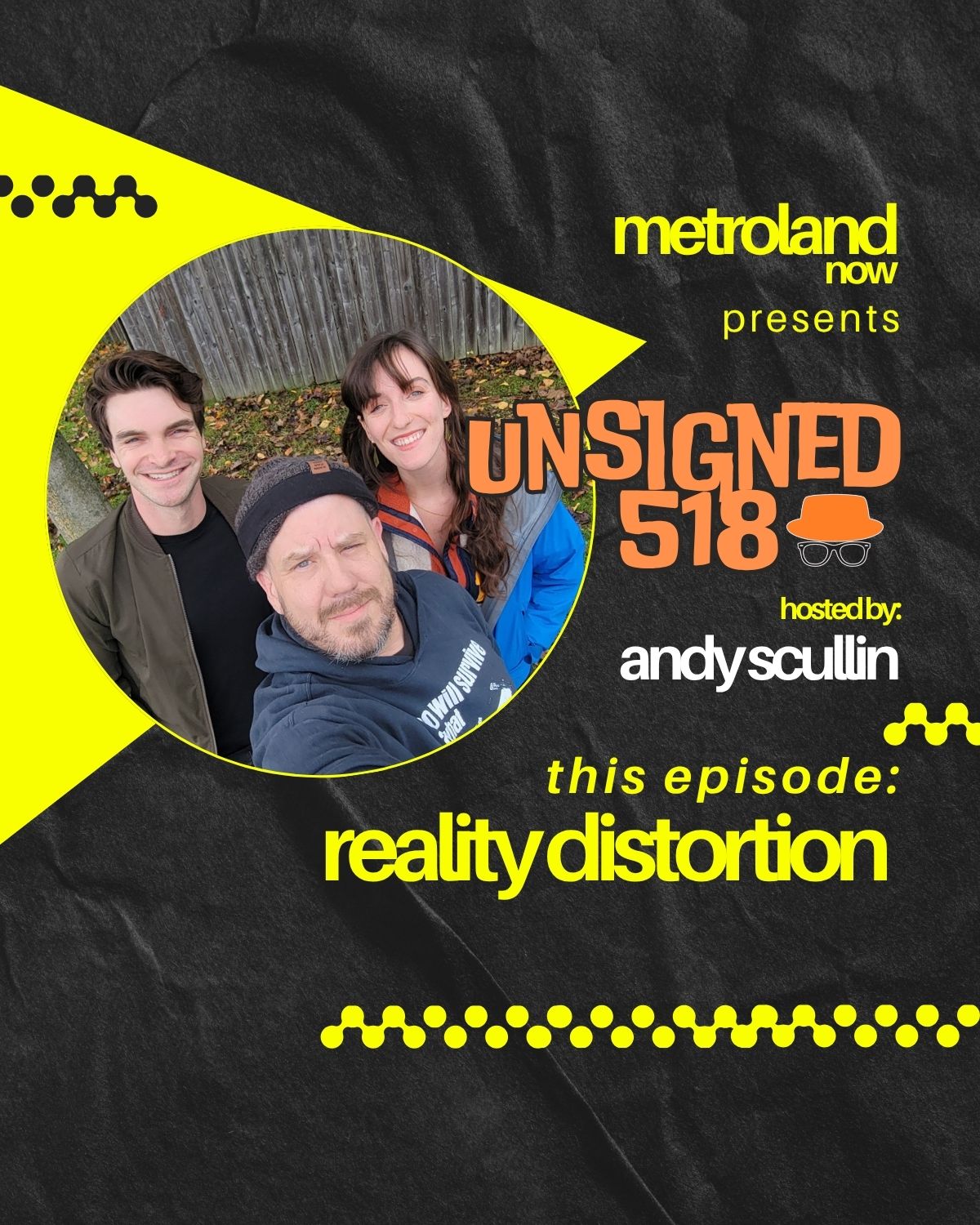
[00:00:27] Speaker B: Welcome to unsigned 518. I'm here with Linnea and Devin, also known as Reality Distortion. How's it going?
[00:00:35] Speaker C: It's going great. It's a bring your own sunshine guide today.
[00:00:38] Speaker D: Good. We're happy to be in the dazzle den. Honestly, I need this amount of lights on a day that's this gray. It's fabulous.
[00:00:44] Speaker B: It is one of those days where it's very fitting to be in here. And I have a lot of. I always say, like when I'm really busy, that basically just means I'm in the dazzle den all day.
And today is one of those days where everything that I have to do is in here. And I'm like, it's the perfect day
[00:01:01] Speaker D: to
[00:01:01] Speaker B: be in a dark room. You know,
[00:01:03] Speaker D: I always want our studio to look like a lamp store. Like it's kind of like, is it a music store or a lamp store?
[00:01:10] Speaker C: And there's not
[00:01:10] Speaker D: a
[00:01:11] Speaker C: big light in sight.
[00:01:13] Speaker D: No,
[00:01:13] Speaker B: yeah, big lights out I do have because I mean, as you can tell, it does kind of play double duty. There's some boots and coats over here. And my wife is very short. So every once in a while, like, especially when no one's here, I do have to put the regular light on in here so that when she comes in and hits the light, it's actual light. Cuz so many times she's like, babe, can't reach. Can't reach. The, the. The pull string. I'm
[00:01:38] Speaker D: jumping. I can't get
[00:01:39] Speaker B: it. Even jumping. She couldn't get it. She's.
[00:01:41] Speaker C: I'm just realizing this now because we both don't like big lights. But yet our, our show is filled with the biggest lights and the brightest robes.
[00:01:50] Speaker D: But they're not like overhead, not overhead. Cold tone for lights. They're like purple and blue vibey lights
[00:01:58] Speaker B: and like fluorescent lights. Like white fluorescent light. I am, I am 100 convinced kills creativity. And that's why it's in like offices because they're just like, we don't want you thinking creative. Yeah, just put the data in the computer and shut up. You know, like
[00:02:14] Speaker D: get your khakis on here. Yeah,
[00:02:17] Speaker B: yeah, same with khakis.
But anyway, we
[00:02:21] Speaker C: have black pants every time you see us,
[00:02:22] Speaker B: right? Yeah, because no
[00:02:23] Speaker D: khakis, no Fluorescent lights. It's our motto.
[00:02:26] Speaker B: I love that we. We want to talk about. You know, I guess I said whatever you want because it is your episode. But. But I guess we'll. We'll start it off with music.
[00:02:36] Speaker D: Yeah.
[00:02:38] Speaker B: In my. On my radar.
It's like, usually, like, bands start with, like, little pings.
You know, I'll get a little sense of something with. With you two. It was literally, like, I heard your name one day, and the next day I heard your name 47 times. And I was like, huh? Like, did
[00:02:57] Speaker C: you meet our mom?
[00:02:59] Speaker B: No, I did not. It had nothing to do with payoffs or nothing. Not
[00:03:03] Speaker D: a momager.
[00:03:04] Speaker B: Interesting. Not a momager. But it literally, to me, felt like that where it was, like, one word, and then the next day you were everywhere. And I think that there's interesting. It is interesting, and that's why I'm excited to be here talking to you now. And I want to hear, I guess, like, your.
I don't want to say take on, but, like, your. Your motto or your method, I guess your method to putting this music together and getting it heard and doing your thing. And, I mean, I feel like saying, how did it get started? You know, that might be an obvious answer with the sibling connection. Correct. Like, you know, yeah,
[00:03:46] Speaker C: anything. We love the creative process and talking about it and the release is just a small part of the creative process.
[00:03:53] Speaker B: All right, then I guess a question I would have is, as siblings, at what point did you say, let's do something with this?
[00:04:02] Speaker D: So I think that's the funny thing that you're like, oh, it just popped onto the radar. And I see this with bands all the time where it's like, you go, oh, wow, they're so good. And they just put out a song this year, and so they must have just been a band for, like, a year.
[00:04:13] Speaker B: And they've been a band for 20 years.
[00:04:14] Speaker D: We've been doing this for 10 years. We had a different band name, and we've been very good at keeping music on our hard drives and also doing, like, one show a year for most of that time.
But, yeah, we've kind of. Devin is five years older than me, and we have a wide range of musical influences, but when I was kind of, like, 15, 16, and getting into EQX and getting into all the, like, alternative rock and figuring out, like, my personal taste in music, we. We kind of realized that it overlapped a bit and went to a couple shows together. And Portugal, the Man at Pearl Paloozo was like, one of the big, big Influences. And then we went to go see the Strokes at Gov Ball. And after that, we were kind of just like, oh, my God, I want to do something like that. Like, it just. It's always been this feeling that music is it. It.
I have so many notes scribbled in random places where I was like, this is the most important feeling in the whole world. And I don't know what to do with it. But I know that this is the thing that makes the most sense and it moves me the most.
[00:05:23] Speaker C: So for some context here, if I may, Linnea is, like, the ultimate super fan. Like, any band dreams of having a fan like Linnea. She's, like, always
[00:05:33] Speaker D: front and
[00:05:33] Speaker C: center. Like, even though she's taller than everyone, she knows the lyrics. She's singing along. She has set lists to, like, every band that are signed.
And that's
[00:05:45] Speaker D: our
[00:05:45] Speaker C: studio. She's the superfan. This is, like, where it begins.
[00:05:49] Speaker D: Yeah, but then it's, you know, like, I had always kind of liked singing. I did musicals and stuff, like, and Dev was in bands. And then after my freshman year of college, we were like, oh, what if we, you know, like, I was home for the summer and he was home for the summer, and it was just like, oh, let's make some sounds. Let's see if we can do some stuff. And we ended up putting together a little ep.
And then, you know, it's been on and off over the past 10 years pretty much. But I think, like, four or five years ago, we started really, like, doing a lot more with it. And that's when we started considering a name change, too, because we started just as Bathrobe Robots. We were like, this is a funny little project and, like, a fun little thing. And it's like a goofy little name. And
[00:06:41] Speaker C: it's a goofy little project. And
[00:06:42] Speaker D: it was a goofy little project. Yeah, it was kind of just like, let's make some beepy boopy sounds. And then.
And then it got some traction and we were both like, oh, I think people might kind of like these beepy boopy sounds. And we both really like making these beepy boopy sounds, so.
So maybe we'll do it a little bit more and, you know, play some gigs and see what that's like.
Yeah, so it's been a long, long, gradual, gradual slope to what you described as, like, one day it was one thing, and then the next day, 47. It's been a very, very long, gradual. And, yeah, I
[00:07:16] Speaker B: mean, usually that is the case, you know, with most bands. Like, you know, there's Almost no such thing as, like, a quote, unquote, overnight success because, like, every overnight success has a decade and a half packed into it, you know? But, like, personal radar. Anyway. It was literally like that. Like,
[00:07:34] Speaker D: and
[00:07:34] Speaker C: that
[00:07:34] Speaker B: was
[00:07:34] Speaker C: also very intentional.
[00:07:35] Speaker D: Yeah,
[00:07:36] Speaker B: like, so you made, like, the. The. You did you decide to, like, make a push and be like.
[00:07:42] Speaker C: Yeah.
So there's. There's all of the origin story that you heard from Nay. And then there was also a very specific memory that came to mind of a RY X show in New York City. And I. I remember it to be one of the most moving shows, and it was just, like, hypnotic. It felt like a ceremony.
And I remember being very moved. And I remember that that was where we decided on the new name.
And so that the name change had been kind of like this limbo mode for a while of, like, hey, we know that our music is cooler than when we initially set off to do this, and it kind of deserves a better framing.
And it felt like we had kind of outgrown the Little Joke and felt more comfortable in our skin to where we don't need to put cardboard boxes on our heads.
[00:08:33] Speaker D: We did also have a sticker that said, holy tits, I met the bathrobe robots. Because that was a different vibe.
[00:08:39] Speaker C: It was a different vibe, you know, and then we have these songs that are. That are more mature. Right. And so I remember that Ry X concert being a very clear turning point.
And then we've had a lot of these songs. A lot of them have been revamped. We've grown a lot musically, and we got those to a point where we're like, these are ready to release.
And then as far as the strategic push, that was an entirely different thing. And it was very intentional to be like, you know, what does an overnight success even look like?
What. What would happen tomorrow if we got signed? Like, what are all the things that would happen? And, oh, we get an interview and press releases, and those get turned out to people. And so, like, we turned our mind not away from the creative process, but, like, took that creative horsepower and engaged a new question that we really haven't thought of for most of the time that we've been doing this.
[00:09:38] Speaker B: So it was like, almost like putting yourself in the mindset that, like, you're already at that level where you're gonna need all this stuff and you put it together. And, I mean, you do need press kits and all that. And nobody. I don't want to say nobody, but there's a lot of fan, and it all depends too. On whether you want to make it or not. Like,
[00:09:59] Speaker C: and also defining what making it is.
[00:10:01] Speaker B: Right.
[00:10:01] Speaker C: I think there was also a humbling moment of, like, no one's gonna do it for you.
[00:10:04] Speaker B: Correct.
[00:10:05] Speaker C: Or, like, everyone's dream maybe is someone coming in and doing it. But, like, that's a disempowered dream. No one. I can't expect anyone to come in and care about this more than us.
[00:10:14] Speaker B: Right.
[00:10:15] Speaker C: That'd be cool. But it's a fantasy.
[00:10:18] Speaker B: Yeah.
[00:10:18] Speaker D: Again, it's just, like, such a slow.
It's the tortoise. It's like, it's the constant evolution and learning, and it's like.
[00:10:26] Speaker C: Because there's. She is slow and steady. Don't leave me hanging.
[00:10:30] Speaker D: Because it's like, even within. Within the writing process itself, there's so many different components, and, like, we do it all ourselves. And there's something really, really cool about that, that you can have a crappy mic and record it into a $50 interface. And, like, that's like, the best part about the music industry at the moment is there is no bare. There's no real barrier to entry in terms of, like, writing, recording, and producing your own material. It's time and initiative. And I think that that is, like, that's super empowering. That's. I love that. And as I've gotten more into the production side of things, I see how much it influences the writing and. And as the same way, like, everything. You know, it's also connected. Like, the more we play live, the more I realize these things really connect with people. And they, like. Like when I sing in this way, it. It does really well live where. I wouldn't have necessarily thought to do that
[00:11:23] Speaker B: because you don't
[00:11:23] Speaker D: get that
[00:11:24] Speaker B: feedback.
[00:11:24] Speaker D: You don't get that feedback. So it's like, even so within the. Within the writing process, there's, like, the genesis of an idea, and sometimes that's a melody or sometimes it's a lyric, and then there's recording it, and then there's producing it, and then there's mixing and mastering it. And a big missing. A big, like, part that we were missing for a long time was getting it mixed, which is pretty much like, if you are not in the music industry, it's just.
We're. We hear the song a certain way on our speakers.
That's the way we want everybody to hear the song. But because that's not our specialty, when we play it on the car speakers or off of your iPhone, it's gonna sometimes sound like a bunch of hot turds and that's not generally what we want to be putting out there. So, like, finding, yeah. This amazing mix engineer, Nick Squalante.
[00:12:12] Speaker B: And that's not easy.
[00:12:13] Speaker D: No. And he. And again, we have, like, a specific sound and, like, it's all these things, like getting comfortable in our voices, in our lyricism, in our musicianship, and being comfortable enough going, yes, our vocals can be heard. Don't bury them underneath everything else. Like, they should be a little bit more forward. That
[00:12:31] Speaker C: shift right there is so. So is so different. There's like this internal shift of, okay, I'm ready to be heard.
[00:12:37] Speaker D: Yeah.
[00:12:37] Speaker C: And this is ready to.
To deserve a mix like this. And, like, we're. We're willing to save up and throw down a chunk of cash to do it. Well,
[00:12:49] Speaker B: because, I mean, I've. I've heard known of, like, bands who, quote, unquote, recorded stuff themselves, but then gave it over to someone to mix it and the stuff that they recorded themselves pre mix. And then when you hear that, it's night and day, I mean, it's. It's hard to even believe that it's the same.
[00:13:13] Speaker D: Yeah.
[00:13:13] Speaker B: You know, it's the same content.
[00:13:16] Speaker C: This is like the extra 10% that most people probably wouldn't hear, but they just are like, yeah, sounds like a song,
[00:13:24] Speaker B: right?
[00:13:24] Speaker C: And we're like, yes.
[00:13:26] Speaker B: And for me, like, the first time I ever recorded in a studio realized, like, I had no idea what went into stuff. And like, realizing, like, I'm like, what do you mean? I have to sing the same thing 14 times. Like, you know, like, can't you. And
[00:13:39] Speaker C: that's all production still. That's not even just the mix.
[00:13:41] Speaker B: Right? That's not even. Yeah, yeah. But like, that. The mixing and mastering blows my mind. Like, I can't even wrap my head around it because I just don't. I just don't have the ear for it.
[00:13:50] Speaker D: It's
[00:13:51] Speaker C: a totally different craft.
[00:13:52] Speaker B: Yeah. It's
[00:13:53] Speaker D: one of those things that, like, I don't think it's mirrored in the live way we do things too, where it's like, there's the song as it exists on our studio speakers, which is how we want it to sound. And then there's the mix that happens. And then once you start getting into the live performance, it's a whole beast itself. And there's again, you start kind of. It's a very Sisyphusian task. You're starting from the bottom again, going like, okay, I have this idea and I know what I want it to sound like.
But now I need to go into technician mode. So that's really what a lot of this past summer has been, is getting.
Figuring out a live show that reflects the sound accurately. And so it was like two or three months of just like putting on a different hat. It's, it's, it's. You're doing an entirely different thing. It's like I'm on Reddit and I'm on YouTube and I'm like, how do I do this? How do I say that?
[00:14:48] Speaker C: Okay, tell. Tell the story about the dream that
[00:14:50] Speaker D: you. Oh, my dream.
So, like, it's been, it's been. I have a written. This
[00:14:56] Speaker C: is to show just like how deep in the nerdy technician having
[00:15:01] Speaker B: nightmares about it.
[00:15:03] Speaker D: We're not kidding yet. It wasn't a nightmare. It was just. So we have, we have part of our rig, part of our live setup because we were like, we're doing this once and we're trying. We're treating it like, professionally, we're treating it like we can go on tour. And we have everything ready to go. And we're fully self contained, so we have like wireless packs for our ears, which just like means you can walk around and it's a lot easier to control our own volume, which means we hear ourselves better, which means we play better.
And I just could not. We were watching this terrible video of a guy trying to set up these wireless mics that were not working properly in the video, but that was the video we were following.
And so I just. They were so confusing to me to set up. And I eventually unlocked it in my dream. Like, I was thinking about it so much because it was the last piece of the puzzle that like everything else, I was like, great. These are the inputs, these are the outputs. This is what the sound guy gets. This is everything. This is how to describe it. Here's our tech writer. Here's all the stuff. And I was like, but I don't know how to do this. And I had a dream that we had a show in a grocery store, but the grocery store had a river inside of it. That
[00:16:08] Speaker B: is one.
[00:16:09] Speaker D: So we were naturally warming up, doing actual vocal warmups in my dream, in this thing. And then I got to the stage and I, step by step went through all of the actual, like, things that I needed to do to set up this tech. In
[00:16:24] Speaker C: the grocery
[00:16:24] Speaker D: store. In my dream, in the grocery store, were you in the river? And I woke up. I wasn't in the river, but I woke up the next day and I did it and I had it and it Was then it was locked in. And it has been. It's like, that's how much I was thinking about it is like my subconscious was like, here, we'll throw you a bone. Yeah, we've got you. We'll
[00:16:40] Speaker B: give you a river. Yeah. Nice little grocery store. Maybe the frozen food aisle. Now
[00:16:44] Speaker D: you understand it. It's been a transformative experience.
[00:16:47] Speaker C: And you got the water down version, but, like, we got so in the weeds that when she described her dream, she was like, walking me through. It's like a launch sequence. You're like,
[00:16:57] Speaker D: first you
[00:16:57] Speaker C: do broadband, easy
[00:16:59] Speaker D: setup, scan, new frequency.
[00:17:02] Speaker B: Yeah, yeah. All that stuff freaks me out. Like, I'm.
[00:17:07] Speaker C: And we figured out lights, and we figured out do it yourself video. And so what we're doing is like, you know, we've had. We have an incredible drummer right now, and he's like, steve, I don't know anyone. Oh, yeah. Right before our release show, we were having some issues. The computer was crashing. Things were not working.
[00:17:24] Speaker D: The entire time we were trying to do this, we had issues. Yeah.
[00:17:27] Speaker C: This is basically like, months of careening towards a deadline without knowing that it's gonna work.
[00:17:32] Speaker D: It's just pivoting. It's going. That didn't work. How do I pivot and find a different way? That didn't work.
Time to pivot again.
[00:17:39] Speaker C: Right. And so I asked Steve, and I was like, who can we reach out to? Like, who knows this stuff? Who's the right person that we should talk to? There must be people that know what we're doing. And he's like, dude, no one. No one's doing this. Like, the only people doing this have, like, a team of professionals.
[00:17:55] Speaker B: Well, you know, I respect that. Like, I do the same thing. Like, I. I dove into things that I have no idea. Like, and
[00:18:02] Speaker C: you figure it
[00:18:03] Speaker B: out. You know, a few years ago, I knew nothing about video editing,
[00:18:06] Speaker C: and you got into podcasting before it was even a thing.
[00:18:08] Speaker B: Yeah, well, I mean, that was. You know, I did. I
[00:18:10] Speaker C: mean,
[00:18:11] Speaker B: I have the radio. Radio training, but even then, when I first did my podcast, I didn't even know how to post it myself.
[00:18:18] Speaker D: Yeah,
[00:18:18] Speaker B: like, I would have to, like, you know, I could edit it myself, and then I would give an MP3 to my buddy who would have to do all his nerd stuff to, like, get it on to the. The website.
And so, like, you know, I basically relied on him. I'm like, if you weren't here, I wouldn't know how to do that. You know,
[00:18:37] Speaker D: it's a lot of that. It's it's so much of it at this point is like, if you want to learn something, just
[00:18:43] Speaker B: do it.
[00:18:43] Speaker D: The opportunity and the information is there. You need a long enough Runway to do it. That's like, everything takes so much longer than you think it's going to. That's
[00:18:53] Speaker B: like my one
[00:18:53] Speaker D: takeaway from everything.
[00:18:55] Speaker B: I've never cursed out loud so much in my entire life than trying to learn Da Vinci.
[00:19:00] Speaker D: Oh, yeah.
[00:19:02] Speaker B: I like. I mean, I'm.
I got it now, but like, trying to learn that, it was kind of like you said, YouTube videos and Reddit and this and just me in here going, you get
[00:19:14] Speaker C: it.
And then now, as an independent artist, you're like, yeah. You know how to do all of your video editing too? Yeah.
[00:19:20] Speaker B: Oh, yeah. Oh, well, I make videos for other people now. You're
[00:19:23] Speaker C: like, oh. So
[00:19:23] Speaker B: I've made videos for like four or five other bands.
[00:19:28] Speaker C: And
[00:19:28] Speaker B: that's why. Because the first video that I did, I was doing it on Cap Cut on my phone.
[00:19:33] Speaker D: Oh. Oh.
[00:19:34] Speaker B: And it got. And it got nominated for music video of the year at the Eddies last year.
[00:19:39] Speaker D: Wait,
[00:19:40] Speaker B: that was yellow. It was called Shortwave Radio. Shortwave Radio Band is my band. But like, I. I did that entire video
[00:19:48] Speaker D: Cap Cut
[00:19:49] Speaker B: on Cap Cut on my phone shot. It goes to
[00:19:52] Speaker C: show, like, we have all of the tools. And
[00:19:54] Speaker B: I have no idea how it got. Like, not, you know, because I didn't submit it or anything. Like, all of a sudden I'm like, what?
Like, I'm like the real
[00:20:02] Speaker C: overnight success here.
[00:20:03] Speaker B: Do they realize that I made that on my phone? Like, getting.
I even edited it on my phone on Capcut.
[00:20:12] Speaker C: Like, we diminish what the phone even is by calling it a phone. It's not a phone.
[00:20:16] Speaker B: Right. It's not a phone. My tiny pocket computer.
[00:20:19] Speaker C: This is more technology than we put a. Than we launched spaceship with.
[00:20:23] Speaker B: Yeah, yeah, yeah, yeah.
[00:20:24] Speaker C: It really is. Like, this is crazier than anything that any royalty has ever had. Or like politicians from in the past hundred years. Like, stuff is possible now that is never possible before.
[00:20:34] Speaker B: Correct.
[00:20:35] Speaker C: As an independent artist, you're like, I can figure out just about anything.
[00:20:39] Speaker B: Yeah.
[00:20:40] Speaker C: Or I can use this technology to find someone that knows how to.
[00:20:44] Speaker B: And like, there's even stepping stones, you know, like, because Cap Cut, even though it's like a chintzy, like, you know, all in one kind of like editing for Dummies, it laid down enough of a foundation that when I moved up to Adobe, I kind of was like, oh, I get it a little bit. And then I was like, all right, now I have to figure out DaVinci because we bought a new cinematic camera that only shoots in blackmagic Raw. Which I'm like, what is that?
You know, and now I like have to edit in that. Like. But yeah, it's all there. It's
[00:21:19] Speaker C: all.
[00:21:19] Speaker B: You just have to be like, all right, gonna eat some edibles and sit in my room for 10 hours and try to learn this new program.
[00:21:26] Speaker C: Can I share a little story with you?
[00:21:28] Speaker B: Of course. Yeah.
[00:21:29] Speaker C: Yeah. So you asked a little while ago, one of the. One of the first questions was like, was there a specific point that you. You were like, let's take this seriously. And so the. The Ryek show, you know, it kind of feels like it started with the Stroke show in. In my world, at least, like Linnea shared. And then it felt like we took it really seriously and made that decision at the Ryek show. But there was this other weird little experience that I had that made it clear that one, no one is coming.
Like, you're not going to get found.
Like A and R doesn't even really exist. Artist development doesn't really exist. And someone is definitely not gonna come hack into our hard drive and find our unreleased music and go, this is great. We'll polish this up.
And so I, I got. Flowed out and I got hired to play guitar on a tour that. And it was my first time ever being a hired guitarist. And it happened very like serendipitously through my, you know, good friend from college who was a drummer and he had just been posting videos of him drumming. But long story short, I went and experienced what it was like to be in an act that had like unlimited money but didn't have what we have.
And so, you know, we saw the inside of this kind of like music industry and we saw this whole machine and they were just like throwing money at a problem that they didn't understand with two songs that they didn't write.
And there was no band either. There was no connection, there was no relationships.
And after leaving the tour, which all of the musicians left the tour before the tour was over to give you some sort of sense of the experience after leaving that, I just realized, like, Linnea and I have what money can't buy and what a label can't bring. And for the first time ever, I was like, oh, why not us? Like, we'd actually be great for a label to find. We'd actually be great for investors to throw a little bit of money at, you know, and so it Was this realization that, yes, you can have all of these tools, you can have all of these resources, and still not, like, have something worth amplifying,
[00:23:46] Speaker B: Right?
But you can have control of it. And then if it's yours and you've done everything, it's yours. And whether it, you know, affords you to not work a day job or it buys you a private jet, like, it's yours if you do it your way. I mean, it's a gamble either way, but at least, you know.
[00:24:11] Speaker D: Another big thing that's happened in the last, like, honestly, just the last year is getting to the point where it's like, okay, like, I don't really use social media much in my day, in my personal life. It's not. It's not a big part of that. But just coming to terms with the fact that, like, if you want to be a musician, you have to befriend that. And that means just getting comfortable putting yourself out there and. And, like, videoing. And again, sometimes, like, I definitely was frustrated at first. I was like, we've done the role of an entire recording studio and label already. I don't really want to, like, film these goofy things, put them on that, like, I'm not even engaging with on the Internet. But, yeah, it's like, that was a big pivoting point. And that's honestly probably why you found us, because we were like, okay, well, if we want this to happen, there's hundreds of thousands of incredibly talented musicians that choose not to participate in that because their version of success is different. And they don't want that, and they don't want to engage with that. And kind of like what we're looking to do, you know, and, like, join folks on tour and. And expand and. And, you know, share our music with more people does require that. And so that was, like, a big shift in the last year. That was pretty recent. It's like,
[00:25:24] Speaker C: I want to acknowledge Linnea because the. Did you ever listen to Renaissance where there's the choir of singers?
[00:25:30] Speaker B: I'm not sure.
[00:25:31] Speaker C: Totally cool. Anyways, we. We wrote a peace anthem, and there were singers from around the world, and that was the one that we played for World Water Day with the UN and such. And. But the cool thing was that was like, I feel like a year ago, and Linnea went out into the woods, and it was snowy, it was cold. And I remember her just, like, propping up her phone on a tree, and she shot this invite video for basically saying, hey, we've got this thing. We're inviting singers to sing on it. And I could tell that, you know, she's got the nerves in her voice as she's shooting the video because, like, shooting a video is awkward.
And she sent it, she pressed it, she, you know, published it. And so singers came from that. And ever since that video, at least in my memory, you've been like, befriending being seen in this way. And it's been a huge hurdle, actually. And we've been also, like, really consistent. Like a post a day.
[00:26:29] Speaker B: Yeah, it's tough. It's tough to like. Like, I've even kind of dialed back, like, a little bit. Like, it's hard to, like, you have to be really confident to put yourself out there and it for sure.
[00:26:42] Speaker D: And like, there is. There's. There's so much time in the day to do a lot of things, but there is also, like, mental and creative capacity to do things. And so there's different seasons. We were very much like, I haven't written a song in a few months. And that's. That used to. That would have freaked me out a couple years ago because I would have gone down a rabbit hole of, will I ever write another song again? It's possible I won't. I think that's just the end of songwriting. But it's. We were just in a different phase, and we were in doing interviews with really cool people and connecting with people and being kind of getting to know this community more, which. It's like, it's such a vibrant and inclusive and. And wonderful group of people. And so that's been one of the advantages of, like, stepping out of the studio a little bit more and knowing that this is just like a season of our life and that, like, we'll go back to songwriting and we'll go back to recording. And we've been trying to share it with people so that we get to meet more people like you and do more cool things like that. And ideally, like, I mean, I think that the thing that's so fun about this is definitely collaborating with more artists and in as many ways as possible. You know, I. One of my friends is working on, like, a T shirt design for us. I just sent her the EP and.
[00:27:56] Speaker C: Yeah, I know about this.
[00:27:58] Speaker D: Yeah, no, it's like, I've sent it to a couple people and I was like, hey, I think you're such an incredible visual artist. If anything in this sparks an idea, I would love to have it. You know, I'd love to collab in that way. Right. So it's just. It's Just, I think. I think one of the big shifts is just moving from that self consciousness of who am I to put my things into the world and want other people to look at them and listen to them and then going like, okay, I want to share this with people, because the people I have shared it with really connect with it and. And it is fostering more of a sense of community. And the whole EP we just released is about, you know, like, peace, protest, and possibility.
And those are things that are, like. Art is essential to that movement and progression and improvement of. Of all of those things.
[00:28:51] Speaker B: So before we go, I think we should maybe play a song.
[00:28:55] Speaker D: Yeah. Yeah, for
[00:28:56] Speaker B: sure. So which. Which one did you want to put on?
[00:29:00] Speaker D: Maybe Speak Now.
Yeah,
[00:29:03] Speaker C: I like it. That was the first thing that came to mind.
[00:29:05] Speaker D: Yeah, it's our favorite song to play. And
[00:29:07] Speaker B: it's called Speak now,
[00:29:08] Speaker D: correct? Yeah.
[00:29:09] Speaker B: All right, well, let's check out Speak now and then we'll be right back to wrap it.
[00:29:50] Speaker E: Can I speak out? Speak out.
These anxious times and unfair trouble.
Speak out, Speak out now.
You know you should speak now Speak out.
We forget to say through the other side if I promise only ever.
[00:32:17] Speaker B: All right, that was Speak Now. Reality distortion. And I want to thank you so much for coming out and doing this with me. It was really cool on this gloomy ass October day. But before we go, like I do with all my guests, I want to give you the chance to say your gratitude. So, Linnea, we'll start with you.
[00:32:36] Speaker D: That's. I did not think about this at all. You warned me to think about this and I didn't.
I'm unsurprisingly, extremely grateful for my family. Our, you know, our parents and our grandma are huge parts of our lives, and it's been really cool, especially our grandma's 95, to continue to share this with her. Our whole family is a bunch of artists. So she, you know, she and my. Our grandpa showed up to one of our early shows, like, 10 years ago, and she still loves hearing us play. So. So tremendous gratitude for that.
All my friends that listen to me rattle on about the technological developments and creative process and just all of the folks we've met in the area, Chris Wink, Andy Gregory, Aaron Hawkes, TJ Foster, it's really inspiring to see all of the folks coming together and believing in something and promoting the art that's in this small area.
So tremendous gratitude to all of those folks, and most importantly, my dog, who is the genesis of all creativity and love.
[00:33:47] Speaker C: Yeah, grateful for you, Nay, and all of our family and also our kind of technical team that we could not be doing this without.
Thank you for Nick Squalante,
[00:33:59] Speaker D: Steve
[00:34:00] Speaker C: and Steve and Luke Mohlman and Cole Polman.
Like, all of these people that are kind of behind the scenes and Kiki, like, there's a whole creative little network around us that, you know, has taken our photos and has done video and has figured things out and lights and teching and all the stuff that like, doesn't get necessarily recognized. So shout out there.
And I'm just overwhelmed by gratitude in general and how, how this has been received has been so like, has surpassed our expectations. And just to be invited to conversations like this and be talking about our music and people listening to our music is like so good. So just grateful for life, grateful for God, grateful for our health and that we can make these songs about peace and things that we believe in and that are meaningful and share and it produces.
[00:35:03] Speaker B: All right, so they are Reality Distortion. I am Andy Scullin, this is unsigned 518 and I'll see you on the road.
Unsigned 518 is produced and hosted by me, Andy Scullin. New episodes are available every week wherever you stream podcasts. If you would like to help support the show, please like and subscribe wherever you are listening. Or you could buy me a
[email protected] unsigned 518 if you would like to advertise on the show, send me an
[email protected] and to be a guest on the show, reach out to me Through Instagram at unsigned518.
Take care of one another and I'll see you next week.